

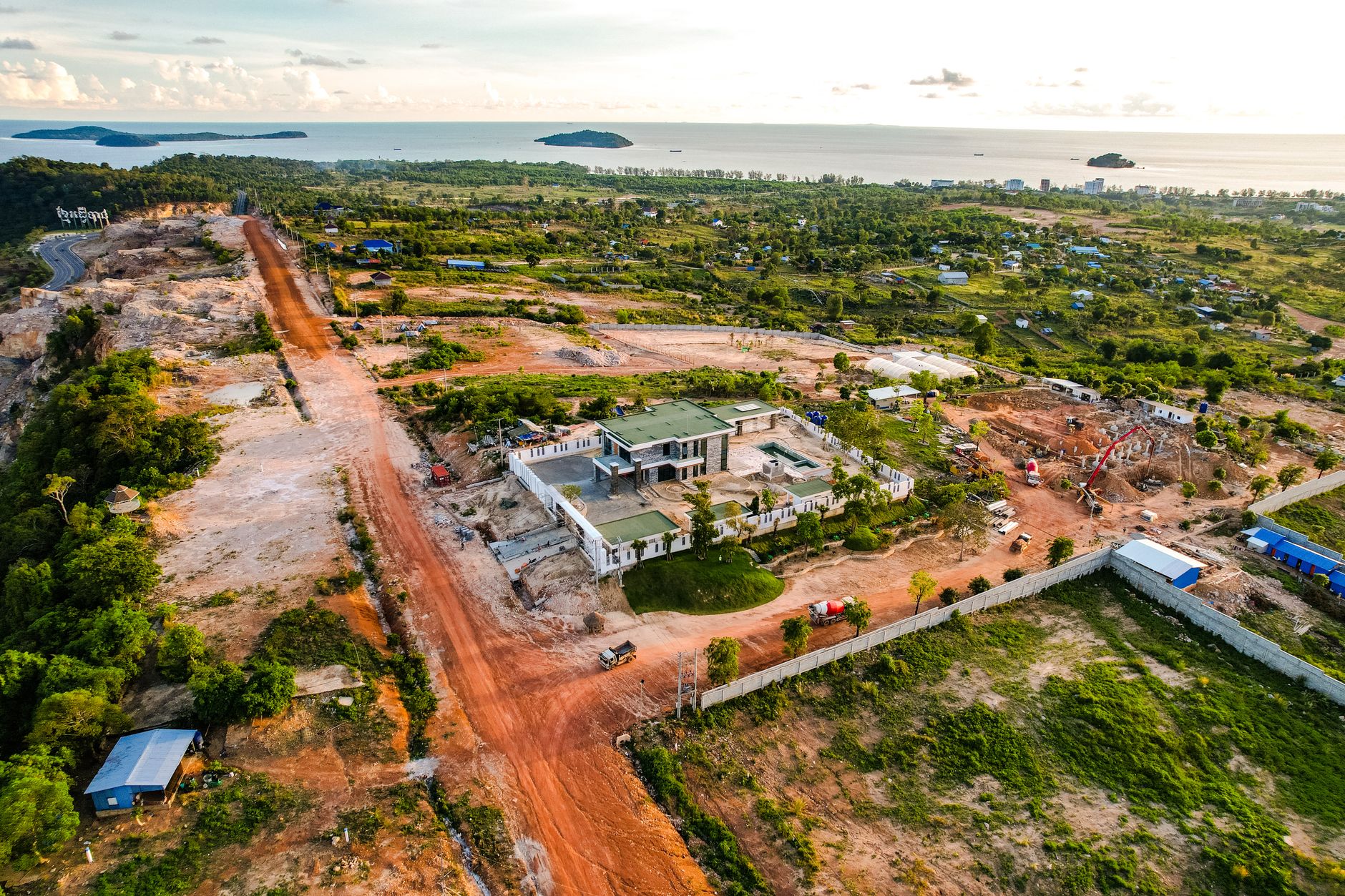
Based on our estimates, between 35 and 50 licensed construction firms currently operating on Koh Samui are capable of delivering a villa project with a budget above 8 million THB. That figure represents fewer than one-third of the comparable contractor pool available on Phuket. Constrained labour supply is one of the most consequential variables shaping both build costs and project timelines on the island in 2026.
Our team has monitored the Koh Samui contractor market for several years. Data from Q1 2026 shows a clear extension in average delivery timelines for two- and three-bedroom villas: from roughly 10-12 months in 2023 to 14-18 months today. The primary drivers are an expanding pipeline of developer projects in Bophut and Maenam running against a persistent shortage of skilled masons, MEP installers, and finishing-trade workers.
For any investor planning a ground-up build or an off-plan villa purchase, this supply-demand imbalance translates directly into cost-per-square-metre, schedule risk, and finish quality. The sections below break the topic down by district and weigh the villa model against the condominium alternative.
Quick answer
- Koh Samui has an estimated 35-50 licensed construction firms capable of building villas priced above 8 million THB (per our estimates, as of 2026)
- Average turnkey villa build cost sits at 38,000-55,000 THB per sq m, equivalent to approximately 1,100-1,590 USD per sq m at current exchange rates
- Delivery time for a standard 200-300 sq m villa has extended to 14-18 months, up from 10-12 months in 2023
- Ready-mix concrete on the island costs 15-20% more than on Phuket, driven by ferry-freight logistics from Surat Thani on the mainland
- Koh Samui Airport (USM) handles roughly 30-35 flights per day, predominantly Bangkok Airways, which constrains tourist volume and influences rental liquidity
- Freehold condominiums from approximately 3.5 million THB offer a lower-execution-risk alternative, since the developer carries the construction risk
Options and scenarios
Scenario A - villa build in Maenam (leasehold, entry budget approximately 12.4 million THB)
We model a 220 sq m villa on a 400 sq m plot in Maenam, one of the island's quieter, family-oriented districts.
- Land cost (leasehold 30+30 years): 3,200,000 THB
- Construction cost (220 sq m at 42,000 THB/sq m): 9,240,000 THB
- Total investment: approximately 12,440,000 THB
- Gross rental income: average occupancy 55-60%, nightly rate 5,500 THB, approximately 1,105,000 THB per year
- Annual operating costs (property management 20%, maintenance, tax, insurance): approximately 380,000 THB
- Net income before tax: approximately 725,000 THB per year
- Net yield: approximately 5.8% on total invested capital
Scenario B - freehold condo in Chaweng (entry budget approximately 5 million THB)
Chaweng carries the highest short-term rental rotation on the island and a denser condo supply suited to foreign freehold ownership.
- Purchase price (45 sq m studio, freehold): 5,000,000 THB
- Gross rental income: occupancy 65%, nightly rate 2,200 THB, approximately 522,000 THB per year
- Annual operating costs (common fees, management, tax): approximately 165,000 THB
- Net income before tax: approximately 357,000 THB
- Net yield: approximately 7.1%
Scenario C - premium villa in Bophut (Thai company structure, budget 28 million THB)
Bophut and Fisherman's Village attract the island's highest villa price points and the most demanding finish specifications.
- Total investment: 28,000,000 THB
- Gross rental income: occupancy 45%, nightly rate 18,000 THB, approximately 2,957,000 THB per year
- Annual operating costs: approximately 950,000 THB
- Net income before tax: approximately 2,007,000 THB
- Net yield: approximately 7.2%, though liquidity risk and resale timelines are significantly higher than in the other two scenarios
Comparison table
| Parameter | Villa Maenam (leasehold) | Condo Chaweng (freehold) | Villa Bophut (company structure) |
|---|---|---|---|
| Entry budget (THB) | 12,440,000 | 5,000,000 | 28,000,000 |
| Ownership structure | Leasehold 30+30 years | Freehold (49% foreign quota) | Thai company structure |
| Build or delivery time | 14-18 months | Ready-built or 12-18 months off-plan | 16-22 months |
| Execution risk | High - depends on contractor availability | Low - developer carries risk | Very high |
| Annual rental occupancy | 55-60% | 60-65% | 40-50% |
| Net yield | approximately 5.8% | approximately 7.1% | approximately 7.2% |
| Resale liquidity | Low | Medium to high | Low |
| Typical resale timeline | 12-24 months | 6-12 months | 18-36 months |
Risks and mistakes
Skipping contractor due diligence. On Koh Samui, unlicensed firms occasionally take on villa contracts beyond their registered scope. Our team verifies contractor registration with the Department of Business Development (DBD) and inspects active build sites before any recommendation is made.
Underestimating materials logistics costs. Investors who benchmark material prices against Bangkok or Phuket consistently miss the 15-25% freight premium that ferry transport from Donsak port adds to concrete, rebar, and ceramics. This is not a minor rounding error on a 9-12 million THB construction contract.
Building schedules without a monsoon buffer. The wet season (October through December) can interrupt ferry services for several days at a stretch. A realistic contingency is at least three months on top of any contractual delivery date.
Ignoring infrastructure line items. On hillside plots in Lamai or Maenam, a deep-water well (80,000-150,000 THB), standby generator (150,000-400,000 THB), transformer, and access road can collectively add 800,000-1,500,000 THB to the project budget.
Contracts without delay penalty clauses. Without a liquidated damages clause, a contractor has no financial incentive to meet the agreed schedule. Based on our review of contracts in this market, a penalty rate of 0.05-0.1% of the contract value per day of delay is a reasonable and enforceable benchmark.
Currency exposure across a long build cycle. A 14-18 month construction timeline leaves significant exposure to THB exchange-rate movement. Investors drawing funds in USD or EUR should factor this into their total cost projections.
Why contractor supply on Koh Samui is structurally tight
The island covers approximately 228 sq km with a resident population estimated at 65,000-70,000. Local construction labour is limited, and the majority of site workers are migrant employees from Myanmar and Cambodia engaged under Thailand's MOU (Memorandum of Understanding) framework. In 2025, Thailand's Ministry of Labour tightened enforcement of foreign employment regulations. Based on our on-the-ground monitoring, this reduced the available labour pool on Samui by an estimated 10-15%.
Logistics compound the issue. Heavy equipment, structural steel, and cement all arrive by ferry from Donsak (roughly 90 minutes crossing time). During peak monsoon season, multi-day disruptions to ferry services occur each year, and we have documented cases where materials delays pushed construction schedules out by two to four weeks per season.
Water and power infrastructure
Koh Samui's mains water network has limited capacity. During the dry months (February through April), pressure drops measurably in parts of Maenam and on the Lamai hillsides. Many villa projects require either a deep well or tanker deliveries. Mains electricity arrives via a submarine cable from the mainland; brown-outs occur several times annually, making backup generators a practical necessity for premium villa builds.
District-by-district breakdown
Bophut and Fisherman's Village form the island's upper market. Most villa projects in the 15-40 million THB range concentrate here. Only 8-12 firms island-wide have verifiable experience at this specification level. Build costs range from 48,000-55,000 THB per sq m, and lead times for imported finishes (stone, tropical hardwoods, integrated smart-home systems) frequently extend the overall schedule.
Maenam operates at a quieter pace, drawing families and long-stay renters. Land parcels here average 6-10 million THB for 400 sq m on a leasehold 30+30 basis, and contractor availability is comparatively better because projects are less complex technically. Build costs run 38,000-45,000 THB per sq m.
Lamai sits mid-market, attracting villa investment in the 8-15 million THB range. We monitor four to six active sites concurrently in the district. Hillside plots carry an additional 15-25% cost premium on foundations and site access works.
Chaweng is the island's most urbanised area. Condominiums and hotel projects dominate; standalone villa builds are uncommon. Contractors experienced in multi-storey work are active here, but available capacity is low because large hotel and condo projects absorb full teams for 18-24 months at a time. For rental investors, Chaweng offers the highest short-term occupancy rates on the island.
Airport constraint as an analytical factor
Koh Samui Airport (USM) is privately owned by Bangkok Airways. Fares on the Bangkok-Samui route typically run 3,500-7,000 THB one-way, roughly two to three times the equivalent Bangkok-Phuket fare. This pricing structurally filters out budget travellers and shapes the island's rental demand profile: fewer arrivals overall, but with a higher average spend per visit.
The airport handles approximately 30-35 flight operations per day, and no second airport is in the planning pipeline. The alternative arrival route via Surat Thani Airport (URT) followed by a ferry crossing adds two to three hours to total journey time from Bangkok. This infrastructure ceiling is a durable constraint on tourist volume growth and, by extension, on the supply side of short-term rental demand.
Villa versus condominium: the 2026 decision framework
For investors with a budget in the equivalent of up to 150,000-180,000 USD, a freehold condominium offers a straightforward acquisition path: no construction execution risk, a lower entry threshold, and a demonstrably more liquid resale market. Net yields in the 6-7% range are achievable under reasonable occupancy assumptions.
Villas generate higher absolute income and offer greater differentiation in the premium rental segment, but they carry construction risk that is measurably higher on Koh Samui than on Phuket, simply because the contractor pool is smaller. Based on our estimates, approximately 25-30% of villa projects on Samui completed in 2024-2025 finished with delays exceeding three months.
FAQ
How many licensed construction contractors operate on Koh Samui in 2026?
Based on our estimates, 35-50 licensed firms on the island are capable of delivering a villa project budgeted above 8 million THB. In the premium segment above 20 million THB, that narrows to roughly 8-12 firms.
What is the per-square-metre build cost for a villa on Koh Samui?
Turnkey villa construction in 2026 costs approximately 38,000-55,000 THB per sq m, depending on district and finish specification. Bophut commands the upper end; Maenam sits at the lower end of that range.
Why is construction more expensive on Koh Samui than on Phuket?
The core reason is island logistics. Concrete, rebar, and structural materials arrive by ferry from the mainland, adding a 15-25% freight premium versus Phuket pricing. A smaller contractor pool also reduces competitive pricing pressure.
How long does it take to build a villa on Koh Samui?
As of 2026, a standard 200-300 sq m villa takes 14-18 months from groundbreaking to handover. In 2023, the same build ran 10-12 months. The extension reflects both labour shortages and a larger concurrent project pipeline.
Can a foreign national purchase a condo on Koh Samui in freehold?
Yes. Foreign buyers may acquire condominium units under freehold title provided the foreign ownership quota in the specific building has not reached the 49% ceiling. Funds must be transferred into Thailand from abroad and documented with a Foreign Exchange Transaction (FET) form issued by a Thai bank.
What net rental yield can a villa on Koh Samui generate?
Depending on district and price segment, net yields after operating costs range from approximately 5-7.5% per year in our data sets. Bophut and Maenam villas achieve higher nightly rates but lower occupancy than Chaweng condominiums.
How does Koh Samui Airport constrain the rental market?
USM operates 30-35 flights daily under private ownership, with fares two to three times higher than Bangkok-Phuket equivalents. This limits budget-traveller volume and anchors the island's demand profile toward higher-spending visitors, resulting in lower occupancy but stronger nightly rates compared with Phuket.
Which district on Koh Samui produces the most stable rental returns?
In our data sets, Chaweng condominiums in the freehold segment produce the most consistent short-term rental performance. Bophut villas deliver stronger gross revenue per night but at lower occupancy. Maenam suits a long-stay or family-rental model.
Is building a hillside villa on Koh Samui worth the additional cost?
Hillside plots in Lamai and parts of Maenam offer sea views and privacy, but foundation engineering, access roads, water wells, and backup power can add 800,000-1,500,000 THB to the project budget. In our assessment, this premium is justified only when the nightly rate differential versus a flat-plot villa is clearly demonstrated in comparable rental data for that sub-area.
How do we verify a construction contractor on Koh Samui?
We recommend checking DBD registration, confirming the firm holds a Class 4 construction licence (ror. 4), visiting at least one active build site, and speaking directly with clients of recently completed projects. Our analysts carry out this verification as part of any location data brief we prepare.
Researching property in Phuket or Koh Samui? Get in touch - our analysts will prepare a data brief for your shortlisted location.