

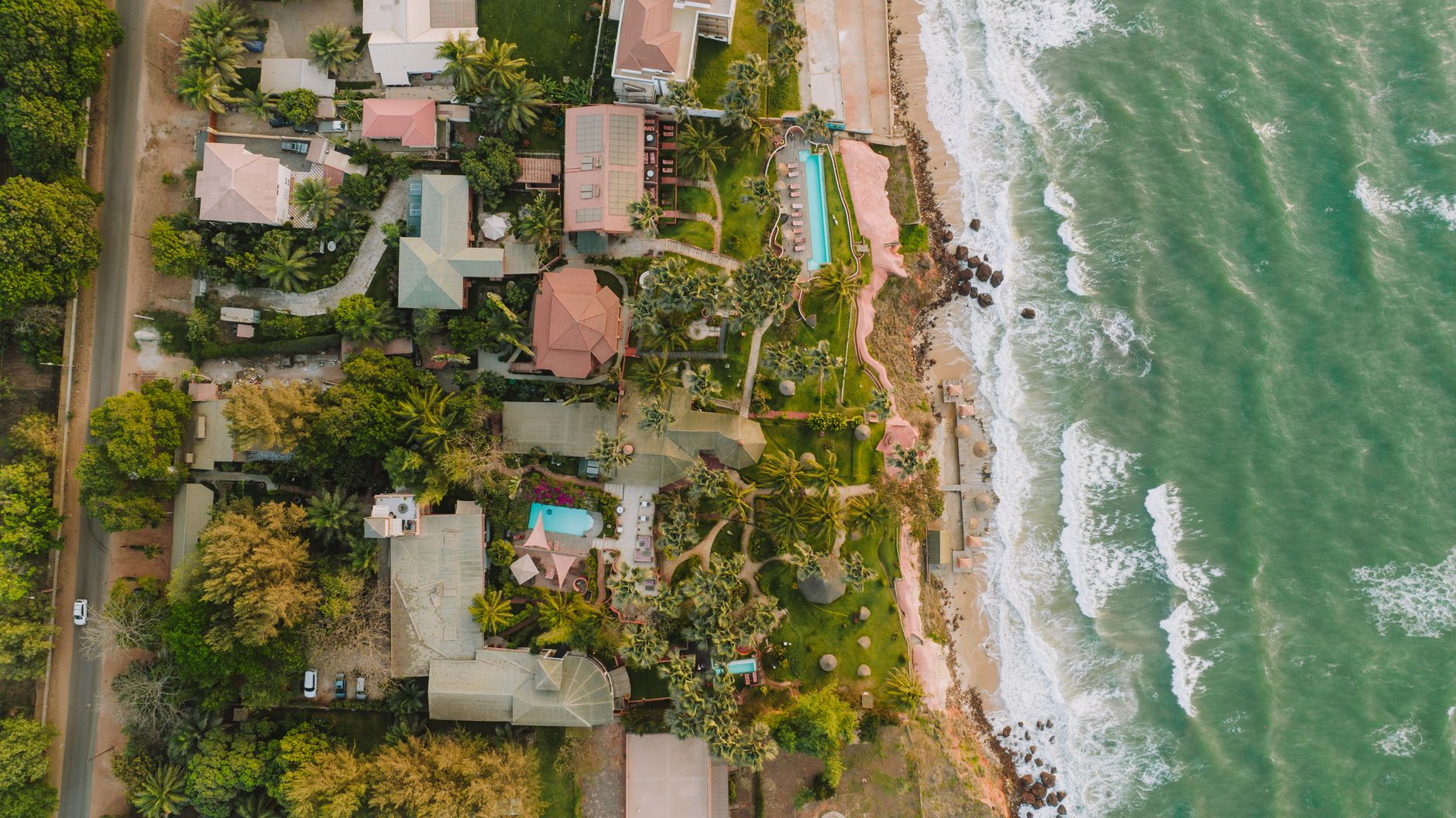
At the start of 2026, a two-bedroom villa within 800 metres of Fisherman's Village in Bophut is listed at 8.5 to 14 million THB (approximately 238,000 to 392,000 USD at prevailing rates). That represents a 12-18% premium over comparable properties in Maenam and roughly 25% above equivalent stock in Lamai. Our analysts have tracked this corridor for several years and the pricing differential has widened steadily, not narrowed.
Bophut is the only district on Koh Samui that sits comfortably alongside what we classify as lifestyle-premium zones: think Bang Tao or Surin on Phuket. The short coastal strip of restaurants, independent boutiques and a weekly night market sustains consistent footfall across 9 to 10 months of the year. For an investor that translates into firmer short-term rental rates, but also a higher entry price and a specific risk profile that differs from the rest of the island.
Quick answer
- Villa price, 2-3 bedrooms (Bophut/Fisherman's Village): 8.5-14 million THB; sea-view premium units reach up to 25 million THB
- Condominium freehold (studio/1-bedroom, Bophut): 3.2-6 million THB
- Gross rental yield, holiday villa: 6-8% per year based on our estimates, at 65-75% occupancy
- Gross rental yield, condominium: 5-7% per year, with lower operating overhead
- Samui Airport (USM) throughput: approximately 1.8-2 million passengers per year; Bangkok Airways controls over 90% of slots
- Reference exchange rate (Q1 2026): approximately 35.5 THB per USD
Options and scenarios
Scenario A - leasehold villa in Bophut, holiday rental model
An investor acquires a two-bedroom villa with a private pool at 10 million THB. Land tenure is leasehold (30-year registered lease, with contractual renewal options). The holding structure is either a Thai-majority limited company (land-holding vehicle) or a clean leasehold registered at the Land Office.
Annual income chain, based on our estimates:
- Gross rental income: average nightly rate 5,500 THB, 70% occupancy (256 nights) = 1,408,000 THB
- Property management fee: 20-25% of revenue = approximately 310,000 THB (at 22%)
- Operating costs (pool, garden, air-conditioning, minor repairs, insurance): approximately 180,000 THB per year
- Local tax and common-area charges: approximately 40,000 THB per year
- Net result before income tax: 1,408,000 - 310,000 - 180,000 - 40,000 = 878,000 THB
- Net yield: 878,000 / 10,000,000 = 8.78% pre-tax
A relevant regulatory note: since 2024 Thailand taxes income remitted to Thai tax residents in the year it is earned. A foreign non-resident investor will be subject to withholding tax on Thai-sourced rental income, with an effective rate of 5-15% depending on the holding structure. The double-taxation treaty between Thailand and most European jurisdictions should be reviewed with a qualified local tax adviser before finalising any structure.
Scenario B - freehold condominium in Bophut, rental and resale model
An investor purchases a 45 sq m one-bedroom unit within the foreign ownership quota (capped at 49% of total building area) at 4.5 million THB. Full freehold title (chanote) held by a natural person, no company structure required.
- Gross rental income: nightly rate 2,800 THB, 65% occupancy (237 nights) = 663,600 THB
- Management fee plus OTA platform commission: 25% = 165,900 THB
- Common-area maintenance (CAM) fee: approximately 60,000-80,000 THB per year (typical range: 120-180 THB/sq m/month)
- Sinking fund (one-off at purchase): 500-800 THB/sq m = 22,500-36,000 THB (excluded from annual cost model)
- Operating costs (electricity, in-unit internet, minor repairs): approximately 35,000 THB per year
- Net result: 663,600 - 165,900 - 70,000 - 35,000 = 392,700 THB
- Net yield: 392,700 / 4,500,000 = 8.73%
The condominium route offers simpler resale (freehold title is internationally recognised), a lower capital threshold and no leasehold renewal risk. The trade-offs are less pricing flexibility on nightly rates, dependence on the juristic person's management decisions and constrained foreign-quota supply in Bophut specifically.
Scenario C - passive investment with developer-guaranteed returns
Several developers active on Koh Samui market guaranteed-return programmes at 5-7% annually for 3-5 years. Our analysts review these schemes on the ground. The core caution: a guarantee is only as solid as the developer's balance sheet. The Thai market does not provide a statutory buyer-protection mechanism comparable to those found in more regulated markets. Independent financial due diligence is strongly advisable before signing any guaranteed-return agreement.
Comparison table
| Parameter | Villa Bophut (leasehold) | Condo Bophut (freehold) | Villa Maenam (leasehold) | Condo Chaweng (freehold) |
|---|---|---|---|---|
| Typical price (THB) | 8.5-14 million | 3.2-6 million | 6.5-10 million | 2.5-5 million |
| Typical price (USD, approx.) | 239,000-394,000 | 90,000-169,000 | 183,000-282,000 | 70,000-141,000 |
| Ownership form | Leasehold / Thai Co. Ltd. | Freehold (foreign quota) | Leasehold / Thai Co. Ltd. | Freehold (foreign quota) |
| Gross rental yield | 6-8% | 5-7% | 5-7% | 6-9% |
| Annual occupancy | 65-75% | 60-70% | 55-65% | 70-80% |
| Resale liquidity | Low-medium | Medium-high | Low | Medium |
| Typical tenant profile | Couple / premium family | Digital nomad / couple | Family / retirement | Budget-to-mid tourist |
| Infrastructure risk | Medium | Medium | Low | High (traffic) |
Risks and mistakes
Samui Airport as a structural bottleneck
USM is privately owned and operated by Bangkok Airways. With no slot competition, one-way fares from Bangkok (BKK-USM) run at 3,500-6,000 THB, two to three times the equivalent fare to Phuket (HKT). There are no direct long-haul flights into Samui from Europe or most Western markets. The typical routing requires a stopover in Bangkok (Suvarnabhumi) and a domestic hop, or a flight to Surat Thani (URT) followed by a ferry crossing of 2 to 2.5 hours. For rental demand modelling, this filters out the high-volume budget traveller segment that drives occupancy on Phuket.
Reports circulated in 2025 regarding a potential second airport or runway extension on Samui. As of Q1 2026, the project remains at feasibility-study stage. We do not incorporate it into near-term yield projections.
Island infrastructure
- Water supply: during the dry months (February to April), mains-water interruptions are documented. Villas with dedicated storage tanks and filtration systems carry a meaningful operational advantage
- Power supply: outages occur 3-6 times per year, most frequently during monsoon season. Investors should budget for a backup generator (80,000-250,000 THB) or UPS system
- Road network: the island has one main ring road (Routes 4169/4170). In peak season (December to February) Chaweng and Lamai experience regular congestion. Bophut and Maenam are materially less affected
- Construction capacity: the pool of qualified contractors on the island is limited. In our data sets, this inflates construction costs by 15-25% relative to Phuket and pushes typical project delivery timelines 3-9 months beyond initial schedules
Leasehold and legal risk
A 30-year registered leasehold is the only land-tenure form that can be cleanly recorded at the Land Office. Contractual renewal options (commonly structured as 30+30 or 30+30+30) rest on private agreement only - there is no statutory guarantee of enforcement. The Thai limited-company structure for land holding is lawful but requires ongoing compliance with rules on nominee shareholders. In 2025 the Land Department intensified scrutiny of nominee-linked company structures, and our analysts observe that trend continuing into 2026.
Common mistakes in Bophut property acquisition
- Proceeding without an independent Thai property lawyer (typical due-diligence cost: 40,000-80,000 THB)
- Failing to verify the land title document type (chanote versus Nor Sor 3 Gor; the latter carries materially higher boundary and encumbrance risk)
- Omitting management fees from yield calculations (20-25% of gross revenue is a meaningful drag)
- Calculating returns on peak-season occupancy without adjusting for 2-3 months of low-season demand
FAQ
Can a foreign national buy a villa in Bophut, Koh Samui?
Foreign nationals cannot hold land title in Thailand. A villa can be acquired via a registered 30-year leasehold on the land (with contractual renewal clauses) or through a Thai-majority limited company that holds the land. The villa structure itself can be owned outright. Condominium units within the 49% foreign-ownership quota can be purchased as full freehold by a foreign individual.
What is the average property price near Fisherman's Village Bophut in 2026?
Based on our market monitoring as of Q1 2026, a two-to-three-bedroom pool villa is priced at 8.5 to 14 million THB. A one-bedroom condominium in the same district runs 3.2 to 6 million THB. Sea-view or beachfront premium units exceed 20 million THB.
What net rental yield can I realistically expect from a Bophut villa?
Based on our estimates, a villa purchased at 10 million THB with a nightly rate of 5,500 THB and 70% annual occupancy generates a net yield of approximately 8.8% before income tax. Management and operating costs absorb around 37-40% of gross revenue, so gross yield figures published by developers should always be stress-tested against these deductions.
How does Bophut compare to Chaweng and Lamai for investors?
Bophut (Fisherman's Village) occupies the premium-lifestyle segment: quieter, higher average daily rates, more discerning tenant profile. Chaweng generates higher raw occupancy through volume tourism but comes with traffic congestion and a noisier environment. Lamai sits between the two on both price and profile. Maenam, adjacent to Bophut, is the quietest and most affordable, with a family and long-stay retirement demographic.
How do I get to Koh Samui from international origins?
There are no long-haul direct flights into Samui Airport (USM). The standard routing is a connection through Bangkok Suvarnabhumi (BKK) onto a Bangkok Airways domestic flight to USM (approximately one hour). An alternative is a flight to Surat Thani (URT) followed by a ferry (2 to 2.5 hours). The one-way BKK-USM fare ranges from 3,500 to 6,000 THB.
Does the airport situation constrain Koh Samui property values?
It is one of the most structurally significant factors in our model. USM handles approximately 1.8-2 million passengers per year under Bangkok Airways' de facto monopoly. The premium ticket cost filters out budget travellers, which suppresses occupancy at the lower end of the market. For premium-positioned properties in Bophut and Maenam, however, this acts simultaneously as a barrier and a quality filter, supporting higher average daily rates among the guests who do visit.
What transaction taxes apply when buying property on Koh Samui?
At the point of transfer: a 2% transfer fee (typically split 50/50 between buyer and seller), plus either Specific Business Tax at 3.3% or stamp duty at 0.5% (depending on the seller's holding period), and withholding tax on the seller's capital gain. Total transaction costs for the buyer typically fall in the range of 4-6% of the agreed price. The annual land and building tax is 0.02-0.1% of the assessed value for residential property.
Should I buy a villa or a condominium in Bophut?
Based on our calculations, net yields under both models converge around 8-9%; the primary difference is the risk and legal profile rather than the return figure. A villa offers higher absolute rental income and rate-setting flexibility, but demands a more complex legal structure and active management. A condominium is simpler to hold (freehold title), easier to resell and has a lower entry price. The right choice depends on the investor's capital position, risk tolerance and intended holding period.
Researching property in Phuket or Koh Samui? Get in touch - our analysts will prepare a data brief for your shortlisted location.