

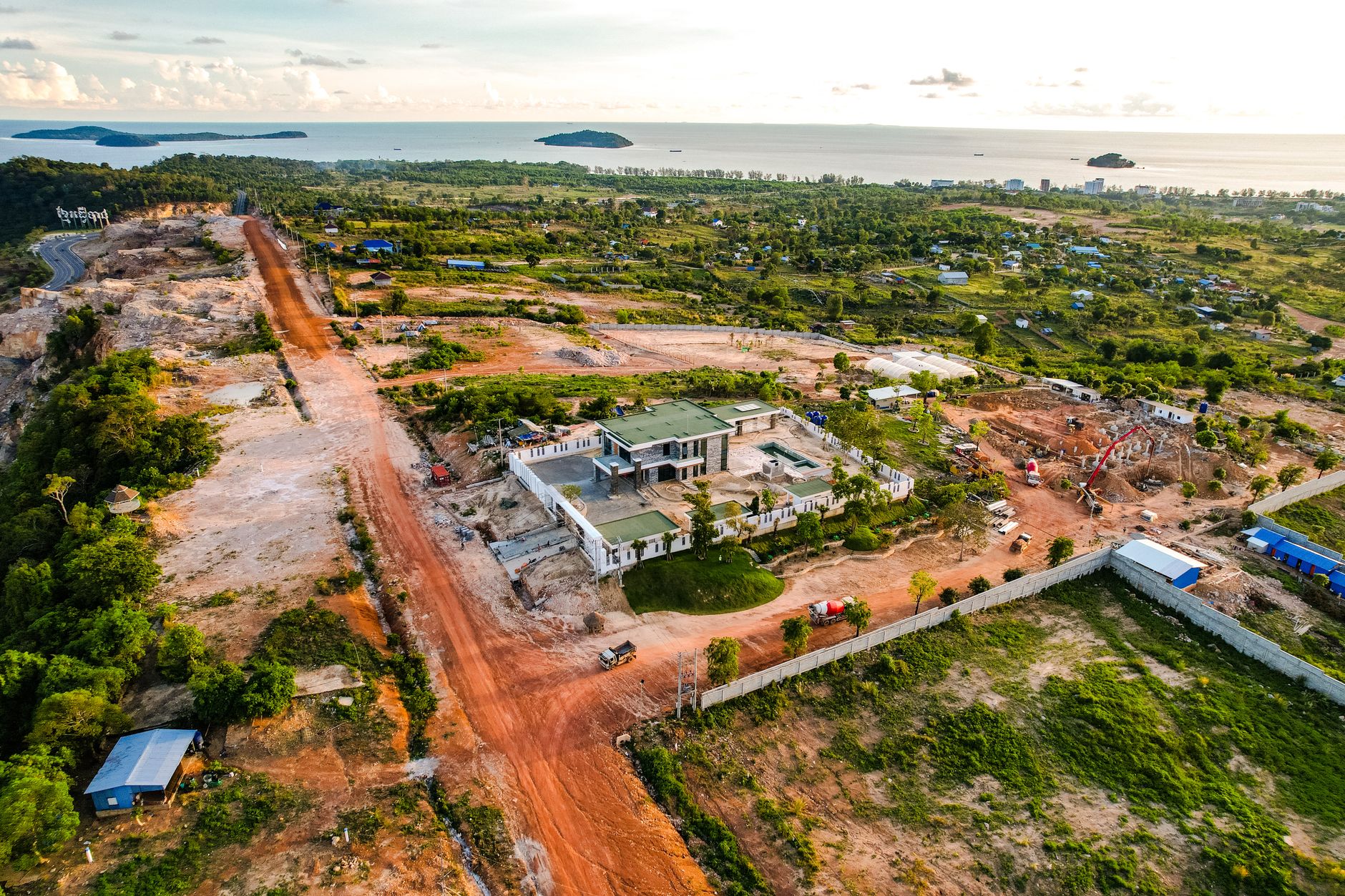
Three of Thailand's largest corporate groups are directing a combined 50 billion baht into mixed-use and luxury developments along Phuket's west coast. According to data published by Money and Banking Magazine in November 2026, this capital is concentrated in the Bang Tao and Cherng Talay corridor, which already accounts for roughly 22% of new hotel room supply on the island. For any individual investor considering a condominium purchase here, this institutional shift functions simultaneously as a confidence signal and a warning about intensifying competition for rental tenants.
Phuket's total residential inventory has reached an estimated 194.5 billion baht in market value, with the average unit priced at approximately 12.9 million baht. Per Nation Thailand, November 2026, 67% of purchase demand in the first half of 2026 originated from foreign buyers, drawn by headline gross rental yields of 8-10% per year. At the same time, our analysts observe a clear deceleration in sales velocity - a signal we treat as an early indicator of saturation in the premium segment.
Quick answer
- The Central Group, ICONSIAM, and Minor Group are collectively deploying around 50 billion THB in Bang Tao and Cherng Talay, covering hotels, retail and branded residential components
- Phuket's total supply exceeds 45,000 units across 403 projects, with 83% classified as condominiums
- Branded residences represent approximately 11% of existing stock; a further 2,004 units are planned from 2027 onward
- New condominium launches rose 44.8% in H1 2026 compared with H2 2025
- 30 hotel projects (around 5,517 rooms) are under construction or in pre-development, with 85% flagged under global brand management
- Agents and developers quote gross yields of 8-10%; based on our estimates, net returns after operational costs and vacancy land between 5-7% in well-managed projects
Options and scenarios
Scenario 1: The prestige umbrella effect
When institutional players bring their own hotel network and retail anchor to a location, they raise its visibility among high-net-worth travellers. In this scenario, Bang Tao and Cherng Talay undergo a transformation comparable to what Bangkok's Sukhumvit corridor experienced after major retail openings - land prices climb and condominiums acquired before the institutional projects complete can appreciate 15-25% over three to five years. The key assumption here is that international arrival volumes remain robust (the market recorded over 6 million foreign visitors in the January-September 2026 period, per C9 Hotelworks data).
Scenario 2: Rental demand cannibalisation
New hotels and branded residences offer short-stay guests a service standard that an individual condo owner cannot replicate. A global operator running a 200-room property has marketing budgets and OTA distribution agreements that dwarf anything available to a private landlord. Under this scenario, occupancy rates in older condo projects slip below 60% and net yields compress to 3-4%. We already monitor early signs of this dynamic in Kamala and Surin, where new hotel supply is growing faster than incremental tourism demand.
Scenario 3: Market segmentation and specialisation
This is the scenario our analysts consider most probable for the 2026-2030 window. Institutional capital claims the ultra-premium tier (above 250,000 THB per square metre), while individual investors find defensible ground in the mid-range segment (80,000-150,000 THB per square metre) in second-ring districts such as Rawai, Nai Harn and Karon. The same logic applies to Koh Samui: Bophut and Maenam offer calmer competitive conditions compared with the more saturated Chaweng market. The critical variable in this scenario is matching the product precisely to a well-defined target tenant profile.
Comparison table
| Parameter | Condo in institutional zone (Bang Tao / Cherng Talay) | Condo in mid-range zone (Rawai / Nai Harn / Karon) | Branded residence (premium tier) |
|---|---|---|---|
| Average price per sqm (THB) | 150,000 - 300,000 | 70,000 - 130,000 | 250,000 - 500,000 |
| Typical unit budget (THB) | 8M - 25M | 3M - 8M | 15M - 50M |
| Gross yield (developer-quoted) | 8 - 10% | 6 - 8% | 5 - 7% |
| Net yield (our estimates) | 5 - 7% | 4 - 6% | 3 - 5% |
| Tenant competition intensity | Very high (5-star hotels nearby) | Moderate | Low (dedicated operator) |
| Oversupply risk | High (44.8% launch surge, H1 2026) | Moderate | Medium (limited unit count) |
| Capital appreciation potential (3-5 yrs) | 15 - 25% (prestige umbrella) | 8 - 15% | 10 - 20% |
| Minimum recommended holding period | 5 years | 3 - 5 years | 7 - 10 years |
Risks and mistakes
Confusing location prestige with guaranteed occupancy
We regularly encounter investors who assume proximity to a luxury hotel automatically generates overflow demand for their condo. That assumption is incorrect. A hotel operating 200 rooms with a multi-million-baht annual marketing budget captures demand rather than creating it for neighbours. We monitor specific projects in Bang Tao where short-term occupancy declined after a nearby branded resort opened.
Aggressive off-plan payment schedules
In the Phuket luxury segment, our team frequently sees payment schedules requiring 50-70% of the purchase price before construction completes. In our due-diligence methodology, we flag any schedule that demands more than 40% of the contract value before the building reaches shell-and-core stage. Thailand does not operate a buyer-protection trust mechanism equivalent to escrow for foreign purchasers, so the only practical safeguard is tying each instalment to a verified, documented construction milestone.
Developer financing structure
Groups the size of Central or Minor finance construction from corporate balance sheets or institutional credit lines. A smaller developer building from buyer deposits carries a cascade risk: if sales slow, construction stalls. We inspect sites in person and scrutinise contracts for disclosed funding sources. Absence of any reference to a construction loan or revolving credit facility is treated by our analysts as a material red flag.
Currency exposure
Foreign buyers purchase in Thai baht and receive rental income in baht as well. Using the Q4 2025 reference rate as a benchmark, even a moderate multi-percent currency move can erase a year of rental yield when returns are converted back to a home currency. In our data presentations we always model two variants: performance in local currency and performance after currency conversion, including a scenario where the home currency weakens by 5-10% against the baht.
Regulatory and social pressure
Per Nation Thailand, November 2026, the pace of development activity is generating rising pressure on local communities and drawing regulatory scrutiny. We monitor the risk of tightened rules for foreign buyers, including potential adjustments to the current 49% foreign ownership quota that applies to condominium floor area.
FAQ
Does large-scale institutional investment in Phuket mean condo prices will keep rising?
Institutional projects raise the profile of a location and can support land price appreciation in Bang Tao and Cherng Talay. However, new launch volumes also jumped 44.8% in H1 2026, expanding overall supply. Based on our estimates, premium-segment price growth of 5-8% per year is plausible, but only for projects managed by a credible rental operator.
How large is Phuket's condo supply in 2026?
Total supply stands at approximately 45,027 units across 403 projects, with condominiums representing 83% of that figure. The aggregate market value of available inventory is estimated at 194.5 billion baht.
What net rental yield can an investor realistically expect from a Phuket condo?
Developers and agents typically quote 8-10% gross per year. After deducting management fees (usually 20-30% of gross revenue), local taxes, insurance and vacancy allowance, our analysts estimate net returns of 5-7% in well-located projects and 3-4% in projects facing direct competition from nearby hotels.
Is a branded residence safer than a standard condominium as an investment?
A branded residence provides a dedicated operator and global-brand distribution, which reduces vacancy risk. The trade-offs are a higher entry price (from 15 million THB upward) and a lower net yield (3-5%), because the operator charges significant management fees. In our assessment, this format suits investors with a holding horizon of seven years or more.
How do we verify developer credibility on Phuket?
Our methodology checks: the number of completed projects and delivery delays (a delay of more than six months on two consecutive projects is a warning threshold), disclosed construction financing, permit completeness (EIA clearance, building permit), and physical build quality, which we assess through on-the-ground site visits.
What protection do foreign off-plan buyers have on their deposits?
Thailand does not operate a buyer-protection trust mechanism equivalent to escrow for foreign purchasers. Practical protection comes from a payment schedule tied to verified construction milestones, contractual penalty clauses for developer delays, and the financial strength of the developer's balance sheet. Our team reviews purchase contracts with these elements as the primary focus.
Which Phuket districts carry the highest oversupply risk?
Bang Tao and Cherng Talay concentrate the heaviest development activity and account for 22% of new hotel supply. We classify these corridors as a high oversupply-risk zone, particularly for units priced above 10 million THB.
Do the same dynamics apply to Koh Samui?
Koh Samui operates at a substantially smaller scale and sees far less institutional capital. Districts such as Bophut and Maenam are developing more organically, without the pressure of mega-projects. We track the island as an alternative for investors seeking lower competitive intensity and lower entry thresholds.
What is the minimum budget for an investment condo on Phuket in 2026?
In the mid-range segment covering Rawai, Nai Harn and Karon, units start from approximately 3 million THB. In the premium corridor of Bang Tao and Layan, the realistic entry point is 8-10 million THB. We always present pricing in both local currency and a reference foreign currency, because exchange-rate movement directly affects realised returns.
How does a large hotel opening affect short-term condo rental performance nearby?
Based on our on-the-ground monitoring, the opening of a branded hotel with 200 or more rooms within one kilometre of a condo project typically reduces average short-term occupancy at that project by 8-15 percentage points during the hotel's first year of operation. The impact is more pronounced in the premium segment than in mid-range properties.
Researching property in Phuket or Koh Samui? Get in touch - our analysts will prepare a data brief for your shortlisted location.