

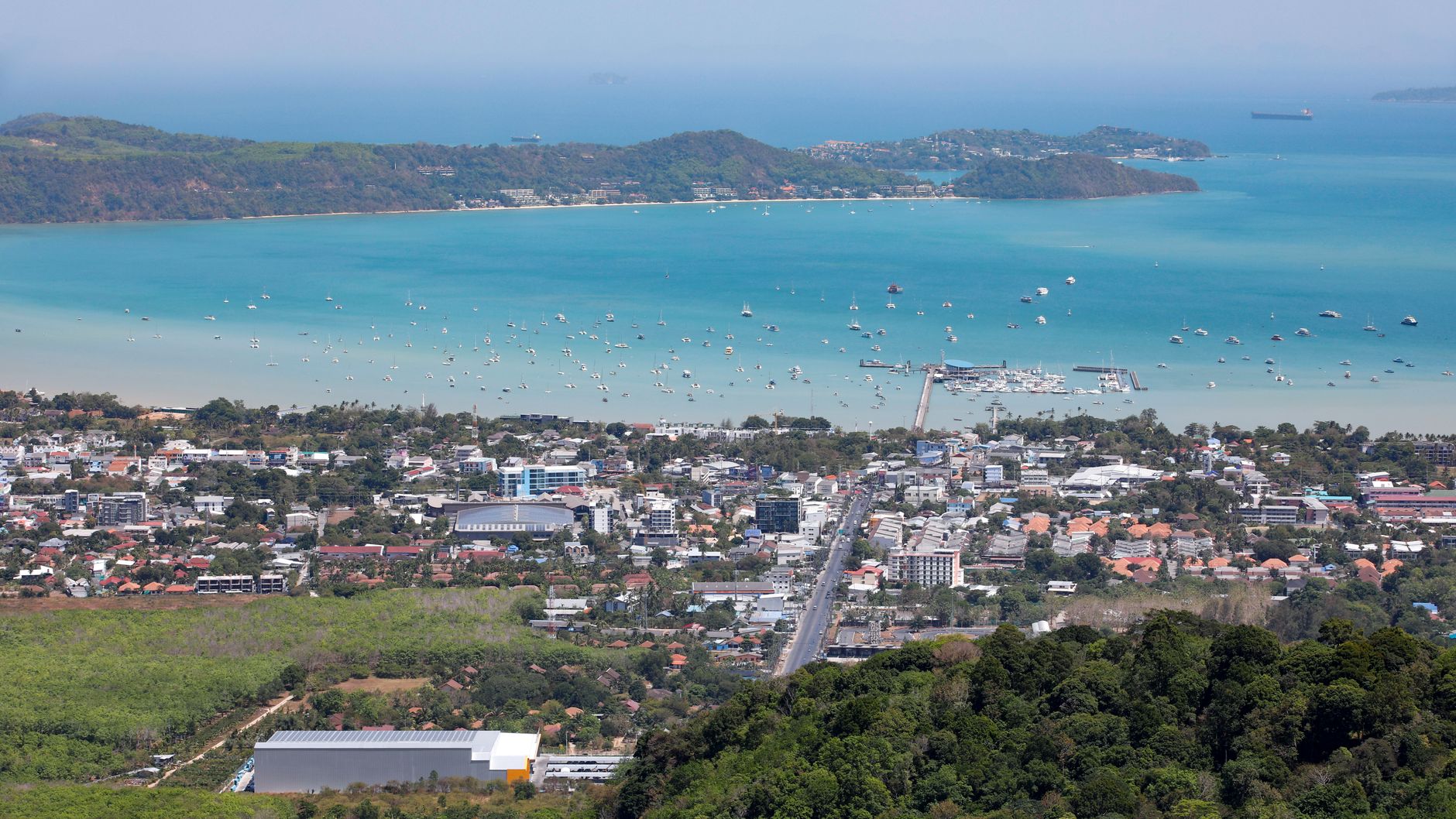
The median price per square metre for mid-to-upper segment condominiums in Kamala stands at approximately 125,000-145,000 THB/m² as of Q1 2026, based on our tracking of listed and closed transactions. That represents year-on-year growth of 8-12% compared with Q1 2025 data in our records. We monitor Kamala systematically because it combines two characteristics that are rarely found together on Phuket's west coast: a structurally constrained land supply and a sustained rise in tourist arrivals that feeds short-term rental demand.
In our quarterly benchmarks, Kamala sits between the more affordable Karon (approximately 95,000-115,000 THB/m²) and the higher-priced Surin (140,000-180,000 THB/m²). The gap between districts is driven primarily by proximity to the shoreline, the year the building was completed, and finish specification. Beachfront and near-beachfront projects within 500 metres of the waterline routinely clear 160,000 THB/m², while units located more than one kilometre inland can be sourced in the 100,000-120,000 THB/m² range.
For international buyers funding purchases in currencies other than Thai baht, exchange-rate sensitivity is a material variable. As of Q1 2026, the USD/THB rate has been trading in a range that places the median Kamala unit at roughly 3,600-4,200 USD/m² (based on our estimates at approximately 34-35 THB per USD). That is a reference point our analysts use when comparing Kamala against comparable resort markets in Southeast Asia.
Quick answer
- Median condominium price per m² in Kamala (Q1 2026, based on our estimates): 125,000-145,000 THB/m²
- Year-on-year price growth (Q1 2025 vs Q1 2026): 8-12% in the mid-market segment
- Beachfront tier (within 500 m of the waterline): 160,000-220,000 THB/m²
- Second and third-line locations (1-2 km from the beach): 100,000-125,000 THB/m²
- Short-term rental occupancy in the high season (November to April): 78-85% based on our on-the-ground monitoring
- New-unit pipeline in Kamala for 2026-2027: approximately 350-450 units across 6 projects, per market estimates
Options and scenarios
Scenario A: continued steady price appreciation (higher probability)
If inbound passenger volumes at Phuket International Airport (HKT) remain above 19 million passengers annually (a figure recorded in 2025 per Airports of Thailand data) and the land supply in Kamala stays constrained by topography and zoning, our analysts project further price growth of 6-10% per year. High-season occupancy of 78-85% in the 2024/2025 cycle supports rental yields and sustains investor demand, which in turn underpins valuations.
Scenario B: supply-side correction (moderate probability)
Should the pipeline of 350-450 new units in Kamala reach completion on schedule by end-2027, local supply would expand by an estimated 12-15%. Under this scenario, price growth is likely to slow to 2-4% per year, and the secondary market for second-line units could see transitional price softness of 3-5% as buyers gain more negotiating leverage.
Scenario C: external shock (lower probability)
A sharp appreciation of the Thai baht against major currencies (EUR, USD, CNY) exceeding 10%, or a fall in Phuket arrivals of more than 15% driven by a geopolitical or health event, could compress Kamala prices by 8-15% over a 12-18 month window. The 2020-2021 period provides a historical reference: asking prices dropped 10-18% across segments during that cycle, before recovering as international travel resumed.
Comparison table
| Parameter | Kamala - beachfront (under 500 m) | Kamala - inland (1-2 km) | Bang Tao | Surin | Karon |
|---|---|---|---|---|---|
| Price/m² (THB, Q1 2026) | 160,000-220,000 | 100,000-125,000 | 120,000-155,000 | 140,000-180,000 | 95,000-115,000 |
| Approx. price/m² (USD, est.) | 4,600-6,300 | 2,900-3,600 | 3,400-4,400 | 4,000-5,100 | 2,700-3,300 |
| YoY price growth (est.) | 10-14% | 6-9% | 7-11% | 8-12% | 5-8% |
| High-season occupancy | 82-88% | 70-78% | 75-83% | 80-86% | 72-80% |
| Low-season occupancy | 45-55% | 30-40% | 38-48% | 42-52% | 35-45% |
| New-unit pipeline 2026-2027 | approx. 120 units | approx. 280 units | approx. 900 units | approx. 200 units | approx. 350 units |
| Distance to HKT airport | approx. 25 km | approx. 26-28 km | approx. 20 km | approx. 23 km | approx. 42 km |
Risks and mistakes
Currency exposure. Buyers funding purchases in foreign currencies (USD, EUR, GBP, AUD) face meaningful exchange-rate risk. THB has moved within a range representing roughly 8-10% swing against major currencies over the past 24 months. Even when THB-denominated prices are stable, the real cost of acquisition and the real value of rental income can shift materially. We incorporate currency scenario analysis into every briefing we prepare.
Overstated rental yield projections. Our analysts regularly encounter developer marketing materials projecting 8-10% net annual returns. Based on our estimates, a realistically managed Kamala unit - after deducting property management fees, common area fees, local taxes, and low-season vacancy - generates a net yield of 4.5-6.5% per year. The gap between marketed and realised yield is largely a function of seasonality: occupancy in the low season (May to October) falls to 30-55%, which many promotional models underweight.
Supply pressure from adjacent districts. Bang Tao, located just 5-7 km north of Kamala, carries a pipeline of approximately 900 new units for 2026-2027. A significant share of that inventory will compete for the same short-term rental pool as Kamala properties. Buyers should stress-test their yield assumptions against a scenario where Bang Tao supply depresses achievable nightly rates.
Segment misalignment. Units priced below 100,000 THB/m² in Kamala are typically older stock from the 2010-2015 construction cycle, with dated fit-outs and higher maintenance cost ratios. Buyers who optimise purely for a low price per square metre may acquire an asset that commands weaker rental rates and requires capital expenditure sooner than anticipated.
Foreign quota constraints. Under Thai condominium law, foreign nationals may hold freehold title only within the foreign quota, which is capped at 49% of a building's total usable floor area. In high-demand Kamala projects, this quota is sometimes fully allocated. Buyers who miss the freehold window are typically offered a leasehold structure (30 years with renewal options), which carries a different risk and pricing profile - see the FAQ section below for detail.
FAQ
What is the price per square metre in Kamala in 2026?
Based on our Q1 2026 data, the median for mid-to-upper segment condominiums is approximately 125,000-145,000 THB/m². Beachfront units within 500 metres of the waterline trade at 160,000-220,000 THB/m², while second and third-line locations typically range from 100,000 to 125,000 THB/m².
How does Kamala compare with other Phuket districts on price?
In our Q1 2026 benchmarks, Kamala is more expensive than Karon (95,000-115,000 THB/m²) and broadly in line with Bang Tao (120,000-155,000 THB/m²), but sits below Surin (140,000-180,000 THB/m²) on a blended basis. The gap between districts widens at the premium beachfront tier.
What net rental yield can a Kamala condominium realistically achieve?
Based on our estimates, a well-managed Kamala unit in the mid-market segment generates a net short-term rental yield of 4.5-6.5% per year, after management fees, common area charges, applicable taxes, and low-season vacancy periods are deducted.
Are prices in Kamala expected to continue rising?
In our base scenario - stable tourist arrivals and a constrained land supply - we project annual price growth of 6-10%. The primary downside risk is the volume of new supply entering Kamala and Bang Tao between 2026 and 2027, which could slow appreciation to 2-4% if delivered on schedule.
How many new units are expected to reach Kamala by end-2027?
Per market estimates tracked in our pipeline database, approximately 350-450 units across 6 projects are scheduled for completion by end-2027, representing an estimated 12-15% increase in local supply.
Can a foreign national buy a freehold condominium in Kamala?
Yes, provided the foreign quota (capped at 49% of the building's total usable floor area) has not been exhausted. In several established Kamala projects, the quota is fully allocated. In those cases, the remaining option is typically a leasehold structure of 30 years with a contractual renewal clause.
What is the difference between freehold and leasehold in this market?
Freehold confers full registered ownership, available to foreigners within the 49% quota. Leasehold is a registered long-term lease, typically 30 years with options to renew - but renewal is not guaranteed under Thai law after the initial term. Leasehold units in Kamala are priced approximately 15-25% below comparable freehold units, reflecting the additional legal uncertainty.
What transaction costs should a buyer budget for in Kamala?
The main statutory costs are: a transfer fee of 2% of the official appraised value, a stamp duty of 0.5%, and - if the seller has held the property for fewer than five years - a Specific Business Tax of 3.3% (typically negotiated as to which party bears it). Ongoing costs include a common area (sinking and maintenance) fee of roughly 40-80 THB/m² per month.
What is the distance from Kamala to Phuket International Airport?
Kamala is approximately 25-28 km from HKT by road, depending on the specific location within the district. That is a shorter drive than Karon (approximately 42 km) and slightly longer than Bang Tao (approximately 20 km).
How does seasonality affect rental income in Kamala?
High season (November to April) occupancy in Kamala runs at 78-88% for well-positioned beachfront and near-beachfront units. Low season (May to October) occupancy drops to 30-55%. Any yield model that does not account explicitly for this seasonality spread will overstate annual income.
Researching property in Phuket or Koh Samui? Get in touch - our analysts will prepare a data brief for your shortlisted location.