

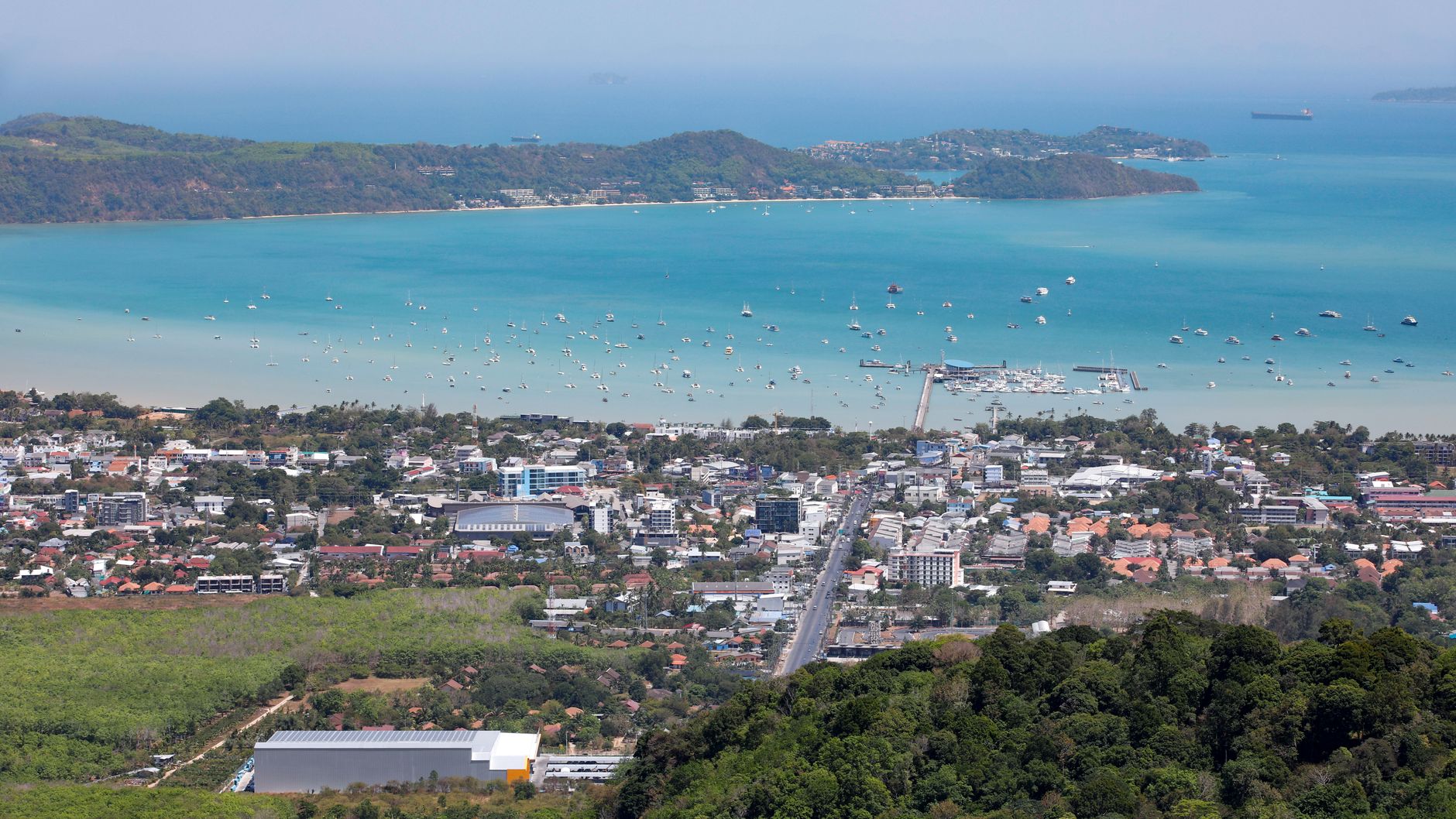
Based on our Q1 2026 listings data, the average asking price for sea-view condominiums in Karon sits at 85,000-110,000 THB per sq m. That positions the district above Rawai and Nai Harn, yet still 15-25% below the most expensive segments on Phuket's west coast, namely Surin and Kamala. Our analysts have tracked this micro-market for several years and consistently observe a upward price trend: year-on-year from Q1 2025 to Q1 2026, new-development prices rose by an estimated 6-9%, while the secondary market expanded at a more moderate 3-5% per year.
Karon occupies roughly 3.5 km of beachfront between Kata to the south and Patong to the north. It is one of the island's longer continuous beach corridors, which sustains steady tourist demand and anchors the rental market. That said, the district's dependency on organised charter tourism creates measurable seasonality risk - a factor we address in detail below.
Quick answer
- Average asking price in Karon: 85,000-110,000 THB per sq m for new condominiums (Q1 2026 data)
- Year-on-year price growth (per our estimates): +6-9% in new projects, +3-5% in the secondary market
- Typical renter profile: organised-tour visitors (European and Russian charter packages), European families wintering December-March, growing share of Chinese and Indian tourists
- Short-term rental occupancy: 65-75% in high season (November-April), 35-45% off-season - both figures lower than Bang Tao, based on our tracking
- New supply pipeline: we currently monitor 4-6 projects in various construction phases in Karon proper, with planned delivery by end of 2027
- Estimated gross rental yield: 5-7% per year depending on unit standard and sub-location within the district
Options and scenarios
Option A - Beachfront premium condominium
At the top of Karon's price range, units in the first row deliver direct Andaman Sea views, infinity pools, reception services, and hotel-managed rental programmes. Asking prices in this segment reach 110,000-140,000 THB per sq m. That remains below comparable beachfront units in Kamala, where our data sets record listings above 150,000 THB per sq m, and below Surin. The buyer profile is typically an investor seeking stable short-term rental income at premium rates who is comfortable with a higher entry cost.
We estimate gross yield in this scenario at 5-6% annually. However, hotel-management fees commonly absorb 30-40% of rental revenue, pulling net yield down to approximately 3-4%.
Option B - Second-row mid-range condominium
This is the scenario we observe most frequently among internationally focused buyers entering the Karon market. Prices range from 85,000-105,000 THB per sq m. Units are typically positioned 300-800 metres from the beach, often without direct sea views, but with a shared pool and security. High-season occupancy tracks close to Option A; off-season drop-off is comparable or slightly steeper.
We estimate gross yield at 6-7% per year. Management costs are lower when handled independently or through local property managers, typically 15-20% of revenue.
Option C - Secondary market, older stock
Karon holds a substantial inventory of condominiums built between 2010 and 2018. Secondary-market prices start from 65,000-80,000 THB per sq m, a clear discount to new projects. Our team verifies physical condition on the ground and notes that a portion of this stock requires capital expenditure: replacement air-conditioning systems, bathroom refurbishment, and common-area updates. Sinking funds in older projects are in some cases partially depleted.
Estimated gross yield can reach 7-8% thanks to the lower entry cost, but capital value risk is real and should be priced into any investment decision.
Comparison table
| Parameter | Karon - new premium | Karon - new mid-range | Karon - secondary | Rawai - new | Bang Tao - new |
|---|---|---|---|---|---|
| Price per sq m (THB) | 110,000-140,000 | 85,000-105,000 | 65,000-80,000 | 75,000-95,000 | 100,000-135,000 |
| YoY price growth (est.) | +7-9% | +6-8% | +3-5% | +5-7% | +8-12% |
| High-season occupancy | 70-80% | 65-75% | 55-65% | 55-65% | 75-85% |
| Off-season occupancy | 40-50% | 35-45% | 25-35% | 30-40% | 45-55% |
| Gross yield (est.) | 5-6% | 6-7% | 7-8% | 6-7% | 6-8% |
| New supply pipeline | Limited | Moderate | None | High | Very high |
| Typical renter | Premium tourist | Families, packages | Budget, backpackers | Long-term residents | Digital nomads, premium |
All figures are indicative, based on our Q1 2026 aggregation of developer listings and property portal data.
Risks and mistakes
Seasonality in Karon is more pronounced than in Bang Tao. The district runs primarily on organised charter tourism from Europe and Russia, peaking November through April. Outside that window, Karon empties more visibly than Bang Tao or Kamala, where digital nomads and long-term residents sustain baseline demand through the low season. We track occupancy rates across both districts and record a gap of 30-35 percentage points between high and low season in Karon - a significant cash-flow risk that should feature in any yield model.
Foreign ownership limits apply as standard. Non-Thai nationals can hold freehold title only as a condominium unit, subject to the rule that foreign-owned units in a given building must not exceed 49% of total floor area. In Karon, where several projects have attracted strong international buyer interest, this quota is in some buildings close to its ceiling. We always verify available foreign quota before providing a recommendation.
Road infrastructure is a constraint. Karon sits on the Route 4028 corridor connecting Patong and Kata. During peak season, traffic on this road can reach a near-standstill. The absence of a bypass road reduces liveability and may act as a ceiling on price appreciation compared with better-connected districts further north on the west coast.
The most common calculation error we see from investors is comparing gross and net yield figures without accounting for all operating costs: management fees (15-40% of revenue depending on the arrangement), common area maintenance charges (CAM fees, typically 40-80 THB per sq m per month), insurance, rental income tax, linen, and cleaning. Based on our estimates, real net yield in Karon is approximately 2-3 percentage points below the headline gross figure.
Oversupply risk in the 2027-2028 window. While the pipeline within Karon itself is moderate, adjacent Kata and Kata Noi are also delivering new inventory. Across the broader Karon-Kata corridor, our Q1 2026 data covers approximately 8-12 projects under construction, which could produce a temporary supply glut and downward pressure on rental rates before the market reabsorbs new stock.
FAQ
What is the price per sq m in Karon, Phuket in 2026?
Based on our Q1 2026 data, new condominiums in Karon are listed at approximately 85,000-140,000 THB per sq m. The range depends on beach proximity, floor level, view, and finish quality. On the secondary market, prices start from around 65,000 THB per sq m.
Is Karon cheaper than Bang Tao or Kamala?
Yes. On a like-for-like basis, Karon's average price per sq m is roughly 10-20% below Bang Tao and 15-25% below Kamala in comparable new condominium segments, as of Q1 2026. Karon is in turn priced approximately 10-15% above Rawai.
What gross rental yield can I expect in Karon?
We estimate gross short-term rental yield in Karon at 5-8% per year depending on the segment. After deducting management fees, maintenance, and applicable taxes, net yield typically falls to 3-5%. Off-season occupancy is the main variable that separates the stronger and weaker performing units.
What is the typical renter profile in Karon?
Karon attracts primarily organised-package tourists from Europe, Russia, and China, plus European families using the district as a winter base from December through March. The share of digital nomads and long-term residents is lower here than in Bang Tao or Rawai, which affects off-season demand resilience.
Is buying an older condominium in Karon a viable strategy?
The secondary market offers a lower entry cost (from 65,000 THB per sq m) but carries higher renovation risk and potentially weaker capital appreciation. We verify physical condition on the ground and recommend checking the status of the building's sinking fund before committing. Older projects may also have limited remaining foreign quota in the ownership register.
How many new projects are under construction in Karon?
As of early 2026, we monitor 4-6 projects in active construction within Karon's boundaries. Including the neighbouring Kata and Kata Noi strip, the total pipeline we track covers 8-12 developments with planned delivery between 2026 and 2028.
How does Karon's occupancy rate compare with Nai Harn?
In high season, Karon occupancy is comparable to or slightly above Nai Harn (we estimate 65-75% versus 60-70%). Off-season, the gap narrows because Nai Harn retains a steadier base of long-term residents, while Karon's dependency on charter tourism causes a sharper demand fall.
Can a foreign buyer own property in Karon outright?
Yes, but only as a freehold condominium unit, provided foreign ownership in that specific building does not exceed 49% of total floor area. In popular projects in Karon, available foreign quota can be limited. We always verify quota availability before making a location recommendation.
Researching property in Phuket or Koh Samui? Get in touch - our analysts will prepare a data brief for your shortlisted location.