

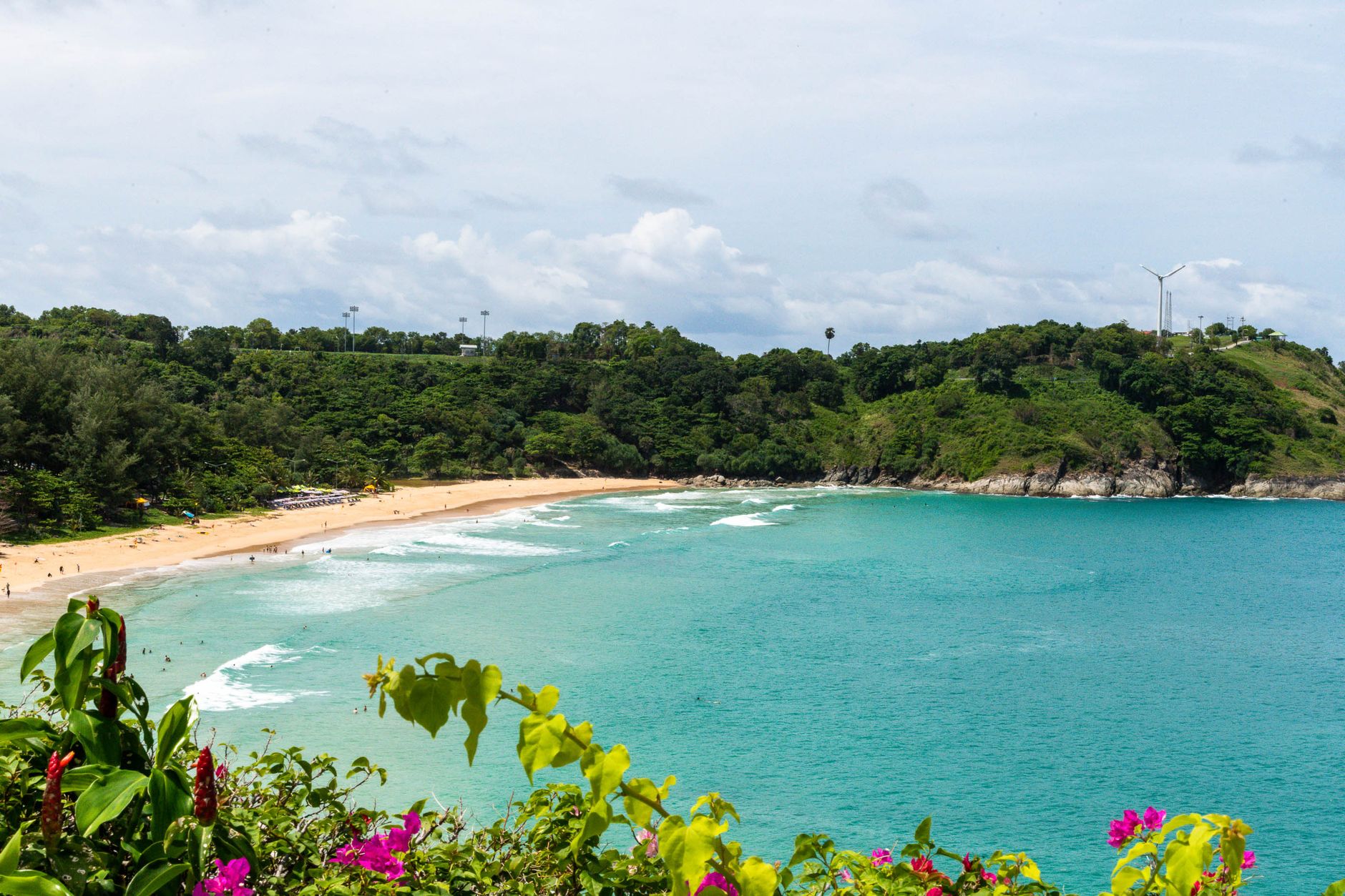
Based on our Q1 2026 data sets, average annual occupancy for short-term rental units in Karon sits at an estimated 68-72%, placing this district in the middle tier among west-coast Phuket locations. The single most important factor shaping returns in Karon is pronounced seasonality: the gap between peak and trough occupancy reaches roughly 45 percentage points, which has a direct and material impact on cash-flow planning.
We have tracked the Karon rental market for several years and observe a consistent, repeating pattern. The high season (November through March) delivers occupancy of 85-95% with nightly rates of 3,200-5,500 THB for a studio or one-bedroom unit. The low season (May through September) pulls occupancy down to 40-55% and rates fall 30-40% below peak levels. On an annual basis, roughly 60-65% of total short-term rental income is generated in just five months.
Karon has two distinguishing characteristics relative to neighbouring districts. First, its large beachfront capacity makes it accessible to organised tour groups, sustaining volume during peak periods. Second, entry-level property prices are measurably lower than in Kamala or Surin, which affects gross yield calculations. Our on-the-ground checks indicate that new supply in Karon is moderate: 5-7 condominium projects are currently under construction, with scheduled delivery between 2026 and 2028.
Quick answer
- Based on our estimates, average annual short-term occupancy in Karon in 2026 is 68-72% (units up to 60 sqm)
- High season (November-March): occupancy 85-95%, average daily rate approximately 3,800 THB
- Low season (May-September): occupancy 40-55%, average daily rate approximately 2,200 THB
- Per our data, Karon entry prices per sqm are 12-18% lower than Nai Harn for comparable new-build condominiums
- New supply pipeline: 5-7 projects under construction, totalling an estimated 900-1,200 units by 2028
- Dominant tenant profile in high season: European and Russian package tourists (7-14 night stays); in low season: digital nomads and families on extended stays
Options and scenarios
Option A: short-term rental only (Airbnb, Booking.com)
This model captures the highest nightly rates during peak months but exposes the owner to full seasonal volatility. Based on our estimates, a professionally managed 45 sqm apartment in Karon can generate gross annual revenue of 480,000-600,000 THB under this approach, provided active dynamic pricing is applied throughout the year. Management costs absorb 20-30% of gross revenue.
During the low season, multi-week vacancy periods are common. Our monitoring of booking platforms shows that in July-August 2025, many Karon listings dropped below 1,800 THB per night simply to secure any reservation at all. Investors relying solely on this model need adequate cash reserves to cover fixed costs during those months.
Option B: blended model (short-term in season, monthly rental out of season)
This is the approach our analysts increasingly flag when reviewing Karon investment cases. From November through March the unit operates on short-term platforms at 3,200-5,500 THB per night. From May through October it shifts to monthly contracts at 18,000-28,000 THB per month.
Estimated gross annual revenue under this model is 420,000-540,000 THB. The upper ceiling is lower than Option A, but cash-flow is substantially more stable and vacancy risk is reduced. Effective annual occupancy rises to an estimated 78-85%. For investors prioritising predictability over maximum yield, this is the more resilient structure.
Option C: long-term rental only (6-12 month contracts)
The most stable but least profitable model. Monthly rents for a 45 sqm apartment in Karon run at 15,000-22,000 THB, producing gross annual revenue of 180,000-264,000 THB. Effective occupancy approaches 95%, but gross yield drops to approximately 4-5% per annum at current purchase prices. This model makes sense primarily for capital-preservation buyers who want minimal operational involvement.
Comparison table
| Parameter | Karon | Nai Harn | Kamala | Rawai |
|---|---|---|---|---|
| Price per sqm - new condos (2026, estimates) | 85,000-120,000 THB | 95,000-135,000 THB | 110,000-160,000 THB | 70,000-100,000 THB |
| Annual occupancy - short-term | 68-72% | 60-68% | 72-78% | 55-65% |
| Occupancy - high season | 85-95% | 80-90% | 88-95% | 70-82% |
| Occupancy - low season | 40-55% | 35-48% | 50-60% | 38-50% |
| Nightly rate - high season | 3,200-5,500 THB | 3,500-6,000 THB | 4,500-8,000 THB | 2,200-3,800 THB |
| Nightly rate - low season | 1,800-2,800 THB | 2,000-3,200 THB | 2,800-4,500 THB | 1,500-2,500 THB |
| Dominant tenant profile | Package tourists, families | Couples, quiet-stay travellers | Premium tourists, families | Long-stay residents, nomads |
| New supply (projects under construction) | 5-7 projects | 3-5 projects | 8-12 projects | 6-9 projects |
| Seasonality amplitude | High (45 pp) | Very high (48 pp) | Moderate (35 pp) | High (40 pp) |
All figures in this table are based on our Q4 2025 and Q1 2026 data sets. Price-per-sqm figures refer to new condominium projects delivered turnkey.
Risks and mistakes
Overestimating low-season occupancy. This is the most frequent error we identify in investor projections for Karon. Developer marketing materials often present a single blended annual occupancy figure without seasonal breakdown. An investor who assumes a flat 70% across twelve months will be materially wrong: the reality is closer to 90% for five months and 45% for the remaining seven. Under that cash-flow profile, May-to-September income may not cover fixed monthly costs (management fees, common area charges, insurance).
Understating management costs. Professional short-term rental management in Karon costs 20-30% of gross revenue. Some operators add separate line items for cleaning, platform marketing, and guest communications. Omitting these costs inflates yield calculations by an estimated 2-3 percentage points.
Rising supply pressure. Our pipeline data shows roughly 900-1,200 new condominium units across Karon and adjacent Kata scheduled for delivery by 2028. If tourist demand growth does not absorb that inventory, nightly rates and occupancy could erode by 3-8 percentage points over a two-year horizon.
Currency exposure (THB vs home currency). Investors buy and earn in Thai baht. Exchange rate movements are a real, unhedged risk for any foreign buyer. A 10% strengthening of a home currency against the baht reduces real returns by an equivalent amount when converted. This is a structural feature of cross-border property investment that no yield figure can offset.
Concentrated tourism dependency. Karon is a predominantly tourism-driven district. Its occupancy is directly exposed to flight disruptions, visa policy changes, and external shocks. Our data shows that districts such as Kamala and Bang Tao, which attract longer-stay digital nomads and residents, have historically shown more resilient occupancy during disruption scenarios.
FAQ
What is the average short-term rental occupancy in Karon in 2026?
Based on our estimates, average annual occupancy for short-term rental apartments in Karon is 68-72% as of 2026. This figure reflects pronounced seasonality: 85-95% during the high season (November-March) and 40-55% during the low season (May-September).
When is the high season in Karon, Phuket?
The high season in Karon runs from November through March. Demand peaks around the Christmas-New Year period (December-January) and again around the Lunar New Year window (January-February). This period concentrates roughly 60-65% of annual short-term rental revenue.
How much does a condominium cost per sqm in Karon in 2026?
Based on our Q1 2026 data, new turnkey condominiums in Karon are priced at approximately 85,000-120,000 THB per sqm. This is 12-18% below comparable Nai Harn projects and 25-35% below Kamala, per our estimates.
How does Karon compare to Nai Harn on occupancy?
Karon has a higher average annual occupancy than Nai Harn (68-72% vs. 60-68%), driven largely by stronger tourist infrastructure and higher visitor volumes. However, both districts share similarly deep low-season troughs: Karon falls to 40-55% and Nai Harn to 35-48% in the May-September period.
What type of tenants rent in Karon?
During the high season, the dominant profile is European and Russian package tourists booking stays of 7-14 nights. During the low season, the profile shifts toward digital nomads and families on extended stays of one to three months. The district draws volume visitors rather than the boutique or ultra-premium segment that characterises Surin or Layan.
Is long-term rental in Karon worth considering instead of short-term?
Long-term rental (6-12 month contracts) provides near-full occupancy of around 95% but compresses gross yield to approximately 4-5% per annum at current prices. The blended model - short-term during high season, monthly contracts during low season - achieves estimated occupancy of 78-85% with higher overall revenue and more stable cash-flow than pure short-term. The right choice depends on the investor's tolerance for cash-flow variability.
How many new projects are under construction in Karon in 2026?
We currently identify 5-7 condominium projects in various stages of construction in Karon, with delivery scheduled between 2026 and 2028. Combined, these represent an estimated 900-1,200 new units, a pipeline that could exert downward pressure on both rates and occupancy over the next two years.
What do property management fees look like in Karon?
Professional short-term rental management in Karon typically costs 20-30% of gross revenue. This covers reservation handling, guest communications, cleaning, minor maintenance, and platform marketing. Some operators charge additional fees for check-in logistics or property photography, which should be factored into any yield projection.
How does Karon seasonality affect investor cash-flow?
Approximately 60-65% of annual short-term rental income is generated in the five high-season months. During the low season (May-September), monthly cash inflows may fall below fixed monthly costs, which we estimate at 5,000-8,000 THB per month (common area fees, utilities, insurance). Investors should maintain a cash buffer sufficient to cover these costs without drawing on other income sources.
Researching property in Phuket or Koh Samui? Get in touch - our analysts will prepare a data brief for your shortlisted location.