

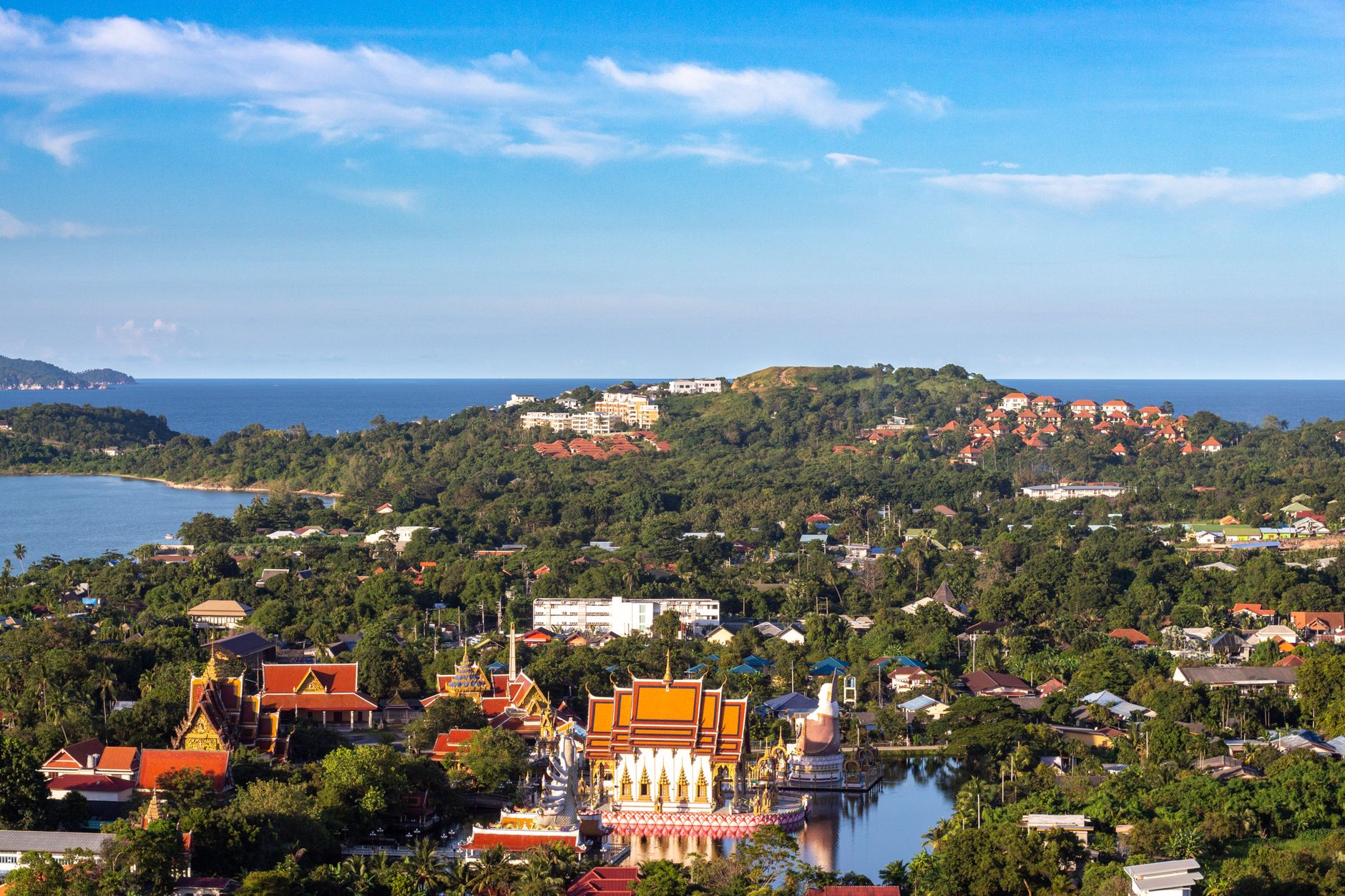
In Q1 2026, our analysts are tracking more than 1,200 active listings of condominiums and apartments available to foreign buyers on a freehold basis across Koh Samui. The median price per square metre in the condo segment sits at 85,000-130,000 THB/m², which positions the island meaningfully below Phuket's west coast, where districts such as Bang Tao and Layan record medians of 150,000-220,000 THB/m² as of the same period.
A lower entry price does not automatically translate into a higher return. Koh Samui carries structural constraints - a single-operator airport, recurring dry-season water shortages, and a shallow secondary market - that directly affect rental liquidity and operating cost assumptions. In the sections below, we map the market district by district and work through the financial arithmetic of condominiums versus villas on the island.
Our team conducts on-the-ground checks each quarter. In 2025, only 7 new condominium projects reached completion on Samui, delivering roughly 320 units in total. Over the same period, Phuket recorded more than 40 project completions and close to 4,500 new units. That supply differential shapes an entirely different market dynamic.
Quick answer
- Median condo price on Koh Samui in 2026: 85,000-130,000 THB/m², varying by district and distance from the beach
- Foreign buyers can acquire a condo unit on a freehold basis provided foreign ownership in the building does not exceed 49% of total usable area; entry-level studios of 30-35 m² start at roughly 2.5-3.5 million THB
- Net rental yield in the short-term condo segment: realistically 5-7% per annum after operating costs, based on our 2025 data sets
- Koh Samui Airport (USM) handles approximately 1.8-2.0 million passengers per year (per 2025 estimates) and operates as a private Bangkok Airways facility, which pushes ticket prices 30-50% higher than equivalent Phuket routes
- Villas held on leasehold (30-plus-30-year structure) can produce higher absolute rental income, but require 8-20 million THB in upfront capital and carry meaningfully higher operating costs
- Seasonal water and power disruptions in hillside zones (Lamai Hills, Maenam Hills) add 15-25% to operating costs relative to beachfront locations
Options and scenarios
Bophut and Fisherman's Village - upper mid-market
Bophut is the most mature condo sub-market on the island. In the Fisherman's Village corridor, we monitor completed units with sea views priced at 110,000-145,000 THB/m². Proximity to international dining, international schools, and Bangkok Hospital Samui makes this district the first choice for buyers targeting both rental income and personal use.
Peak-season occupancy in Bophut (December through April) reaches 75-85%; in the wet months of October and November it falls to 35-45%. Blended across the full year, our reservation-aggregator data points to an average occupancy of 58-65%.
Maenam - family-oriented northern coast
Maenam offers the lowest condo prices on the north shore: 75,000-100,000 THB/m². The district attracts families and long-stay tenants including retirees and remote workers. Long-term rental income is more stable here, though lower - based on our estimates, 4-5.5% net per annum. The district benefits from less hotel competition and lower property-management fees than Chaweng or Bophut.
Lamai - broad mid-market spread
Lamai shows the widest price spread on the island, from 70,000 THB/m² for older projects set 500 metres or more from the beach, up to 120,000 THB/m² for newer boutique condos fronting the coastal road. Infrastructure investment in Lamai has lagged Bophut, but the district is gaining traction with digital nomads. We are currently tracking 3 new projects with scheduled delivery in 2026-2027.
Chaweng - highest short-term rental volume
Chaweng generates the strongest short-term rental revenue on the island, but also the highest operating costs. Condo prices range from 90,000 to 135,000 THB/m². Peak-month occupancy in December and January can reach 80-90%. The structural concerns in Chaweng are ageing road infrastructure, heavy traffic during high season, and noise levels - factors that weigh on premium resale values.
Villa versus condo: the financial comparison
Below we present two model scenarios based on 2025-2026 data and our estimates.
Option A: Freehold condo in Bophut, 45 m², purchase price 5,000,000 THB
- Gross rental income (60% occupancy, average rate 2,800 THB/night): 612,000 THB/year
- Operating costs (25% management fee, CAM charge at 800 THB/m²/year, utilities, internet, insurance): 189,000 THB/year
- Net income: 423,000 THB/year
- Net yield at 60% occupancy (optimistic): 8.5%
- Net yield at 45% occupancy (base case): approximately 5.2%
Option B: Two-bedroom leasehold villa in Maenam, 150 m² on a 400 m² plot, purchase price 12,000,000 THB
- Gross rental income (55% occupancy, average rate 6,500 THB/night): 1,304,750 THB/year
- Operating costs (30% management fee, garden, pool, structural maintenance, building tax, utilities): 523,000 THB/year
- Net income: 781,750 THB/year
- Net yield at 55% occupancy: 6.5%
- Net yield at 40% occupancy (base case): approximately 4.1%
The key distinction is structural simplicity. The condo requires 5 million THB upfront and provides straightforward freehold title. The villa requires 12 million THB, involves either a leasehold structure or a Thai company vehicle, and carries higher legal risk - while delivering greater absolute income.
Scenario 1: Passive investor, budget up to approximately 575,000 USD equivalent Freehold condo in Bophut or Lamai, 35-50 m², handed to a hotel management operator. Expected net yield: 5-7% at adequate occupancy. Resale is simpler under freehold, although the Samui secondary market is thin.
Scenario 2: Active investor, larger budget Two-to-three-bedroom villa in Maenam or Bophut Hills on a 30-plus-30-year leasehold registered at the Land Office. Higher absolute income but requires active oversight or a property manager charging 25-35% of gross revenue. Key risk: leasehold renewal after the initial 30 years is not legally guaranteed.
Scenario 3: Samui and Phuket portfolio split Our data sets show that buyers with larger budgets increasingly divide their Thai allocation: a condo on Samui for the higher quoted yield, and a condo on Phuket for stronger resale liquidity and superior air connectivity. Phuket receives seasonal direct charter flights from multiple European cities; Samui requires a connection through Bangkok or Surat Thani.
Comparison table
| Parameter | Condo - Bophut | Condo - Lamai | Condo - Chaweng | Villa - Maenam (leasehold) |
|---|---|---|---|---|
| Price per m² (THB) | 110,000-145,000 | 70,000-120,000 | 90,000-135,000 | 80,000-110,000 (structure only) |
| Typical budget (THB) | 4-7 million | 2.5-5 million | 3.5-6 million | 10-20 million |
| Ownership form | Freehold | Freehold | Freehold | Leasehold 30+30 |
| Annual occupancy | 58-65% | 45-55% | 55-70% | 45-60% |
| Net yield | 5-7% | 4.5-6% | 5.5-7.5% | 4-6.5% |
| Resale liquidity | Medium | Low to medium | Medium | Low |
| Operating costs (% of revenue) | 25-30% | 25-30% | 28-35% | 35-45% |
| Legal risk | Low | Low | Low | Medium to high |
Risks and mistakes
Infrastructure constraints - a hard analytical variable
Koh Samui Airport (USM) is a private Bangkok Airways facility with a single runway and a capacity ceiling of roughly 50 flight operations per day. No low-cost carriers operate scheduled services there. A one-way Bangkok-Samui ticket costs 3,500-7,000 THB, compared with 1,200-3,000 THB for Bangkok-Phuket. This filters out budget travellers and inflates construction logistics costs: building materials shipped by ferry from Surat Thani add an estimated 15-25% to build costs versus Phuket.
During the dry months (February through April), hillside districts experience water supply interruptions. Projects without private tanks or artesian wells pay 2,000-5,000 THB per month for water deliveries at a pool villa. Power outages averaging 3-8 incidents per month during peak season make generator or UPS investment a practical necessity rather than an option.
The pool of qualified construction contractors on Samui is small. Our on-the-ground monitoring recorded average project delivery delays of 4-8 months against developer schedules in 2025. The comparable figure on Phuket, where the contractor market is deeper, was 2-4 months.
Route 4169/4170 is the island's only arterial road. In peak season, traffic in Chaweng and Lamai can double journey times. A condo's proximity to key nodes - Bophut, Nathon - has a measurable effect on rental desirability.
Tax considerations for international buyers
Foreign buyers should account for Thai progressive income tax on rental income (rates 0-35%; at income below 500,000 THB/year the effective rate is roughly 5-10%), withholding tax deducted at source (5-15% depending on structure), and domestic reporting obligations in their home jurisdiction. Thailand has double-taxation agreements with numerous countries; buyers should verify the applicable method - credit or exemption - with a local tax adviser. Repatriating funds from Thailand requires documentation of the source and typically clears through SWIFT in 3-10 business days.
Transaction costs at purchase for a new condo: transfer fee 2% (typically split between buyer and seller), withholding tax 1%, and either specific business tax at 3.3% (if the seller has held for fewer than 5 years) or stamp duty at 0.5%. Total buyer-side closing costs: approximately 1-3% of the purchase price.
Key risks to monitor
- Secondary market liquidity. Average time on market for a resale condo on Samui is 12-24 months based on our observations, compared with 6-14 months on Phuket
- Leasehold renewal risk. A change in land ownership (sale, inheritance) can complicate renewal negotiations; the Thai legal framework does not guarantee continuation
- Currency exposure. The THB fluctuated by approximately plus or minus 18% against major currencies between 2020 and 2025, which over a five-year hold can substantially affect returns measured in the buyer's home currency
- Title verification. We encounter projects on Samui built on land with ambiguous title documents (Nor Sor 3 rather than full Chanote). Our team verifies title at the local Land Office before any transaction recommendation
- Low-season vacancy. October and November generate occupancy below 30%. A minimum two-to-three months of zero revenue must be built into any annual cash-flow model
- Short-term rental regulation. Thailand's Hotel Act technically requires a hotel licence for rentals shorter than 30 days in residential buildings. Enforcement on Samui as of 2026 remains limited, but regulatory risk is not zero and should be monitored
FAQ
Can a foreigner own an apartment in Koh Samui outright?
Yes. A foreign national can acquire a condominium unit on a freehold basis, provided that aggregate foreign ownership in the building does not exceed 49% of total usable floor area. The purchase funds must be transferred from abroad in foreign currency and converted to Thai baht through a Thai bank, which issues a Foreign Exchange Transaction (FET) form required for Land Office registration.
What is the entry-level price for a condo on Koh Samui in 2026?
In Lamai and Maenam, we track studio listings of 25-30 m² from 2.2-2.8 million THB in older projects (2010-2015 vintage). New-build premium condos start at roughly 3.5-4 million THB for a 30-35 m² studio.
What net rental yield can a condo on Koh Samui realistically achieve?
Based on our 2025 data sets, net yield after management fees, common-area charges, and taxes runs at 5-7% per annum for short-term rentals in Bophut and Chaweng. Long-term rental in Maenam and Lamai produces 4-5.5% net per annum.
Is a villa a better investment than a condo on Samui?
A villa generates higher absolute income but requires two to four times more capital, involves a leasehold or Thai company structure, and carries higher operating costs for pool, garden, and structural maintenance. In our observations, net yields for villas are comparable to or lower than condos at 4-6.5% per annum. A villa makes analytical sense above a 10 million THB budget and with active management in place.
How do you get to Koh Samui from Europe?
The standard routing is a flight to Bangkok (10-11 hours) followed by a Bangkok Airways connection to Samui (1 hour, 3,500-7,000 THB one-way). The alternative is flying to Surat Thani with a low-cost carrier (800-1,500 THB) and then taking the ferry (1.5-2 hours, 400-600 THB). There are no direct flights from Europe to Samui. Phuket receives seasonal direct charters from several European cities.
What are the annual running costs for a Koh Samui condo?
For a 45 m² unit: common-area maintenance (CAM) fee 600-1,200 THB/m²/year, electricity 2,000-4,000 THB/month, internet 600-900 THB/month, building insurance 3,000-8,000 THB/year. Total annual cost excluding property management: approximately 50,000-85,000 THB.
Have condo prices on Koh Samui increased recently?
Between 2022 and 2025, median condo prices on the north coast (Bophut, Maenam) rose by 12-18% in THB terms, according to our tracking data. That rate of appreciation is slower than Phuket, where the comparable figure was 18-28% over the same period - a reflection of lower demand momentum and the infrastructure constraints outlined above.
How many new developments are launching on Koh Samui in 2026?
We are monitoring 4-5 new condominium projects with scheduled delivery in 2026-2027, concentrated in Bophut and Chaweng. Total new supply is estimated at 180-250 units - a fraction of Phuket's annual pipeline.
What are the closing costs when buying a new condo from a developer on Samui?
Buyer-side closing costs at a new-build purchase typically total 1-3% of the purchase price, covering the transfer fee (2%, often shared equally with the seller) and withholding tax (1%). Specific business tax at 3.3% applies to the seller if they have held the unit for fewer than 5 years; otherwise stamp duty at 0.5% applies instead.
What is the analytical recommendation for a first-time buyer on Koh Samui in 2026?
For a buyer with a budget in the 5-6 million THB range, a freehold condo of 35-55 m² in Bophut managed by a professional hotel operator represents the most balanced entry point - combining the strongest resale liquidity on the island with a net yield of 5-7% and low legal complexity. Buyers with larger budgets and a higher risk tolerance may consider a leasehold villa in Maenam, but must factor in higher operating costs, a longer payback horizon, and the leasehold renewal risk. In every case, our team verifies the land title (full Chanote), the foreign ownership quota remaining in the building, and the developer's delivery track record before forming a view.
Researching property in Phuket or Koh Samui? Get in touch - our analysts will prepare a data brief for your shortlisted location.