

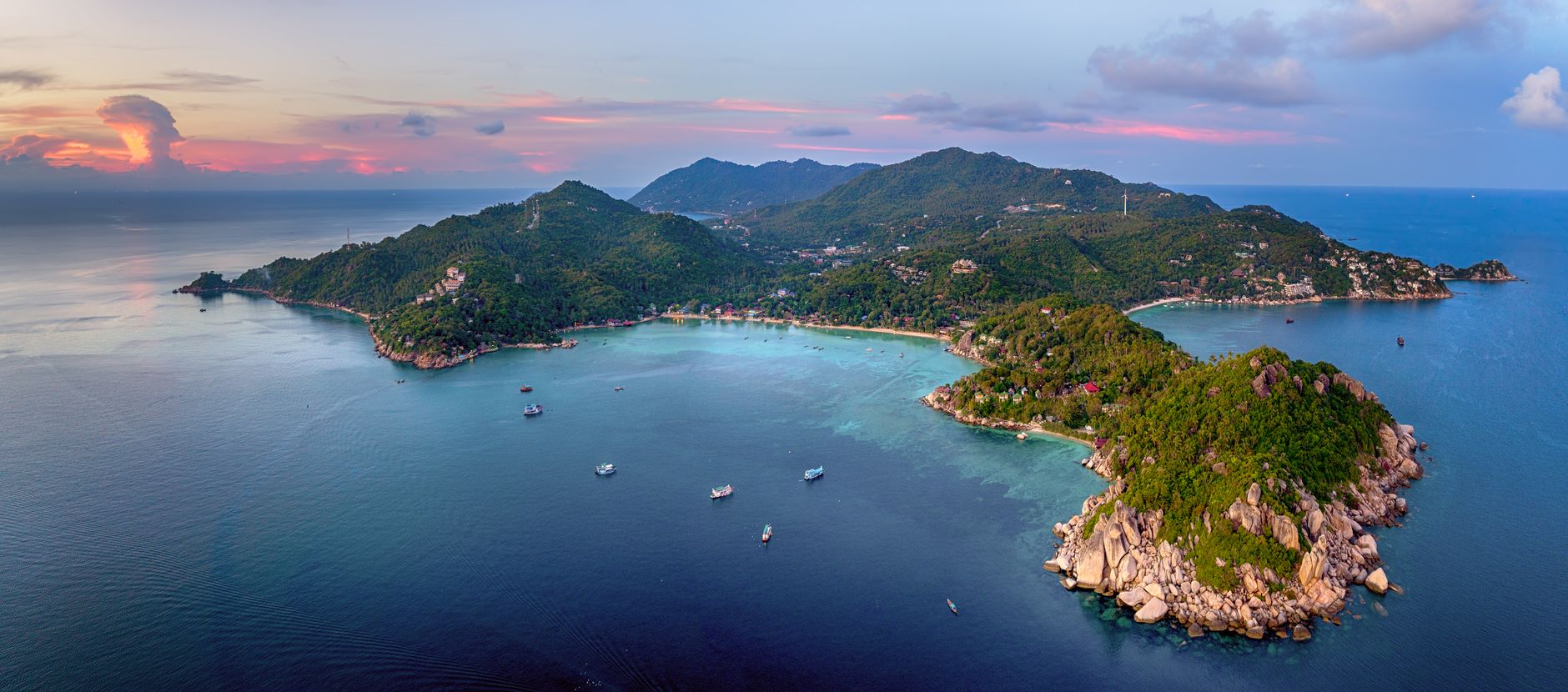
Koh Samui Airport (USM) handled approximately 2.1 million passengers in 2025 against a terminal design capacity of around 1.8 million, according to operator-published data. The island is running above its nominal transport infrastructure ceiling, and that single fact already reshapes the investment economics before a buyer reviews a single floor plan. Below, our analysts break down each structural constraint by district and by number.
Koh Samui differs from Phuket in one foundational respect: there is no airline competition at USM. The airport is privately operated by a single carrier, which sustains structurally higher ticket prices and a constrained route network. By contrast, Phuket International Airport (HKT) handled over 10 million passengers in 2025 and operates under government oversight with multiple competing carriers. That gap in air access translates directly into a different demand profile for short-term rental property on Samui.
Quick answer
- USM capacity: design throughput roughly 1.8 million passengers per year; actual 2025 volume exceeded 2.1 million; a one-way Bangkok-Samui fare averages 2,800-4,500 THB, roughly two to three times the equivalent fare to Phuket
- Road network: one primary ring road (Route 4169/4170), approximately 51 km in total; during peak season (December-February) a 10-km stretch through Chaweng or Bophut can take 40-50 minutes
- Water supply: during the dry season (February-April) municipal supply fails in elevated zones; villas above 200 m elevation require private tanks and tanker deliveries at 1,500-2,500 THB per 10 m³
- Electricity: the Provincial Electricity Authority submarine cable from the mainland covers baseline demand, but our monitoring records 8-12 outages per year; most larger projects budget for backup generators and UPS systems
- Construction contractors: approximately 30-40 licensed building firms operate on the island; villa construction costs run 15-25% above Phuket equivalents as of Q1 2026
- Wastewater: no centralised treatment plant exists; every project must engineer its own system, adding 800,000-1,500,000 THB to villa development budgets
- Resale liquidity: the secondary market on Samui is materially thinner than Phuket, particularly for leasehold villas in quieter districts such as Maenam
Options and scenarios
Option 1: Premium villa in Bophut
Bophut and the Fisherman's Village corridor represent the most mature segment on the island. In our data sets, leasehold land (30+30+30-year structures) in Bophut trades at 18,000-35,000 THB per m² depending on beach proximity. A three-bedroom villa of 250 m² built on a 400 m² plot carries an all-in construction and fit-out cost of 12-18 million THB (per market estimates using the March 2026 exchange rate).
Our analysts model the following yield chain for a representative 15 million THB Bophut villa:
- Gross rental revenue: average rack rate 8,500 THB per night in season, 4,200 THB per night off-season; at 55-60% annual occupancy this produces roughly 1,150,000-1,250,000 THB per year
- Annual operating costs: property management at 20-25% of revenue (approx. 250,000 THB), pool and garden maintenance (120,000 THB), insurance (35,000 THB), repairs and contingency (80,000 THB), land and building tax (15,000 THB), utilities during vacancy periods (40,000 THB) - total approximately 540,000 THB
- Net income before personal income tax: roughly 610,000-710,000 THB per year
- Net yield on invested capital: approximately 4.1-4.7%
This is a typical outcome for the Samui premium segment. We verify on the ground that comparable Phuket locations - Bang Tao, Layan, Surin - achieve 65-72% occupancy due to superior air access, lifting net yields to 5.0-6.5% on similar capital outlay.
Option 2: Condominium in Chaweng
Chaweng is the island's mass-tourism hub. Freehold condominiums (foreign quota up to 49% of total building area) are available from 3.5 million THB for a 35 m² studio to 8 million THB for a 65 m² two-bedroom unit. Entry capital is substantially lower than for villa investment.
Yield model for a representative 45 m² freehold condo at 5.2 million THB:
- Gross rental revenue: 2,800 THB per night in season, 1,400 THB per night off-season; at 60% occupancy this produces roughly 520,000 THB per year
- Operating costs: common area maintenance (CAM) fees 60,000 THB, property management at 25% of revenue 130,000 THB, taxes and insurance 18,000 THB - total approximately 208,000 THB
- Net income: roughly 312,000 THB per year
- Net yield: approximately 6.0%
The higher percentage yield reflects the lower entry ticket. In absolute baht terms the net income is roughly half that of a Bophut villa. We also observe that freehold condos resell more easily on the Samui secondary market because the ownership structure is straightforward and the price point attracts a broader buyer pool.
Option 3: Long-stay villa in Maenam
Maenam carries lower land costs - 12,000-22,000 THB per m² on leasehold terms - and lighter tourist pressure. Properties in this district predominantly attract long-stay tenants (3-12 month contracts) and remote workers rather than short-stay holidaymakers. Based on our estimates, long-term rental net yields in Maenam run at 3.5-4.2%, but operating costs are 20-30% lower than Bophut because of simpler infrastructure demands and lower turnover cleaning cycles.
Comparison table
| Parameter | Bophut - villa | Chaweng - condo | Maenam - villa | Lamai - villa |
|---|---|---|---|---|
| Entry price (THB) | 12-18 million | 3.5-8 million | 9-14 million | 8-13 million |
| Ownership structure | Leasehold / company | Freehold (49% quota) | Leasehold / company | Leasehold / company |
| Net yield | 4.1-4.7% | 5.5-6.5% | 3.5-4.2% | 4.0-5.0% |
| Annual occupancy | 55-60% | 58-65% | 45-55% (long-stay) | 50-60% |
| Build cost per m² (THB) | 35,000-55,000 | n/a (developer unit) | 30,000-45,000 | 28,000-42,000 |
| Water supply risk | Low (flat land) | Low | Medium (hillside) | Medium |
| Resale liquidity | Medium | High | Low | Medium |
| Airport sensitivity | High | Very high | Moderate | High |
Risks and mistakes
1. Airline monopoly as a systemic risk. USM is the island's sole commercial airport and operates under a private concession. Unlike Phuket, there is no government oversight of pricing or slot allocation. Any operational disruption - runway works, a commercial decision by the operator - immediately compresses short-term rental demand. We monitor signals regarding a potential second airport or a mainland bridge link; as of 2026 both projects remain at preliminary feasibility study stage with no confirmed timelines.
2. Construction costs inflated by logistics. Every tonne of cement, steel, and ceramic tile reaches Koh Samui by ferry from Surat Thani. Based on our estimates, the logistics surcharge adds 12-18% to material prices. During monsoon season (October-December) ferry disruptions can delay deliveries by one to three weeks, extending build schedules accordingly.
3. Thin contractor market. We verify on the ground that Koh Samui has significantly fewer licensed building firms than Phuket - roughly 30-40 compared with 120-150 on the larger island. The practical consequences are longer pre-construction waiting times (6-12 months in the current 2026 pipeline) and reduced negotiating leverage for buyers commissioning bespoke villa projects.
4. Dry-season water shortages in elevated zones. The Maenam Hills, Lamai Hills, and southern hillside areas regularly lose municipal water supply between February and April. Installing a private tank of 20-30 m³ capacity costs 150,000-300,000 THB and is, in practice, non-optional for hillside developments.
5. No centralised sewage treatment. Every villa project must design and install its own wastewater treatment system. The cost runs from 800,000 to 1,500,000 THB. Our analysts note this is one of the most frequently omitted line items in developer brochures and in private investor feasibility models.
6. Currency exposure on construction and income. The Thai baht fluctuated materially against major currencies in 2025. On a 15 million THB investment, a 5% exchange rate shift can represent the equivalent of several months of net rental income. Currency hedging instruments exist but carry costs that erode yield for individual investors.
7. Exit taxes on resale. Specific Business Tax (SBT) at 3.3% of the transaction price applies if a property is sold within five years of acquisition. For holdings beyond five years, Stamp Duty at 0.5% applies instead. Both figures should be modelled into any exit scenario from day one.
FAQ
Does the airport situation at Koh Samui directly affect rental yields?
Yes, materially. A single private operator controlling all commercial flights sustains ticket prices that are on average two to three times higher than equivalent routes to Phuket. In our data sets, Phuket receives roughly five times more international passengers per year than Samui. That volume difference flows through directly into short-term rental occupancy rates and achievable daily rates.
What does it cost to build a villa on Koh Samui in 2026?
Premium-standard villa construction in Bophut runs at 35,000-55,000 THB per m² of usable floor area. In Maenam and Lamai the range is 28,000-45,000 THB per m². Both figures sit 15-25% above comparable Phuket benchmarks, driven by ferry logistics costs and the limited local contractor pool.
Is a villa or a condo the stronger investment on Koh Samui?
They serve different objectives. A freehold condo in Chaweng delivers a higher percentage net yield (5.5-6.5%) with a lower entry ticket and simpler resale via the foreign quota. A Bophut villa produces a lower percentage yield (4.1-4.7%) but higher absolute income, a more stable premium-tenant profile, and somewhat lower dependence on mass-market tourist flows.
How serious are the water and power problems on the island?
In elevated districts - Maenam Hills, Lamai Hills, southern hillsides - dry-season water shortfalls are a recurring annual event from roughly February through April. Power outages from the submarine cable average 8-12 incidents per year island-wide. Private water storage tanks and backup generators are standard practice for villa developments rather than optional upgrades.
What are land prices on Koh Samui as of 2026?
Leasehold land in Maenam trades at roughly 12,000-22,000 THB per m², while Bophut beachside plots reach 35,000 THB per m². Hillside plots with sea views fall in the 25,000-40,000 THB per m² range. Based on our tracking, Samui land prices appreciated at approximately 5-8% per year between 2023 and 2025.
What do property management companies charge on Koh Samui?
Short-term rental management fees run at 20-25% of gross revenue. For long-term lets (three months or more) the typical fee falls to 10-15%. On top of management fees, villa owners should budget 100,000-150,000 THB annually for pool, garden, and housekeeping maintenance on a standard three-bedroom property.
Can a foreign national buy a condo on Koh Samui in freehold ownership?
Yes. Foreign buyers may acquire condominium units in freehold under Thai Condominium Act provisions, subject to the foreign quota rule: foreigners collectively may not own more than 49% of the total floor area of a given building. Purchase funds must originate from outside Thailand and be transferred in a foreign currency with the corresponding bank documentation (Thor Tor 3 form) to establish the foreign-sourced funds record needed for future resale or repatriation.
Which districts have the strongest infrastructure on Koh Samui?
Chaweng and Bophut lead on road quality, retail density, and medical facilities. Chaweng hosts the highest concentration of commercial services and the Bangkok Hospital Samui. Bophut offers a balance between service availability and a quieter residential character. Maenam and Lamai have thinner road infrastructure and fewer on-island services, which is reflected in their lower land prices but also in lower short-stay occupancy potential.
How does Koh Samui compare to Phuket for infrastructure investment risk?
Based on our comparative analysis, Phuket carries materially lower infrastructure risk across four dimensions: airport access (HKT is multi-carrier, government-regulated, and handles five times the passenger volume), contractor availability (three to four times the number of licensed firms), water supply reliability (municipal coverage is broader across the main investment districts of Bang Tao, Layan, Kamala, and Surin), and resale market depth. Samui's infrastructure constraints do not make the market uninvestable, but they establish a structurally lower ceiling on achievable yields and exit liquidity.
What is the analytical recommendation for Koh Samui in 2026?
Koh Samui infrastructure represents a hard constraint on property value appreciation. The airline monopoly, single ring road, seasonal water deficits, absent centralised sewage, and thin contractor market are structural factors that no individual investor decision can remove. Based on our analysis, Samui performs best as a portfolio diversification position rather than a primary exposure to the Thai market. For investors prioritising liquidity and lower infrastructure risk, Phuket remains the stronger entry point. Within Samui, we rate Chaweng freehold condos and Bophut premium villas as the two segments with the most defensible risk-adjusted return profiles.
Researching property in Phuket or Koh Samui? Get in touch - our analysts will prepare a data brief for your shortlisted location.