

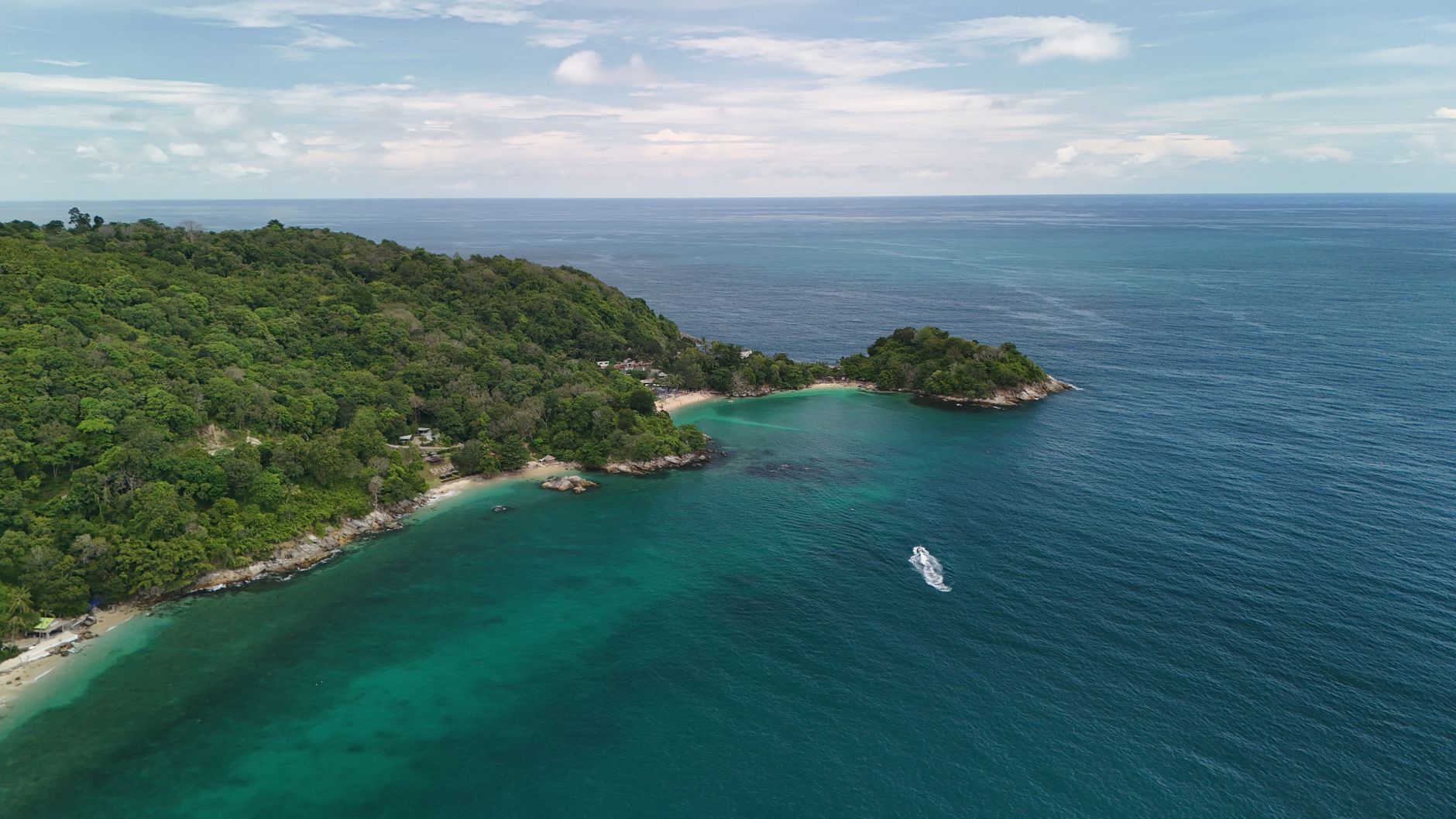
In Q1 2026, our analysts track average off-plan prices in Kamala Beach at approximately 130,000-165,000 THB per sq m (as of March 2026, based on monitoring of more than 20 active projects in the district). By comparison, completed resale apartments in the same area are listed in the 155,000-210,000 THB per sq m range. The resulting price gap between buying at construction stage versus buying on the secondary market sits at 15-25%, making Kamala one of the more compelling off-plan discount locations on Phuket's west coast.
Kamala occupies a distinctive position in the western coastal corridor: it sits between the premium micro-markets of Surin and Layan to the north and the high-volume tourism belt of Patong to the south. We monitor projects here ranging from studios of around 28 sq m to penthouses exceeding 200 sq m. The median off-plan unit price in the condominium segment runs at approximately 4.8-5.5 million THB for apartments in the 38-45 sq m bracket.
For internationally-based investors converting at current rates, that entry point represents a meaningful but accessible commitment - broadly comparable to a mid-range city apartment purchase in several European markets, with a materially different return profile.
Quick answer
- The off-plan discount in Kamala Beach versus the resale market is approximately 15-25% as of 2026, depending on project phase
- Typical payment schedules are structured across 4-6 tranches spread over an 18-30 month construction window
- Reservation deposits usually run 100,000-300,000 THB (roughly 2-5% of unit value) and become non-refundable upon signing the sale and purchase agreement
- The largest source of schedule risk is the permitting and EIA phase - we document cases of 6-12 month overruns in this area
- There are no buyer-protection holding accounts for off-plan payments in Thailand; the only safeguards are contractual clauses and developer financial strength
- Indicative gross rental yield on a completed Kamala apartment in the short-term rental market is 5-7% per year, based on 2025 leasing data we track
Options and scenarios
Scenario 1 - pre-launch purchase (phase zero)
This entry point offers the largest discount but the highest risk exposure. Developers typically price pre-launch units 20-25% below the projected post-completion sale price. The buyer commits a reservation deposit and a first tranche - collectively 25-35% of the unit value - before construction begins. The core risk at this stage: the project may not yet hold a building permit, and the EIA (Environmental Impact Assessment) process can extend well beyond the developer's stated timeline. In Kamala, where portions of the available land adjoin protected hillside and buffer zones, we observe these delays on a regular basis.
Scenario 2 - mid-construction purchase
At this stage the discount narrows to approximately 10-15%, but the regulatory exposure has largely been resolved. Foundations are in place and permits have been issued. The buyer's initial outlay is lower (around 15-25%), with the balance tied to construction milestones. Based on our data sets, this is the entry scenario we most frequently reference for first-time buyers considering Kamala.
Scenario 3 - completed resale purchase
No off-plan discount applies, but construction risk is eliminated entirely. The buyer inspects exactly what they are acquiring. The premium paid over off-plan pricing is partially offset by immediate rental income availability. In Kamala, a completed, well-located apartment can begin generating leasing revenue within weeks of transfer.
Comparison table
| Parameter | Pre-launch (Phase 0) | Mid-construction | Completed resale |
|---|---|---|---|
| Discount vs resale market | 20-25% | 10-15% | 0% |
| Initial outlay | 25-35% of value | 15-25% of value | 100% of value |
| Time to handover | 24-30 months | 10-18 months | Immediate |
| Regulatory risk | High | Low (permits issued) | None |
| Construction delay risk | High | Medium | None |
| Capital deployed in year one | 40-55% of value | 50-70% of value | 100% of value |
| First rental income | After 24-30 months | After 10-18 months | Immediate |
| Indicative price per sq m (Kamala, 2026) | 130,000-145,000 THB | 140,000-160,000 THB | 155,000-210,000 THB |
Payment schedule structure and how tranches shift buyer risk
A representative off-plan payment schedule for a 5,000,000 THB apartment in Kamala Beach breaks down as follows (indicative figures):
- Reservation - 100,000-200,000 THB (2-4%), payable within 7-14 days of signing the reservation form
- Sale and purchase agreement signing - 20-30% of value (1,000,000-1,500,000 THB), due within 30-60 days of reservation
- Foundation completion - 10-20% (500,000-1,000,000 THB)
- Structural frame completion - 10-20% (500,000-1,000,000 THB)
- Fit-out and finishing - 10-15% (500,000-750,000 THB)
- Handover and title transfer - 20-35% (1,000,000-1,750,000 THB)
A key pattern we observe: after paying the contract-signing tranche and the foundation milestone, the buyer typically has 30-50% of the purchase price committed to the project. At that point, withdrawing from the deal means forfeiting those funds unless the contract contains a specific refund mechanism. This is the stage at which negotiating leverage shifts decisively toward the developer.
In quantitative terms: at a pre-launch entry on a 5 million THB unit, a buyer may have approximately 1.5-2 million THB deployed six months after reservation. If the developer delays by one year, that capital is frozen with no income. At an opportunity cost rate of 5%, that represents 75,000-100,000 THB in foregone annual return. A mid-construction entry shortens the frozen period materially, reducing this opportunity cost by an estimated 40-50%.
Risks and mistakes
EIA and permitting delays
Buildable land in Kamala Beach frequently borders protected hillside zones. We document cases in which obtaining the EIA clearance took 6-12 months longer than the developer's stated schedule. During that window, buyer capital is committed with no guarantee of project completion. The contractual clause that matters here is one requiring a full refund of all payments if a building permit is not secured within a defined deadline.
Construction phase overruns
Material supply disruptions and labor shortages on Phuket intensified after 2023 as the construction boom accelerated island-wide. Based on our on-the-ground monitoring in Kamala, 3-6 month overruns at the structural phase are closer to the norm than the exception. Buyers should scrutinize the penalty clause in the contract. Rates of 0.01-0.05% of contract value per day are common - at 0.01%, the daily penalty on a 5 million THB contract is 500 THB, which imposes minimal financial pressure on a developer.
Finish specification drift
We regularly observe discrepancies between materials shown in the developer's showroom and those installed in the completed unit. The contractual safeguard is a detailed specification sheet attached as an annex to the sale and purchase agreement, naming specific brands, grades, and standards for all material categories.
Skipping an independent technical inspection
Paying the final tranche without an independent pre-handover inspection is one of the most common and costly mistakes we see. A professional snagging inspection in Kamala typically costs 15,000-25,000 THB and can identify defects whose remediation would cost multiples of that figure. We treat this step as non-negotiable before releasing the final payment.
Absence of buyer-protection payment holding accounts
This is a fundamental structural difference from most European property markets. In Thailand, there are no buyer-protection holding accounts for off-plan payments made by foreign purchasers. Funds paid at each tranche transfer directly to the developer's account. The buyer's only protections are the quality of the contractual clauses and the financial stability of the developer entity. Our team verifies the developer's project history, ownership structure, and financial standing before forming any view on a project.
Common transactional mistakes
- Signing contracts without a certified translation from Thai or English
- Failing to verify land title status (Chanote versus Nor Sor 3 Gor) at the Land Office
- Overlooking ownership transfer costs (approximately 1-2% of purchase price on the buyer's side, though some developers share this cost)
- Ignoring recurring common area fees and sinking fund contributions post-handover (combined approximately 500-800 THB per sq m per year in Kamala)
FAQ
What is the typical reservation deposit for off-plan property in Kamala Beach?
Across projects we monitor in Kamala, reservation deposits run 100,000-300,000 THB. The amount is credited against the purchase price but becomes non-refundable once the sale and purchase agreement is signed.
Can a foreign national purchase an off-plan apartment in Kamala on a freehold basis?
Yes, within a condominium building where the foreign ownership quota (capped at 49% of total usable floor area) has not been exhausted. We verify quota availability for each project before forming a view on it.
What is the realistic off-plan discount in Kamala relative to completed apartment prices?
Based on our estimates for 2026, the discount ranges from 15-25% depending on the project phase. The largest reductions apply at pre-launch; projects close to completion carry the narrowest gap.
How long does a typical off-plan construction cycle take in Kamala?
From building permit issuance to key handover, the standard window is 18-30 months. In practice, we track delays of 3-9 months in the majority of projects we follow.
What contractual protections does an off-plan buyer have in Thailand without a holding account?
The primary protections available are: a refund clause triggered by non-completion or permit failure, financial penalties for construction delays, a materials specification annex, and thorough due diligence on the developer's financial position. No buyer-protection holding accounts exist for foreign purchasers in Thailand.
What are the ongoing ownership costs for an apartment in Kamala after handover?
Buyers should budget approximately 500-800 THB per sq m per year for common area fees, plus a one-time sinking fund contribution of 500-700 THB per sq m at handover. For a 40 sq m apartment, annual running costs typically fall in the 20,000-32,000 THB range.
How does Kamala compare to Bang Tao or Layan for off-plan investment?
Kamala offers lower entry prices than Layan, where off-plan averages we track run 170,000-220,000 THB per sq m, and stronger existing tourism infrastructure than many Bang Tao projects that are still building out their immediate surroundings. Kamala tends to perform better in the short-term rental segment due to its established beach and amenity base.
What is the land title situation for new projects in Kamala Beach?
The majority of new condominium developments in Kamala are built on land with Chanote title (full freehold land certificate). Some older hillside projects carry Nor Sor 3 Gor titles, which offer weaker legal protection. We verify title status at the Land Office for every property we analyze.
What are the tax obligations for a foreign investor receiving rental income from a Kamala property?
Rental income in Thailand is subject to progressive personal income tax rates of 0-35%. Thailand and most investor home countries maintain double taxation treaties. Income is taxed at source in Thailand; the applicable treaty method (typically exemption with progression) governs treatment in the investor's country of residence. We recommend consultation with a tax adviser familiar with both jurisdictions before committing.
Researching property in Phuket or Koh Samui? Get in touch - our analysts will prepare a data brief for your shortlisted location.