

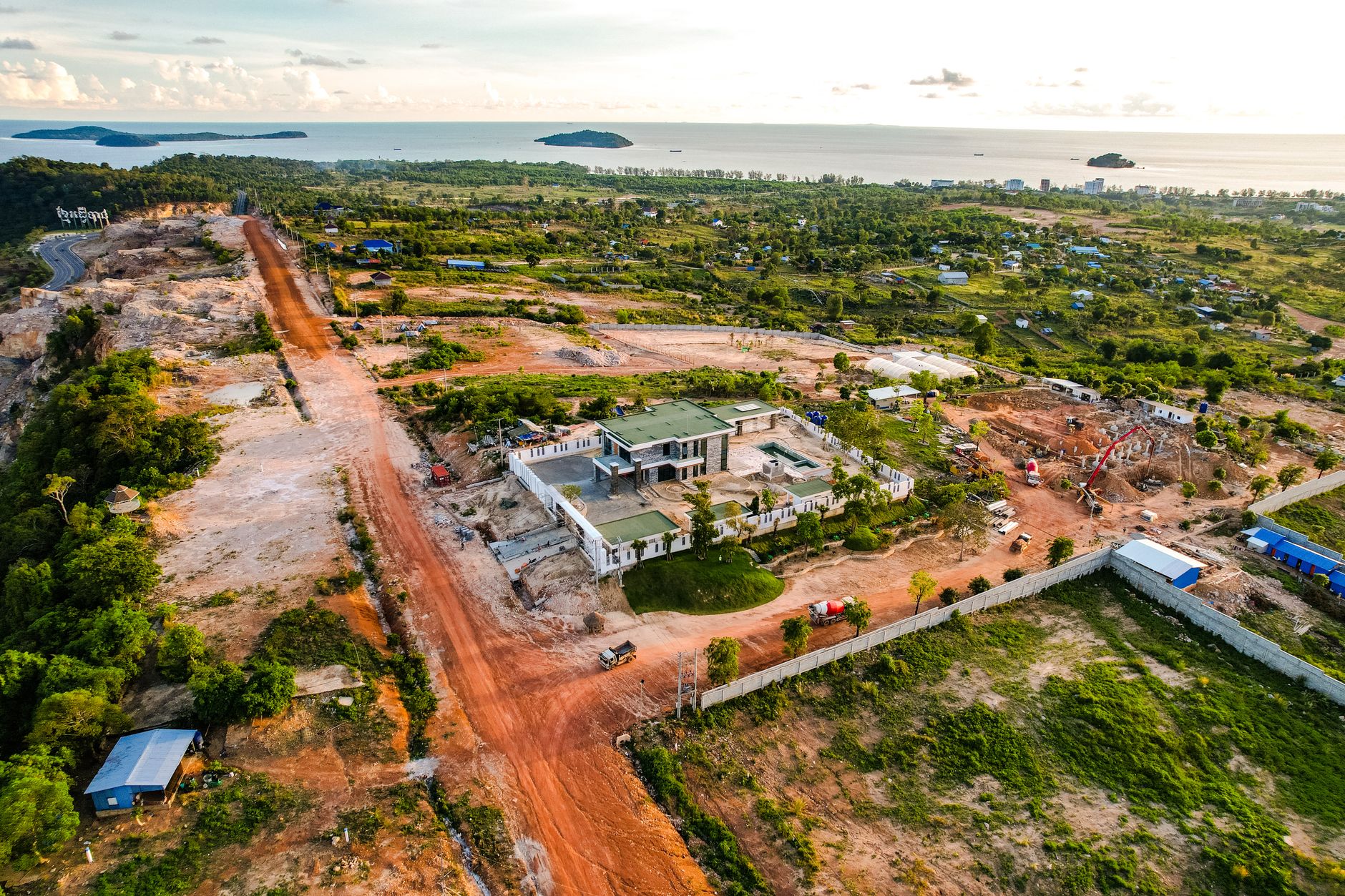
In Q1 2026, our analysts estimate the average price discount for off-plan purchases in Phuket at 15% to 25% relative to completed units in the same project. On Koh Samui the range is comparable, and in some smaller-scale developments the gap can be wider. We monitor construction progress in both locations and break down the transaction mechanics so that prospective buyers can accurately assess their capital exposure over time.
An off-plan purchase in Thailand is, in practical terms, a time-extended contract for future property delivery. The buyer receives no title (or leasehold right) until handover and full payment are completed. This means that throughout the construction period - typically 18 to 36 months - all funds paid are held by the developer, and the buyer's only protection comes from contractual provisions and the financial standing of the project company.
Quick answer
- A typical off-plan payment schedule involves 5 to 7 instalments spread over 18 to 30 months of construction
- The reservation deposit is usually 50,000 to 200,000 THB (roughly USD 1,400 to 5,600 at Q1 2026 rates), credited toward the purchase price
- The buyer's total capital exposure before handover commonly reaches 60% to 70% of the contract value
- We estimate the off-plan discount versus the secondary market at 15% to 25% in Phuket (Bang Tao, Layan) and 18% to 30% in Koh Samui (Bophut, Maenam)
- There are no buyer-protection trust accounts for foreign real estate purchasers in Thailand - all payments go directly to the developer
- The key contractual safeguards are: late-delivery penalty clauses, termination rights with refund provisions, and completion guarantees
Options and scenarios
Standard payment schedule - condominium, Phuket
The most common structure we observe in projects across Bang Tao, Layan, Kamala and Surin runs as follows:
- Reservation deposit - 100,000 THB. Payable within 7 to 14 days of signing the reservation form. Minimal initial exposure, but the deposit is typically non-refundable if the buyer withdraws.
- Sale and Purchase Agreement (SPA) signing - 30% of the purchase price minus the reservation deposit. Due within 30 to 45 days of reservation. Capital exposure increases sharply at this stage.
- Foundation completion - 20% of the purchase price. Approximately 4 to 6 months after construction start.
- Structural frame (superstructure) complete - 20% of the purchase price. Approximately 10 to 14 months after construction start.
- Fit-out and MEP installations - 10% of the purchase price. Approximately 16 to 22 months after construction start.
- Handover and title transfer - 20% of the purchase price. Payable at key handover and title registration.
Under this model, by the time the structural frame is complete the buyer has already paid approximately 70% of the contract value while holding no legal interest in the property.
Aggressive front-loading structure - villas, Koh Samui
In villa developments in Bophut and Maenam, we regularly encounter higher upfront concentration: a reservation deposit plus 40% to 50% at SPA signing, with the remainder spread across two or three further instalments. Developers cite higher material costs and the bespoke nature of villa construction. For the buyer, this means half of total capital is committed before groundworks are complete.
Extended schedule - premium projects, Phuket west coast
A smaller number of premium projects in Layan and Surin offer schedules of 8 to 10 instalments spread over 30 to 36 months, with individual tranches of 5% to 15% of the price. This structure reduces single-payment exposure but extends the period of locked-in capital and increases currency risk over a longer horizon.
The discount arithmetic - when off-plan makes financial sense
A worked example for a Bang Tao condominium, based on our 2026 data set (indicative figures):
- Off-plan price: 5.5 million THB (approximately USD 153,000)
- Estimated completed-unit price in the same project at handover: 7.0 million THB (approximately USD 194,000)
- Nominal discount: 21.4%
- Estimated opportunity cost of capital (instalments spread over 24 months at a 5% annual hurdle rate): approximately 110,000 THB
- Net effective discount after adjusting for capital cost: approximately 17% to 19%
Even after accounting for the opportunity cost of staged capital deployment, the off-plan entry point remains meaningfully cheaper - provided the developer delivers on time and to specification.
Comparison table
| Parameter | Phuket Condo (standard) | Koh Samui Villa (front-loaded) | Premium Phuket (extended) |
|---|---|---|---|
| Number of instalments | 5 to 6 | 3 to 4 | 8 to 10 |
| Construction period | 18 to 24 months | 12 to 18 months | 30 to 36 months |
| Exposure at SPA signing | 30% | 40% to 50% | 20% to 25% |
| Exposure at structural frame | 70% | 80% to 85% | 45% to 55% |
| Final instalment at handover | 20% | 10% to 15% | 20% to 25% |
| Discount vs. completed unit | 15% to 20% | 18% to 30% | 20% to 25% |
| Typical entry price (THB) | 4M to 8M | 8M to 25M | 10M to 30M |
| Currency risk level | Moderate | Moderate | Higher (longer horizon) |
All figures are indicative and reflect projects monitored by our team as of Q1 2026.
Risks and mistakes
Permits and environmental impact assessment (EIA)
In Phuket province, an Environmental Impact Assessment is required for buildings exceeding 80 units or for developments near the shoreline. We have documented cases where developers begin off-plan sales before the final EIA approval is in place. If the report is rejected or requires material modifications, the project can be suspended or substantially redesigned. Before signing any SPA, we verify that both the Construction Permit and the EIA (where applicable) have been issued. This is the baseline credibility check.
Structural-frame stage delays
Delays at this phase most often stem from subcontractor issues or rising input costs. Per data from the Thai Contractors Association, reinforcing steel prices rose approximately 8% year-on-year in 2025. A developer operating on tight margins may slow progress or substitute lower-grade materials. The critical contractual provision here is a late-delivery penalty clause - the market standard is 0.01% to 0.05% of the contract value per day beyond the declared completion date.
Fit-out specification drift
This is the stage at which discrepancies most commonly emerge between the finishes promised in the specification and those actually installed. We recommend that the SPA include a detailed specification annex listing manufacturer names and product models. Without this attachment, the buyer has no effective contractual basis for a defect claim.
Snagging and technical handover
Handover is the point at which the buyer should commission a snagging inspection before paying the final instalment. Based on our monitoring, approximately 30% to 40% of units in new projects require remedial work at this stage. It is worth negotiating a retention clause into the SPA: 5% to 10% of the final instalment withheld for 3 to 6 months after handover as security for defect rectification.
No buyer-protection trust accounts
To be explicit: Thailand has no system of protected trust accounts for foreign property buyers. All instalments go directly to the developer. In the event of developer insolvency, the buyer becomes an unsecured creditor. The realistic protections available are:
- Verification of the developer's financial standing via filings at the Department of Business Development (DBD)
- Review of the developer's track record of completed projects
- SPA provisions granting the right to terminate and recover all payments in the event of delay beyond an agreed threshold (typically 6 to 12 months)
- Completion guarantees from a parent company, or a mortgage charge over the land (rare, but observed in premium-tier projects)
Contractual gaps that create legal exposure
A common mistake is signing a short-form reservation agreement without engaging a Thai property lawyer to review the full SPA before the 30% instalment falls due. By that point, the deposit is already gone and the leverage to renegotiate terms is reduced. The cost of a legal review in Thailand is modest relative to the sums at stake.
FAQ
Is off-plan buying in Thailand safe for international investors?
Safety depends on three factors: the developer's credibility, the quality of the SPA terms, and the due diligence conducted before the first instalment is paid. Because there are no buyer-protection accounts in Thailand, verifying the developer through the DBD registry and analysing their project completion history is the absolute minimum.
What is the typical reservation deposit for an off-plan purchase in Phuket?
Most commonly 50,000 to 200,000 THB (approximately USD 1,400 to 5,600 at Q1 2026 rates). The amount is credited toward the final purchase price but is generally non-refundable if the buyer withdraws.
What is the realistic off-plan discount versus a completed property on Koh Samui?
In the Bophut and Maenam areas, our data set shows discounts of 18% to 30% relative to comparable completed units as of Q1 2026. The precise figure depends on the construction stage at the time of purchase - earlier phases carry higher discounts and higher risk.
What happens to paid instalments if the developer does not complete the project?
The buyer becomes an unsecured creditor of the developer company. Recovering funds requires litigation in Thailand. The critical safeguard is a SPA provision granting the right to terminate the contract and recover all payments if the project is delayed beyond a defined threshold - typically 6 to 12 months past the contracted handover date.
Can I resell an off-plan unit before the project is completed?
Most developers in Phuket and Koh Samui permit assignment of contractual rights for a fee of approximately 1% to 3% of the contract value. Assignment terms should be defined explicitly in the SPA. The off-plan assignment market is active, particularly in Bang Tao and Kamala projects.
What late-delivery penalty should the SPA include?
Market standard is 0.01% to 0.05% of the contract value per calendar day beyond the stated completion date. We recommend negotiating a rate of no less than 0.03% per day, plus the right to terminate and recover 100% of paid instalments if delay exceeds 6 months.
Is it better to buy at pre-sale or wait until the structural frame is visible?
The highest discounts - up to 25% to 30% - are available at the pre-sale phase before construction begins. So is the highest risk. Purchasing at the structural-frame stage yields a lower discount, roughly 10% to 15%, but allows physical verification of construction progress and build quality. The right entry point depends on the buyer's risk tolerance and capital planning.
What should a snagging inspection cover at handover?
Key checkpoints are: finish materials versus specification, electrical and plumbing systems, window and door hardware, floor and wall surfaces, and air-conditioning operation. We recommend engaging an independent building inspector for this step. The cost is approximately 10,000 to 20,000 THB and is well justified given the amounts involved.
Researching property in Phuket or Koh Samui? Get in touch - our analysts will prepare a data brief for your shortlisted location.