

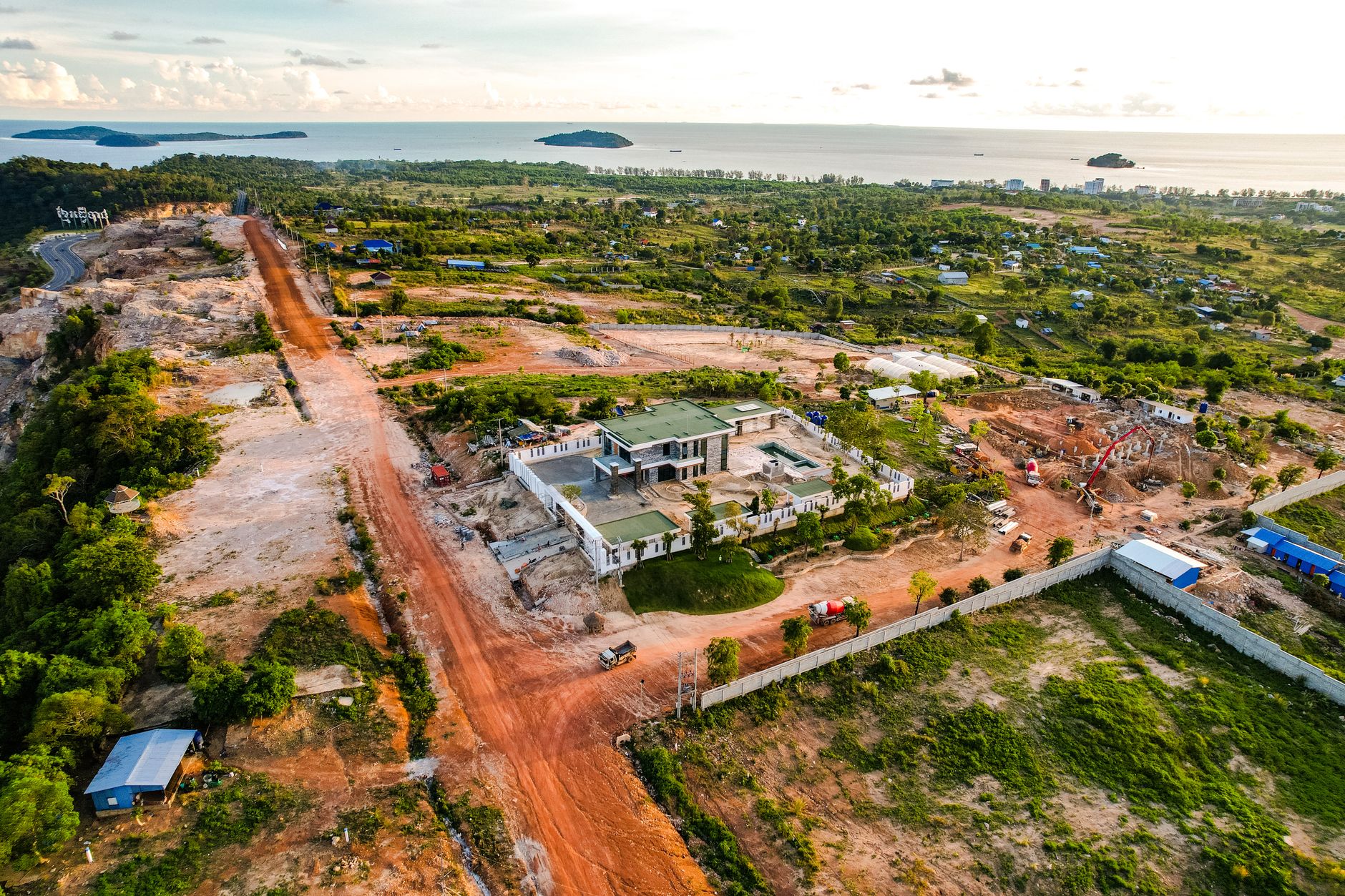
In 2026, the price discount for off-plan purchases in Phuket and Koh Samui sits at roughly 15% to 30% compared with completed properties of a similar standard in the same districts. Our analysts monitor construction progress across Bang Tao, Layan, Kamala, and Bophut, and what we consistently observe is that the discount comes attached to a measurable, stage-by-stage risk exposure that can be broken down and assessed before any funds change hands.
The payment schedule on an off-plan contract is not a convenience feature. It is a risk-management mechanism. Each tranche corresponds to a specific construction milestone, and each carries a distinct level of exposure. Understanding that structure in advance is, in our view, the single most practical step a buyer can take.
Quick answer
- A typical off-plan payment schedule covers 5 to 7 tranches spread across 18 to 36 months of construction
- The reservation fee is usually 50,000 to 200,000 THB (non-refundable in most contracts); contract signing requires 20 to 30% of the purchase price
- The highest risk concentration falls in the foundation and shell stages, where delays have the largest cascading effect on the overall timeline
- In Layan and Bang Tao (Phuket), the off-plan discount against the secondary market is, based on our estimates, 20 to 28% as of 2026
- On Koh Samui (Bophut, Maenam), the discount is lower at 15 to 22%, reflecting a smaller inventory of completed stock
- Thailand has no escrow or buyer-protection fund mechanism for foreign real estate purchasers; contractual terms and developer track record are the only real safeguards
Options and scenarios
How the payment schedule maps to buyer exposure
The model below reflects the structure our team encounters most frequently in Phuket and Koh Samui projects. Percentages are indicative; individual contracts may vary by a few points in either direction.
Stage 1 - Reservation. Payment: 1 to 3% of the purchase price, often a flat fee of 50,000 to 200,000 THB. Absolute exposure is low, but the amount is typically non-refundable. At this stage, we recommend verifying the developer's credibility, the Construction Permit status, and the Environmental Impact Assessment (EIA) report if the project requires one.
Stage 2 - Contract signing. Payment: 20 to 30% within 30 to 60 days of the reservation. Cumulative exposure reaches 23 to 33% of property value, often before a single foundation pile has been driven.
Stage 3 - Foundations complete. Payment: 10 to 15%. Cumulative exposure: 33 to 48%. Earthworks can reveal geotechnical issues, particularly on sloped terrain in Kamala and Surin. Delays at this stage tend to cascade through the entire schedule.
Stage 4 - Shell structure complete. Payment: 10 to 15%. Cumulative exposure: 43 to 63%. In our monitoring data, this is the stage where supply-chain disruptions (steel, concrete) and labour shortages during the rainy season (May to October) most frequently cause project slippage.
Stage 5 - Fit-out and finishing. Payment: 10 to 15%. Cumulative exposure: 53 to 78%. Risk shifts character here: structural delays give way to specification compliance issues and finish quality disputes.
Stage 6 - Handover. Payment: 20 to 40% (the remaining balance). This is the buyer's primary negotiating lever and the only point in the process where defects can realistically be remedied before funds are released.
Scenario A - on-schedule delivery
For a buyer who acquires a unit in Layan at 6.5 million THB off-plan and receives it on schedule within 18 to 24 months, our estimates place the secondary-market value at delivery at roughly 8.0 to 8.5 million THB. Pre-tax capital gain: 23 to 31% over the construction period. After transaction costs (transfer fees, taxes, legal - approximately 6 to 8% of price), the net gain falls to 15 to 23%.
Scenario B - delay of 6 to 12 months
Across the Phuket projects our team monitored between 2023 and 2025, approximately 35 to 40% recorded delays exceeding three months. For a nine-month delay on a 6.5 million THB unit in Bang Tao, the opportunity cost in foregone rental income reaches roughly 195,000 to 260,000 THB, based on an assumed net yield of 4 to 5% per annum.
Scenario C - developer fails to complete
This outcome is uncommon among established developers (market estimates suggest 2 to 5% of Phuket projects), but meaningfully more frequent among smaller firms delivering single villas. A buyer in this position faces civil proceedings in Thai courts that typically run 2 to 4 years, with legal costs in the range of 200,000 to 500,000 THB, and no guarantee of recovering the full sum paid.
Comparison table
| Parameter | Off-plan (early phase) | Off-plan (shell stage) | Secondary market (completed) |
|---|---|---|---|
| Price per sqm in Bang Tao | 75,000-95,000 THB | 85,000-105,000 THB | 110,000-135,000 THB |
| Price per sqm in Bophut | 65,000-80,000 THB | 72,000-90,000 THB | 85,000-110,000 THB |
| Capital exposure | 20-33% of value | 43-63% of value | 100% of value |
| Time to rental income | 18-36 months | 6-18 months | Immediate |
| Completion risk | High | Moderate | None |
| Physical inspection possible | No (renders only) | Partial | Full |
| Discount vs. secondary market | 20-30% | 10-20% | None (market price) |
| Resale liquidity | Low | Moderate | High |
All figures are indicative, based on our estimates from monitored transactions as of 2026.
Risks and mistakes
Skipping permit verification before paying the reservation fee
Our team has documented cases where developers launch off-plan sales before securing a full Construction Permit or a mandatory EIA report. In Phuket, an EIA is required for projects exceeding 80 residential units or located in protected zones. Buyers should request the permit reference number and cross-check it directly with the relevant local authority (Tessaban or OrBorTor) before transferring any funds.
Accepting contracts without a delay-penalty clause
The market standard is a penalty of 0.01 to 0.05% of contract value per day beyond the agreed completion date. In our contract reviews, however, we encounter projects with no such clause at all, or with a total penalty cap as low as 1 to 2% of the price. We recommend negotiating a daily rate of at least 0.03% with a total cap of no less than 5% of the contract value.
No termination right in the contract
A critical clause is the buyer's right to exit the contract and recover payments (less an agreed retention) if the delay exceeds a defined threshold - typically 180 or 365 days. Without this provision, a buyer has no practical exit: they cannot recover funds and cannot obtain the property.
Absence of a completion guarantee
A small number of larger Phuket developers offer a bank guarantee covering project completion. In our analysis, this appears in fewer than 10% of projects reviewed. Its presence is a meaningful credibility signal, but its absence should not automatically disqualify a developer - track record matters more.
Currency risk over a multi-year payment schedule
With tranches spread across 24 months, the THB exchange rate can shift by 8 to 15% against major currencies. Buyers converting from other currencies should model both upside and downside scenarios for each tranche. Currency forward contracts are available, but their cost partially erodes the off-plan discount.
Specification drift during construction
Developers typically retain the right to substitute materials with 'equivalent' alternatives. In practice, swapping Italian tiles for lower-grade imported alternatives reduces the unit's market value. We recommend attaching a specification annex to the contract that names brands and models for key elements: plumbing fixtures, air conditioning units, and windows.
FAQ
Is buying off-plan in Thailand safe for a foreign national?
Safety depends on three factors: the developer's track record of completed projects, the quality of the contractual terms (penalties, termination rights, specification detail), and independent legal review before signing. Thailand has no buyer-protection fund or state-backed payment guarantee for foreign purchasers, so funds flow directly to the developer's account. Due diligence before any payment is the only meaningful protection available.
What is the off-plan discount versus completed property in Phuket in 2026?
Based on our estimates, the early-phase (pre-construction) discount is 20 to 28% in Bang Tao and Layan, 18 to 25% in Kamala and Surin, and 15 to 22% on Koh Samui in Bophut and Maenam. These figures reflect comparable units by size, finish standard, and sub-district location, as of 2026.
What does a typical off-plan payment schedule in Phuket look like?
The most common structure our analysts see is: reservation 1 to 3%, contract signing 20 to 30%, foundations complete 10 to 15%, shell structure 10 to 15%, fit-out 10 to 15%, handover 20 to 40%. Total time from reservation to handover is 18 to 36 months depending on project scale.
What happens if the developer does not complete the project?
Without a contractual termination clause, the buyer must pursue a civil claim in Thai courts. Proceedings typically take 2 to 4 years. Legal costs run approximately 200,000 to 500,000 THB. Recovery of the full amount paid depends heavily on the developer's financial position at the time of the claim.
How should I verify a developer before committing?
Our standard process covers: a track record review of at least 2 to 3 completed projects, company registration verification via the Department of Business Development (DBD) portal, review of publicly available financial statements on the DBD platform, confirmation of the current Construction Permit, and title deed verification (Chanote) for the land parcel. A visit to a previously completed project by the same developer is, in our assessment, mandatory rather than optional.
Can I resell an off-plan unit before handover?
Most contracts permit assignment of contract rights to a third party, subject to an assignment fee of 1 to 3% of the price. Some contracts prohibit assignment or require developer consent. The secondary market for pre-completion off-plan units in Phuket is relatively thin, and finding a buyer before construction finishes typically requires a meaningful time investment.
What taxes apply to a foreign buyer at registration?
At the Land Department, the transfer fee (2% of the assessed value) and stamp duty (0.5%) are split between buyer and seller in proportions that are subject to negotiation. If the seller has held the property for fewer than five years, Special Business Tax (3.3%) applies to the seller. The buyer's all-in transaction costs typically fall in the range of 1.5 to 4% of the purchase price.
What does project completion look like statistically for established versus new developers?
In our dataset, developers with at least three completed projects on Phuket show an on-time or near-on-time delivery rate of 70 to 80%. For developers delivering their first project, that rate falls below 50%, based on our estimates from projects monitored between 2023 and 2025.
Researching property in Phuket or Koh Samui? Get in touch - our analysts will prepare a data brief for your shortlisted location.