

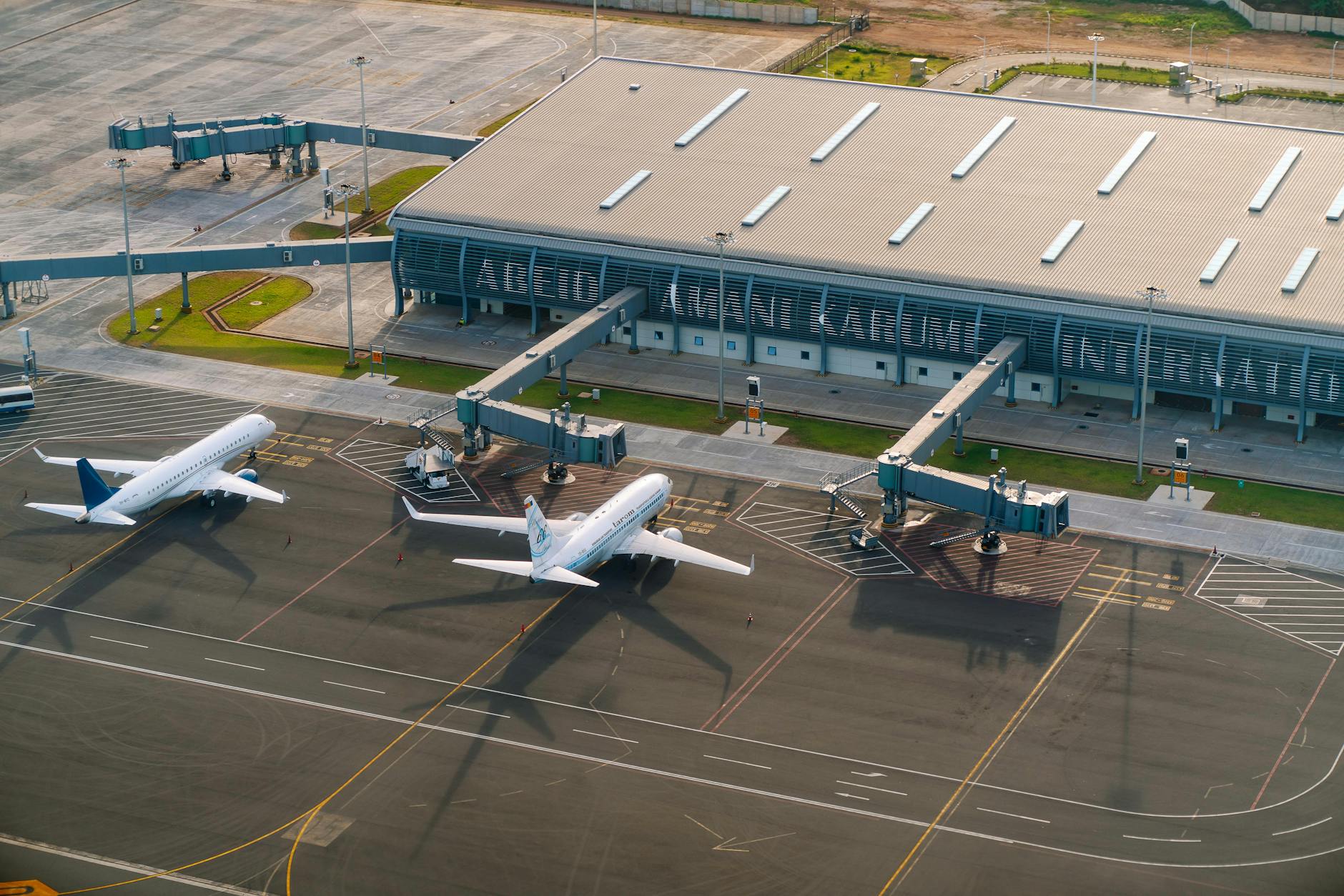
As of mid-2026, the expansion of Phuket International Airport (HKT) has moved firmly into the construction-contract phase. Airports of Thailand (AOT) has approved a total project budget of approximately 42.1 billion THB (roughly 1.2 billion USD at current rates), making this the single largest infrastructure investment on the island in the past decade. The project has a direct and measurable effect on property valuations within a 20-kilometre radius of the terminal.
Our analysts monitor construction progress on the ground and track AOT procurement documentation through Thailand's e-GP government procurement system. The sections below set out the current project status, phased timeline, price-impact zones, and the risks we consider most relevant for international buyers weighing a condominium or villa purchase on Phuket.
Quick answer
- Approved budget: approximately 42.1 billion THB, per AOT official documents; contracts signed through 2024-2025
- Capacity target: from roughly 12.5 million passengers per year today to 18-20 million after full completion
- Key components: new international Terminal 2, apron and taxiway upgrades, a new multi-storey car park, and landside road improvements
- Official completion window: AOT cites 2027-2029 across separate phases; Terminal 2 is scheduled no earlier than late 2028
- Current construction status (2026): foundation works and structural steelwork for Terminal 2 are active; apron modernisation is approximately 60-70 percent complete per market estimates
- Primary price-impact zones: Mai Khao, Nai Yang, Thalang, and the road corridor toward Bang Tao and Layan
Options and scenarios
Baseline scenario: on-schedule delivery by 2028-2029
In this scenario, AOT holds its timeline and Terminal 2 enters service in Q4 2028 or Q1 2029, lifting annual capacity to roughly 18 million passengers. Based on our estimates, districts closest to the airport - Mai Khao and Nai Yang, within 5-10 km of the terminal - have already recorded land-price appreciation of 15-25 percent between 2023 and 2026, partly reflecting forward pricing of the expansion. We project a further 8-12 percent uplift across 2026-2029 for this immediate zone, conditional on no significant global demand slowdown.
For districts further from the airport - Bang Tao, Layan, and Cherng Talay - the transmission mechanism is indirect. Faster passenger processing and higher tourist volumes translate into stronger short-term rental rates. In our data sets, villa occupancy in Bang Tao during the 2025-2026 high season held at 72-78 percent; a meaningful step-up in air traffic could add 3-5 percentage points to that figure over the medium term.
Delayed scenario: 12-18 month slip
The construction histories of Suvarnabhumi and Don Mueang airports demonstrate that delays of one to two years are the norm rather than the exception in Thai aviation infrastructure. If Terminal 2 is not commissioned until 2030, prices in the immediate airport zone may plateau or soften by 3-5 percent relative to 2026 levels. Buyers who purchased primarily as an infrastructure play would face an extended period of capital lock-up with limited catalysts for appreciation.
Accelerated scenario: new direct flight routes
During 2025, several airlines launched new direct routes into Phuket from European cities. If this trend continues and more convenient routing options emerge from additional origin markets, inbound demand could rise ahead of the infrastructure timeline. In our data sets, buyers from non-traditional source markets already represent a growing share of condominium transactions on Phuket, and any expansion of direct connectivity would reinforce that trend.
Comparison table
| Parameter | Mai Khao / Nai Yang | Bang Tao / Layan / Cherng Talay | Kamala / Surin | Rawai / Nai Harn |
|---|---|---|---|---|
| Distance from airport | 3-8 km | 12-18 km | 18-25 km | 35-45 km |
| Land price appreciation 2023-2026 (estimates) | 15-25% | 10-18% | 8-14% | 5-10% |
| Condominium price per sqm (2026, indicative) | 85,000-130,000 THB | 120,000-200,000 THB | 140,000-250,000 THB | 80,000-140,000 THB |
| Primary airport-expansion effect | Direct: accessibility gain, noise exposure, land value uplift | Indirect: higher tourist volumes, stronger rental occupancy | Indirect: prestige lift, seasonal demand increase | Minimal: distance dilutes effect |
| Aircraft noise risk | High | Low | Minimal | Minimal |
| Projected additional uplift 2026-2029 | 8-12% | 6-10% | 5-8% | 3-6% |
Risks and mistakes
Paying for the infrastructure promise, not the infrastructure itself. This is one of the most common errors we observe among foreign buyers in Asian growth markets. Developers routinely use airport expansion announcements as a sales argument, embedding a 10-20 percent premium into off-plan pricing before a single structural element is in place. We verify construction progress on the ground and cross-reference it against AOT's quarterly progress reports. Buyers should establish exactly which phase has signed contracts and which remains at the conceptual stage before accepting any infrastructure premium.
Schedule slippage risk. AOT has historically moved completion dates on major projects. The expansion of Suvarnabhumi's second terminal ran more than two years late. In our internal valuations we model a 12-18 month delay as the base-case timing buffer, and we recommend buyers apply the same discipline.
Aircraft noise in the Mai Khao and Nai Yang corridor. Higher throughput means more daily flight operations. Properties directly under or adjacent to the flight path may see noise levels increase, which can paradoxically dampen residential price growth even as the surrounding area benefits from accessibility. Hotel and serviced-apartment assets tend to be more resilient to this effect than owner-occupied residential stock.
Currency exposure. The THB has traded across a meaningful range in recent years. On a purchase of 5-10 million THB, a 5 percent currency move represents a material difference in home-currency terms. Currency risk is real, it compounds over a multi-year holding period, and it should be explicitly modelled in any investment case.
Not all AOT plan elements have executed contracts. We distinguish carefully between approved-budget line items, signed construction contracts, and conceptual masterplan elements. Monitoring the e-GP procurement system allows us to track which tenders have been awarded and which are still pending, a distinction that matters significantly for forward-pricing logic.
FAQ
When is the Phuket airport expansion expected to finish?
AOT's official timeline places Terminal 2 completion in 2028-2029, with apron and taxiway works concluding earlier. As of 2026, structural construction is active. Based on our estimates and AOT's historical delivery record, a realistic handover date for Terminal 2 is late 2029 to early 2030.
What is the total budget for the Phuket airport expansion?
The AOT-approved budget is approximately 42.1 billion THB, financed through AOT's own capital allocation and government-backed lending. This is entirely a public-sector investment.
How does the airport expansion affect Phuket property prices?
Districts in the immediate airport corridor - Mai Khao and Nai Yang - recorded land-price appreciation of 15-25 percent between 2023 and 2026, based on our estimates. Further districts such as Bang Tao, Layan, and Kamala absorb the effect indirectly through rising tourist volumes and stronger rental yields rather than direct proximity value.
Is buying property close to Phuket airport a sound investment?
The answer depends on the investment objective. Short-term rental strategies benefit from fast transfers between the terminal and the property. However, aircraft noise exposure is a genuine constraint on residential appeal. Based on our analysis, districts 12-20 km from the airport - particularly Bang Tao and Cherng Talay - offer a more balanced risk-return profile for most buyer types.
What other infrastructure projects are active in Phuket in 2026?
Our analysts track Route 402 road widening (the main north-south artery), the proposed Phuket Light Rail Transit project (currently at feasibility study stage), private hospital expansions in the Thalang area, and new international school developments in Cherng Talay. Each of these has a localised effect on property values within its catchment.
What is the current construction status at Phuket airport in 2026?
As verified on the ground in H1 2026: Terminal 2 foundation works and structural steelwork are progressing. Apron and taxiway modernisation is approximately 60-70 percent complete per market estimates. The multi-storey car park remains at detailed design stage.
How many passengers does Phuket airport currently handle?
HKT processed approximately 11.5-12 million passengers in 2024, per AOT data. Post-expansion capacity is targeted at 18-20 million passengers annually.
Are there direct flights to Phuket from Europe?
As of 2026, the most frequent routing options connect via Doha (Qatar Airways), Dubai (Emirates), Istanbul (Turkish Airlines), and Abu Dhabi (Etihad), with total journey times of roughly 12-16 hours. Charter services operate during the northern-hemisphere winter season. Additional direct routes from European cities were introduced in 2025 and the network continues to evolve.
Which Phuket district offers the best balance of airport upside and noise protection?
Based on our data sets, Bang Tao and Cherng Talay sit at a distance of 12-18 km from HKT - close enough to benefit from rising tourist volumes and improved connectivity, but outside the primary noise corridor. Condominium prices in Bang Tao range from approximately 120,000-200,000 THB per sqm as of 2026, with projected additional uplift of 6-10 percent through 2029 per our estimates.
Researching property in Phuket or Koh Samui? Get in touch - our analysts will prepare a data brief for your shortlisted location.