

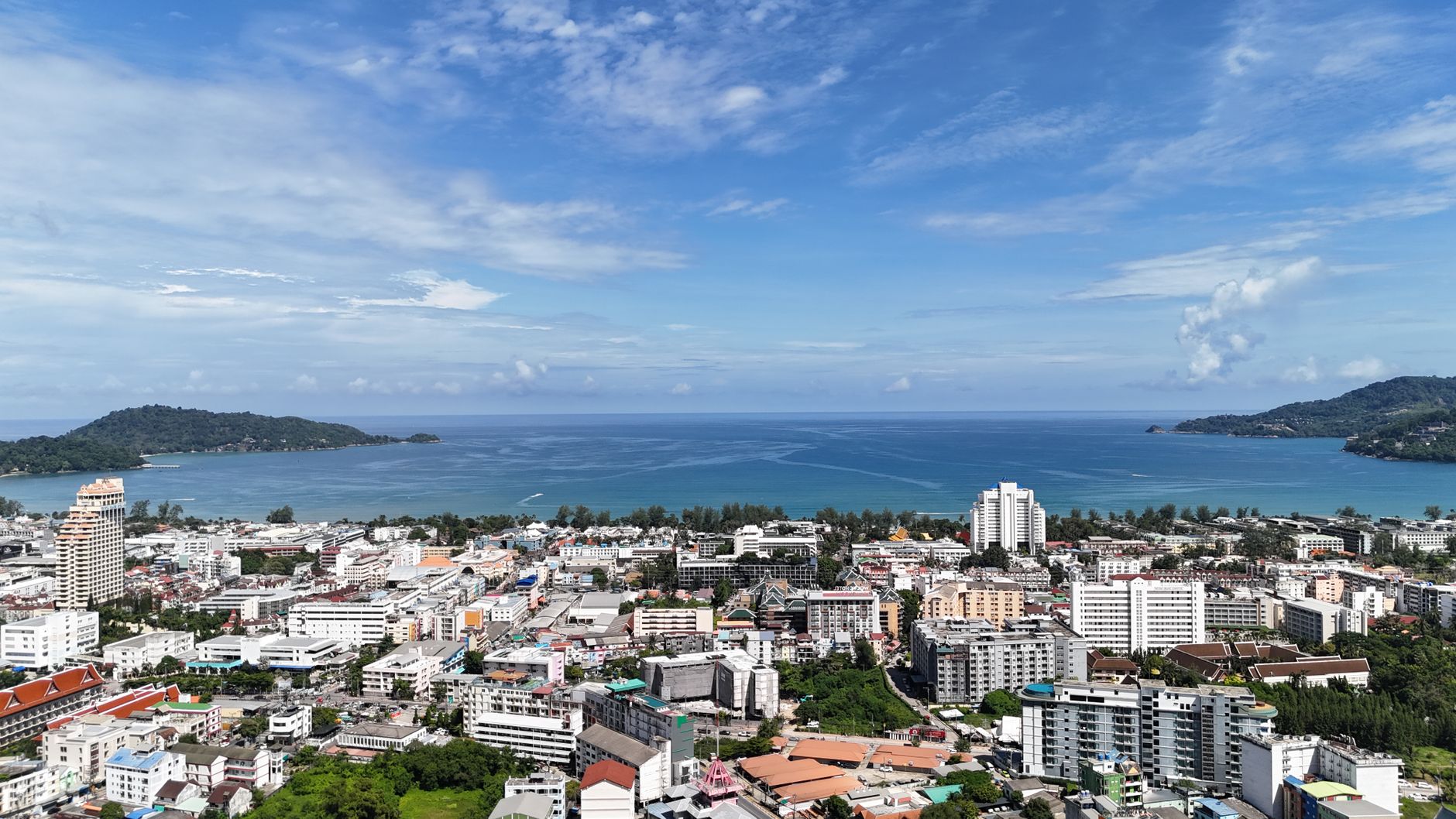
In Q1 2026, the average asking price for condominium units on Phuket's beachfront strip reached 5.2 million THB for a 35 m² unit, representing an increase of approximately 11% year on year. We track these figures on a quarterly basis, and the data reveals a clear divergence within the island: the west coast corridors of Bang Tao, Layan, and Surin are appreciating faster than the southern areas of Rawai and Nai Harn, where new supply is entering the market at a slower pace.
For internationally based buyers, currency exposure is a central variable. The THB/USD rate averaged around 0.028 USD per 1 THB at end-March 2026 - an entry price of roughly 145,000 USD for a typical beachfront studio. That figure is approximately 8% higher in USD terms than twelve months prior, reflecting both underlying THB price growth and modest baht appreciation against major currencies over the period.
Below we present the seven indicators our analysts monitor in quarterly tracking, with commentary on supply, demand, and short-term rental yield implications.
Quick answer
- Average price per m² (freehold condo, Phuket west coast) - 148,000 THB/m² in Q1 2026, up 11% year on year per our data sets.
- Development pipeline - approximately 4,200 condo units are under construction or in presale on the island as of March 2026, with over 1,600 concentrated in the Bang Tao - Layan corridor.
- Foreign buyer share - in 2025, foreign nationals accounted for an estimated 38% of condo transaction value on Phuket, based on Phuket Land Office registry data.
- Short-term rental occupancy (high season) - average occupancy in the premium segment (Kamala, Surin) reached 81% during December 2025 to February 2026, per market estimates.
- Phuket International Airport arrivals - HKT handled over 9.8 million international passengers in 2025, approaching pre-pandemic peak volumes.
- Gross rental yield - based on our estimates, 6.0-7.5% per year for 30-40 m² studios in the Phuket coastal zone, assuming professional operator management.
- Supply risk (Bang Tao / Layan) - the pipeline density in this corridor is the single variable we monitor most closely heading into H2 2026.
Options and scenarios
We model three scenarios for the Phuket residential market through end-2026. Each rests on distinct assumptions about tourism momentum, supply delivery, and currency movement.
Base scenario assumes arrival growth at HKT of 5-8% year on year, consistent with January-March 2026 airport data. The developer pipeline in Bang Tao and Layan delivers projects broadly on schedule. Nominal condo prices in THB rise 8-12% year on year. For USD-based buyers, gross rental returns in this scenario sit at 6.0-7.5%, with net yield after management fees and maintenance in the 4.0-5.5% range.
Optimistic scenario is anchored on two catalysts: extended visa-free access for additional Asian markets (liberalization for Indian and Saudi nationals remains under active policy discussion as of Q1 2026) and continued Chinese capital outflows into Thai property, historically amplified when the yuan weakens. In this case, prices could rise 15-18% year on year. We note, however, a risk of localized overheating in districts with the highest pipeline concentration.
Pessimistic scenario incorporates a demand shock - a 10-15% decline in arrivals against 2025 levels due to a global slowdown - coinciding with simultaneous delivery of a large block of pipeline units. In the Bang Tao - Layan corridor, the entry of more than 1,000 units within a single calendar year could compress asking rents by 10-15% and push high-season occupancy below 65%. Asking prices could correct 5-8% from current levels in that case.
Comparison table
| Parameter | Bang Tao / Layan | Kamala / Surin | Rawai / Nai Harn | Koh Samui (Bophut / Maenam) |
|---|---|---|---|---|
| Avg. price per m² (condo, Q1 2026) | 155,000 THB | 160,000 THB | 120,000 THB | 95,000 THB |
| Year-on-year price change | +12% | +14% | +7% | +6% |
| Units in pipeline | approx. 1,600 | approx. 800 | approx. 500 | approx. 350 |
| High-season occupancy | 78% | 81% | 72% | 68% |
| Gross yield (short-term rental) | 6.0-6.8% | 5.5-6.5% | 6.5-7.5% | 5.8-7.0% |
| Typical tenant profile | Europeans, Russians | Europeans, Australians | Digital nomads, retirees | Families, couples |
| Supply risk (our assessment) | High | Medium | Low | Low |
Kamala and Surin record the highest per-metre prices while facing the tightest land constraints - a combination that has historically limited sharp price corrections. Bang Tao and Layan carry elevated supply risk: simultaneous handover of multiple large projects could create short-term rent pressure. Koh Samui operates at a significantly smaller transaction volume than Phuket, which reduces secondary-market liquidity but also dampens price volatility.
Risks and mistakes
Supply concentration risk in Bang Tao and Layan. We are tracking over 1,600 units in active construction or presale in this corridor. If the majority reach completion within a narrow window - H2 2026 through H1 2027 - existing unit owners in the same area may face rental rate compression of 10-15% relative to current levels.
Mistake 1: Treating high-season occupancy as an annual figure. The 78-81% occupancy rates quoted for premium Phuket districts apply to December through February. In the shoulder and low seasons (May through October), occupancy in most locations falls to 40-55%. Our annualized yield calculations use a weighted average occupancy of 58-66% for well-managed properties - a more conservative and realistic basis for underwriting.
Mistake 2: Underweighting currency exposure. Buyers funding in a currency other than THB carry real exchange-rate risk. Baht volatility against major currencies over any 12-month window can run to 8-12%, which is sufficient to offset a year of gross rental income. We recommend building a currency buffer of at least 8-10% into acquisition cost projections.
Mistake 3: Purchasing off-plan without developer due diligence. Our on-the-ground monitoring has recorded individual project delays of 18-24 months on Phuket. We verify the developer's completed-project track record and confirm Environmental Impact Assessment (EIA) permit status before recommending any off-plan commitment.
Regulatory risk. Discussions in the Thai legislature regarding a foreign property tax have been ongoing since 2024. As of March 2026, no draft has been placed on the parliamentary agenda. We continue to monitor this closely and will update our data sets if the legislative status changes.
FAQ
What is the average property price in Phuket in 2026?
Based on our Q1 2026 data, the average asking price per square metre for freehold condominiums on Phuket's west coast ranges from 148,000 to 160,000 THB/m². At current exchange rates, that corresponds to approximately 4,100-4,500 USD/m².
What gross rental yield can I expect from a short-term rental on Phuket?
Based on our estimates, gross short-term rental yield for 30-40 m² studios in the Phuket coastal zone runs at 6.0-7.5% per year. Net yield, after operator management fees (typically 20-30% of revenue), maintenance, and local tax, generally falls in the 4.0-5.5% range.
Is Koh Samui cheaper than Phuket for property investment?
Yes, considerably. Our Q1 2026 data puts average condo prices in Bophut and Maenam on Koh Samui at approximately 95,000 THB/m² - roughly 35-40% below comparable west-coast Phuket levels. The trade-off is lower secondary-market liquidity and a smaller overall transaction pool.
How do tourist arrival numbers affect the Phuket property market?
We monitor a consistent lag of one to two quarters between arrival volumes at HKT and occupancy movements in the rental market. Historically, a 10% increase in annual international arrivals has corresponded to a 4-6 percentage point improvement in rental occupancy in the following high season. We treat airport statistics as a leading indicator for rental market performance.
Can foreign nationals buy property on a freehold basis in Phuket?
Foreign nationals can acquire freehold title to condominium units provided foreign ownership within a given building does not exceed 49% of total registered floor area. Land, houses, and villas cannot be held freehold by foreigners. Common structures for villa acquisition include long-term leasehold (typically 30 years, renewable) or a Thai company arrangement. We verify the foreign quota status of any specific building as part of our on-the-ground checks.
What taxes apply to foreign property owners in Thailand?
The Land and Building Tax applies at 0.02-0.1% of assessed value per year for residential properties not used as a primary residence. On disposal, either Specific Business Tax (3.3% of sale price) or Stamp Duty (0.5%) applies, alongside a withholding income tax deducted by the Land Office at transfer. The applicable rate depends on holding period and ownership structure.
How many new condo units are entering the Phuket market in 2026?
As of March 2026, our data sets show approximately 4,200 condo units either under construction or in presale across Phuket island. The Bang Tao - Layan corridor accounts for over 1,600 of those units, representing the highest pipeline density on the island.
What is the supply risk outlook for Kamala and Surin?
We rate the supply risk for Kamala and Surin as medium, lower than Bang Tao and Layan. Land availability in both districts is constrained by topography and existing development, which limits the scale of new projects. This structural scarcity has historically provided a degree of price floor support in downside scenarios.
How does the development pipeline affect rental yields in Bang Tao?
With over 1,600 units in the pipeline for the Bang Tao - Layan corridor, simultaneous project completions in H2 2026 through H1 2027 could temporarily increase rental supply faster than demand. In our pessimistic scenario, this could compress asking rents by 10-15%, pulling gross yields in that corridor toward the lower end of the 6.0-6.8% range or below in the short term.
Researching property in Phuket or Koh Samui? Get in touch - our analysts will prepare a data brief for your shortlisted location.