

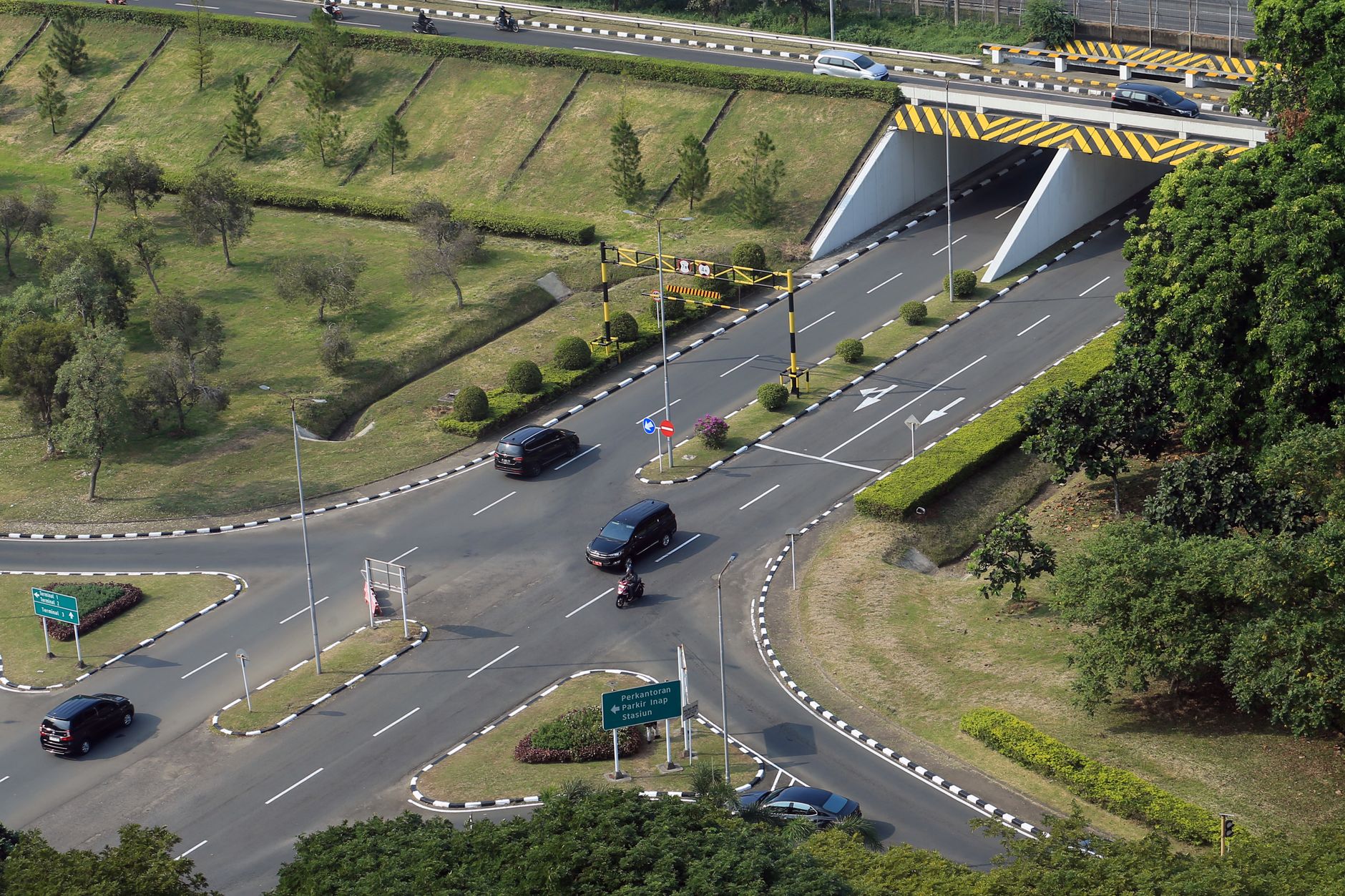
Phuket's new ring road programme is among the largest road infrastructure projects in the island's history. According to data from Thailand's Department of Highways, the combined budget of approved sections exceeds 13.6 billion THB as of Q1 2026 - equivalent to roughly 390 million USD at prevailing exchange rates. Our analysts monitor construction progress on the ground and assess how each project phase translates into land and property prices across affected districts.
The programme is not a single road but several distinct sections at different stages of readiness. The most consequential element is the Kathu-Patong Expressway (including a tunnel) and a planned corridor linking the western and eastern coastlines while bypassing Phuket Town entirely. If delivered on schedule, travel time from the airport to western-coast districts such as Bang Tao, Kamala, and Patong could fall from a current peak-hour range of 60-90 minutes to an estimated 25-35 minutes. That reduction is a direct input into investment-location attractiveness, and we factor it into our district-level pricing models.
Quick answer
- Combined approved budget for Phuket road sections: 13.6 billion THB (based on Department of Highways figures, Q1 2026)
- Kathu-Patong Expressway (approx. 4 km including tunnel): detailed design and tendering phase as of 2026; earliest realistic opening 2029-2030
- Northern bypass (airport area to Kathu): feasibility study and land acquisition stage as of 2026; estimated opening 2031 or later
- Land prices within 2-3 km of planned interchanges rose 15-25% between 2023 and 2025, based on our estimates drawn from Phuket Land Department transaction data
- Districts with the strongest current price response: Kathu, Kamala, and northern Patong
- Delay risk is material: past Phuket road projects have averaged 2-4 years of overrun relative to original schedules
Options and scenarios
Baseline scenario - delivery broadly on schedule
In this scenario, the Kathu-Patong section opens around 2029-2030. The northern bypass receives Environmental Impact Assessment (EIA) approval by end-2027 and enters full construction. Property prices in the influence zone appreciate gradually. Our analysts estimate a 5-8% per year premium above the island-wide average for Kathu and Kamala in this outcome.
For a buyer acquiring a condominium or villa in the 5-12 million THB range, this implies a potential price premium of 20-35% by the time the key section opens - provided the specific property sits within the actual travel-time catchment, not merely within the same province.
Delay scenario - 2 to 4 years of overrun
Historical precedent makes this the most probable outcome. The Chalong Underpass, opened in 2022, ran more than two years late. The Patong-Kathu tunnel concept has been in circulation since 2014 and has not yet reached full construction phase. In a delay scenario, prices in the influence zone may stagnate or grow below the island average for an extended period as the market begins to price in disappointment. Our models apply a minimum 2-year delay buffer to any infrastructure-led valuation adjustment.
Accelerated delivery scenario
Thailand's 'Andaman Economic Corridor' initiative could unlock additional central-budget funding and compress timelines. We assess this outcome at roughly 15-20% probability. If realised, the price effect would be sharper and faster - potentially 10-15% per year in districts directly adjacent to new interchanges.
Comparison table
| Parameter | Kathu-Patong Expressway | Northern Bypass (Airport to Kathu) | Route 402 Widening (Thepkrasattri Road) |
|---|---|---|---|
| Section length | Approx. 4 km (incl. tunnel) | Approx. 18-22 km (per market estimates) | Approx. 27 km (existing road, being widened) |
| Budget | Approx. 9.6 billion THB | Approx. 4 billion THB (estimate) | Approx. 2.8 billion THB (phases to date) |
| Stage as of 2026 | Detailed design and tendering | Feasibility study | Widening ongoing, partially complete |
| Planned opening | 2029-2030 | 2031 or later | Phased completion to 2028 |
| Districts in influence zone | Kathu, Kamala, Patong | Thalang, Cherng Talay, Bang Tao | Thalang, Mai Khao, Pa Khlok |
| Estimated land price rise 2023-2025 | 20-25% | 15-20% | 10-15% |
| Delay risk | Medium-high | High | Low (construction active) |
Risks and mistakes
Buying the announcement rather than the asphalt. This is the most common error we observe in the Thai property market. Land prices near the planned Patong tunnel corridor were already rising in 2016-2017 on the back of early-stage government announcements. Buyers who acquired plots at that point have now been waiting close to a decade for groundbreaking. We verify physical construction progress on-site before incorporating any infrastructure premium into a valuation.
Expropriation and route-change risk. Land acquisition for public roads in Thailand is governed by the Land Expropriation Act. Properties sitting directly on a planned alignment can be subject to compulsory purchase, often at officially assessed values that run 20-40% below prevailing market prices. Before any parcel acquisition in an infrastructure corridor, we cross-reference planning registers held by local administrations (OrBorTor and Tessaban offices).
Overstating the price-impact multiplier. Not every road generates an equivalent price response. We draw on documented precedent: the opening of the Chalong Underpass in 2022 was followed by condominium price increases of approximately 8-12% within a 1 km radius over 18 months, based on our estimates from transaction-level data. An expressway tunnel will carry a stronger effect, but direct comparisons with Bangkok metro lines (BTS, MRT) are misleading given the different demand depth and urban density.
Capital lock-up cost versus investment horizon. An infrastructure-linked property play involves holding capital for years before the catalyst materialises. With risk-free rates in major currencies running at meaningful levels in 2026, every year of project delay carries a real opportunity cost that must be modelled explicitly. We factor this into our hold-period return calculations.
THB currency exposure. Between 2020 and 2025, the THB fluctuated within a range that produced roughly a 10-12% swing in USD or EUR terms at the extremes. A currency move of that magnitude can absorb an entire infrastructure premium. We monitor exchange-rate exposure and recommend it be incorporated in any multi-year return projection.
FAQ
When will the Phuket ring road be completed?
There is no single ring road - the programme consists of several separate projects. The most significant section, the Kathu-Patong Expressway including its tunnel, has a target opening of around 2029-2030 as of 2026. The northern bypass is at an earlier stage and a realistic delivery date is 2031 or later. Route 402 widening is proceeding in phases and is partially already complete.
What is the total construction budget for the Phuket road programme?
The combined budget of approved and planned sections exceeds 13.6 billion THB, equivalent to approximately 390 million USD at Q1 2026 exchange rates. Funding flows from Thailand's central budget through the Department of Highways.
Which Phuket districts stand to benefit most from the new roads?
Based on our analysis, the strongest price response is projected in Kathu, Kamala, and northern Patong - the primary influence zone of the Kathu-Patong tunnel section. Cherng Talay and Bang Tao are positioned to benefit from the northern bypass. Districts with already strong connectivity, such as Rawai and Nai Harn in the south, are likely to see a smaller incremental effect.
Is it advisable to buy property near a planned Phuket interchange now?
Proximity to a road interchange has historically added value, but the entry timing is critical. We recommend committing capital only after EIA approval and the commencement of physical earthworks - not at the concept or feasibility stage. Our valuations apply a minimum 2-year delay buffer to any infrastructure-driven price premium.
How will the northern bypass affect travel times from the airport to Bang Tao?
Currently, the airport-to-Bang Tao journey takes 40-60 minutes in peak traffic. After the northern bypass and Route 402 upgrades are complete, that figure should drop to approximately 20-30 minutes. A 50% reduction in travel time is a variable that, in our models, corresponds to an additional 10-15% property price uplift in Bang Tao above the base trend.
Does Koh Samui have comparable road infrastructure projects?
Koh Samui has no equivalent bypass programme. The main ring road (Routes 4169/4170) is maintained and periodically resurfaced, but no new alignments are planned. The key infrastructure developments on Samui centre on airport capacity (under Bangkok Airways concession) and a proposed marina at Nathon. Because of the island's compact geography, infrastructure projects on Samui tend to have a more muted effect on property prices than equivalent projects on Phuket.
What is the expropriation risk when buying land along a planned road corridor?
Land directly on a planned alignment can be acquired compulsorily under the Land Expropriation Act. Compensation is set at official appraised values, which in our experience tend to be 20-40% below open-market prices. We verify on the ground whether a given parcel falls within a designated acquisition corridor before any purchase recommendation is made.
How can investors track the current construction status of the Phuket road projects?
We monitor tender announcements published by the Department of Highways (doh.go.th) and communications from the Phuket Provincial Office. We also conduct regular site visits to verify physical progress. Investors can contact our team for a current ground-level data brief on any specific corridor or district.
Researching property in Phuket or Koh Samui? Get in touch - our analysts will prepare a data brief for your shortlisted location.