

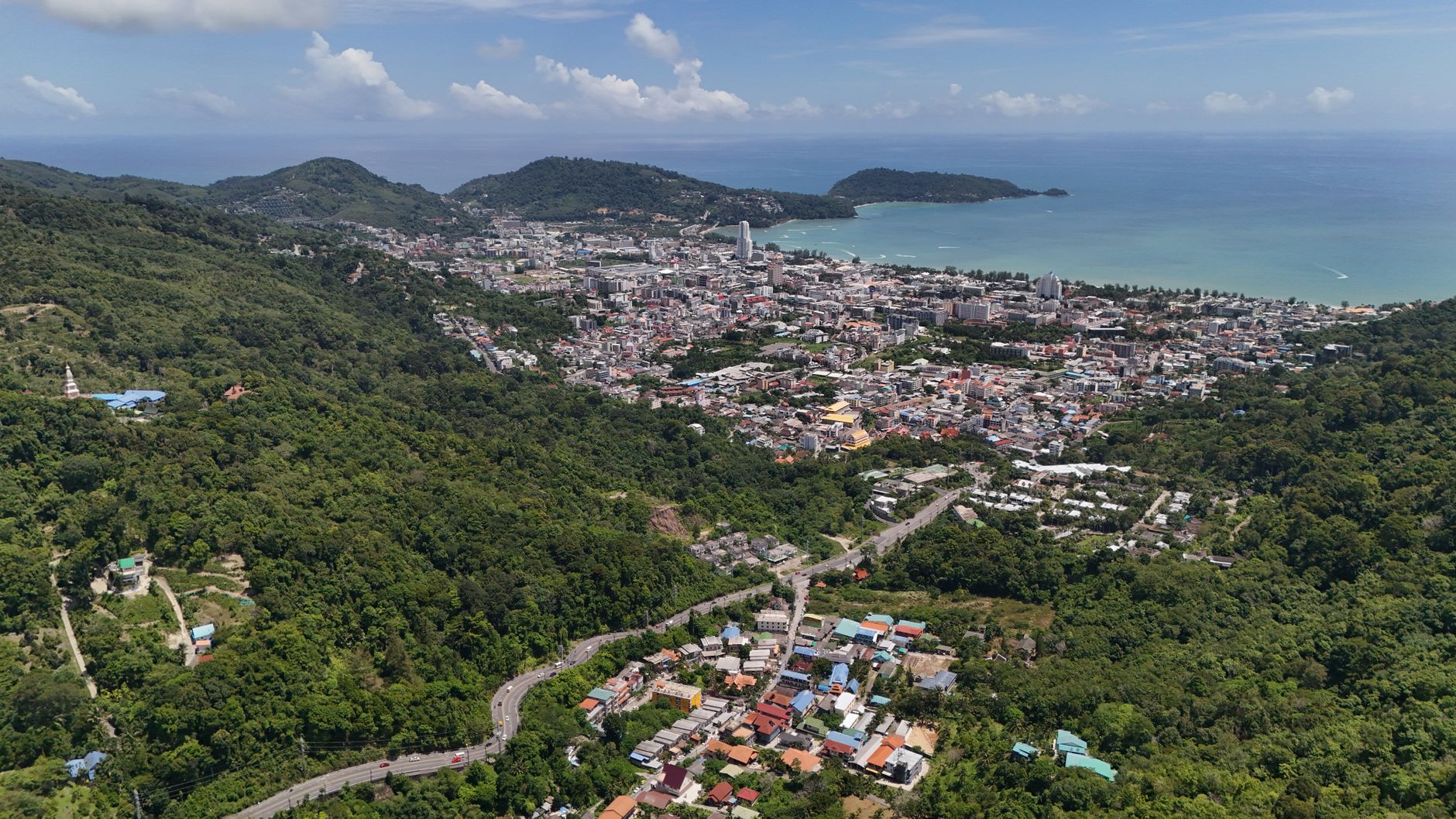
Based on our compiled listings data, the median asking price gap between Rawai and Nai Harn stands at roughly 18-22% in favour of Rawai as of early 2026. In concrete terms: condominium median price per square metre in Rawai sits at approximately 85,000-105,000 THB/m², while the same metric for Nai Harn lands in the 105,000-130,000 THB/m² range (Q1 2026 data). Both districts occupy the southern tip of Phuket, separated by just 4-5 kilometres, yet their micro-markets diverge noticeably in demand profile, seasonality, and capital appreciation trajectory.
We have monitored these two micro-markets for several years and observe a clear and sustained divergence. Rawai draws long-term residents and digital nomads seeking lower cost of living and year-round rental stability. Nai Harn, by contrast, is consolidating its position as a compact premium enclave, characterised by constrained supply and higher average nightly rental rates. The core analytical question for any investor is straightforward: which micro-market delivers a better ratio of acquisition cost to rental income generated.
Quick answer
- Rawai condominium median asking price: approximately 85,000-105,000 THB/m² (Q1 2026)
- Nai Harn condominium median asking price: approximately 105,000-130,000 THB/m² (Q1 2026)
- Annual price growth 2024-2025: we estimate 6-8% for Rawai and 8-11% for Nai Harn
- High-season occupancy (November-April) in Nai Harn reaches 78-85%; in Rawai 65-72%, based on our 2024/2025 season estimates
- New supply in Nai Harn is structurally limited: we identify 3-4 projects under construction (under 200 units combined); Rawai has 8-12 projects (over 500 units)
- Gross short-term rental yield: we estimate 5.5-7% for Nai Harn and 5-6.5% for Rawai (indicative 2025 figures)
Options and scenarios
Scenario 1: Capital appreciation as the primary objective
Nai Harn benefits from a naturally constrained supply environment. Topography - hills, national park boundaries, and limited flat buildable land - means new developments emerge far less frequently than in Rawai. Based on our Q4 2025 site observations, fewer than 15-20 hectares of land zoned for multi-unit residential remain available in Nai Harn. This structural supply ceiling supports sustained price growth.
For an investor with a 5-7 year horizon focused primarily on asset appreciation, Nai Harn represents a more defensive choice. The price growth trajectory over the past two years - estimated at 8-11% per year - outpaces the broader southern Phuket average.
Scenario 2: Rental income and cash flow as the primary objective
Rawai offers a lower entry threshold and a broader pool of potential long-term tenants. We verify on the ground that demand for monthly rentals (contracts of 3-12 months) in Rawai remains stable throughout the year, not only within the tourist season. The dominant tenant profile consists of digital nomads, retirees from Western Europe and Scandinavia, and families on extended stays.
Monthly rent for a 30-35 m² studio in Rawai runs approximately 18,000-28,000 THB, while a comparable unit in Nai Harn commands 25,000-38,000 THB. Given Rawai's lower acquisition cost, the long-term rental yield can be comparable to - or in some cases marginally above - what Nai Harn delivers despite the latter's higher nightly rates.
Scenario 3: Personal use with rental income offset
An investor planning to spend 2-4 months per year on Phuket and rent out the property for the remainder should give serious consideration to Nai Harn. Higher nightly rates in season - averaging 3,500-5,500 THB per night for a one-bedroom apartment, per our estimates - allow the rental income to compensate effectively for the personal-use period. In Rawai, a comparable standard generates roughly 2,200-3,800 THB per night, which translates to approximately 30-40% lower short-term rental revenue.
Comparison table
| Parameter | Rawai | Nai Harn | Notes |
|---|---|---|---|
| Median price (THB/m²) | 85,000-105,000 | 105,000-130,000 | Condominiums, Q1 2026 |
| Annual price growth | 6-8% | 8-11% | Estimates 2024-2025 |
| High-season occupancy | 65-72% | 78-85% | Season 2024/2025 |
| Low-season occupancy | 40-50% | 45-55% | Based on our estimates |
| Nightly rate (1-bed) | 2,200-3,800 THB | 3,500-5,500 THB | Short-term rental |
| Monthly rent (studio) | 18,000-28,000 THB | 25,000-38,000 THB | Contracts 3-12 months |
| Gross yield (short-term) | 5-6.5% | 5.5-7% | Indicative 2025 data |
| Active construction projects | 8-12 | 3-4 | As of Q1 2026 |
| Units in pipeline | Over 500 | Under 200 | Based on our estimates |
| Distance to beach | 1-3 km (pier/waterfront) | 0.5-1.5 km (Nai Harn beach) | Varies by project location |
| Primary tenant profile | Digital nomad, long-stay resident | Premium tourist, family | Observations from 2024/2025 season |
Risks and mistakes
Oversupply risk in Rawai. We currently identify 8-12 projects under construction with a combined pipeline of over 500 units. If developers launch additional phases in 2026-2027, the sub-market could enter a saturation cycle. In our data sets, the pace of new building permit applications in Rawai accelerated by approximately 15% year-on-year in 2025.
Limited liquidity risk in Nai Harn. The higher entry cost - typically above 4-5 million THB for a standard one-bedroom apartment - narrows the pool of secondary-market buyers. We estimate average time from listing to transaction close at 6-10 months in Nai Harn, compared to 4-7 months in Rawai.
Common mistake: comparing gross yields without deducting operating costs. Many investors overlook property management fees (typically 20-30% of short-term rental revenue), common area charges (which in Nai Harn run 15-25% higher than in Rawai), and applicable taxes. Net yield after costs drops to approximately 3.5-5% in both locations.
Common mistake: assuming continuous appreciation. Phuket's market experienced a correction in 2020-2021, with transaction prices falling 8-15% depending on the district. A repeat scenario in the context of a global slowdown cannot be ruled out. Geographic diversification - across Phuket districts or between Phuket and Koh Samui (for example Bophut or Maenam) - reduces concentration risk in a single micro-market.
Legal structure risk with leasehold titles. Both districts offer foreign buyers primarily a leasehold structure (30+30+30-year land lease) or freehold ownership within a condominium, subject to the 49% foreign quota on each building's total area. We strongly recommend verifying that the foreign quota in any target project has not been exhausted before proceeding.
FAQ
Is Rawai significantly cheaper per square metre than Nai Harn?
Yes. Based on our Q1 2026 data, the median condominium asking price in Rawai is approximately 18-22% lower than in Nai Harn. Entry-level pricing in Rawai starts around 85,000 THB/m², while Nai Harn begins at roughly 105,000 THB/m².
Which district records higher occupancy during the tourist season?
Nai Harn. We estimate high-season occupancy (November-April) at 78-85%, versus 65-72% in Rawai. The gap reflects proximity to one of Phuket's most highly rated beaches and Nai Harn's structurally tighter rental unit supply.
What is the indicative gross rental yield for short-term rentals in both districts?
We estimate gross yield at 5.5-7% per year for Nai Harn and 5-6.5% for Rawai. After deducting management fees, common charges, and taxes, net yield falls to the 3.5-5% range in both locations.
How many development projects are currently under construction in Rawai and Nai Harn as of 2026?
We identify 8-12 active projects in Rawai representing over 500 planned units, and 3-4 projects in Nai Harn representing under 200 units. The supply constraint in Nai Harn is structural, driven by topography and the scarcity of large developable parcels.
Can a foreign buyer acquire freehold title in Rawai or Nai Harn?
Foreign nationals can hold freehold title within a registered condominium only, provided the building's foreign ownership quota (capped at 49% of total floor area) has not been exhausted. In practice, quota availability in popular projects in both districts requires case-by-case verification. The standard alternative is a long-term leasehold (30 years, with contractual renewal options).
What is the typical tenant profile in Rawai?
Rawai attracts primarily digital nomads, retirees from Western Europe and Scandinavia, and families on stays of one to six months. Long-term rental demand in the district remains relatively consistent across all twelve months, reducing the income volatility that characterises more tourism-dependent areas.
How does seasonality affect rental revenue in Nai Harn?
Nai Harn is strongly seasonal. Nightly rates during the high season (3,500-5,500 THB for a one-bedroom unit) can fall by 40-50% during the low season. A realistic annual revenue model should assume full-rate income for approximately 5-6 months and reduced-rate income for the remainder.
Is Koh Samui worth considering as an alternative to southern Phuket?
Koh Samui - particularly Bophut and Maenam - offers entry prices broadly comparable to Rawai with lower current supply saturation. We monitor that market in parallel. The principal drawbacks are more limited international air connectivity and a less liquid secondary resale market relative to Phuket.
How long does it typically take to sell a property on the secondary market in these districts?
We estimate average time from listing to closing at 4-7 months in Rawai and 6-10 months in Nai Harn, based on indicative 2025 transaction data. The longer timeline in Nai Harn reflects its higher price point and the correspondingly smaller buyer pool.
To summarise the analysis: Rawai suits an investor seeking a lower entry cost and stable cash flow from long-term rentals. Nai Harn is the stronger candidate for capital appreciation combined with higher nightly rates during the tourist season. In both cases, we recommend thorough due diligence on legal title status, foreign quota availability within the specific project, and a realistic revenue model that accounts for seasonality and full operating costs.
Researching property in Phuket or Koh Samui? Get in touch - our analysts will prepare a data brief for your shortlisted location.