

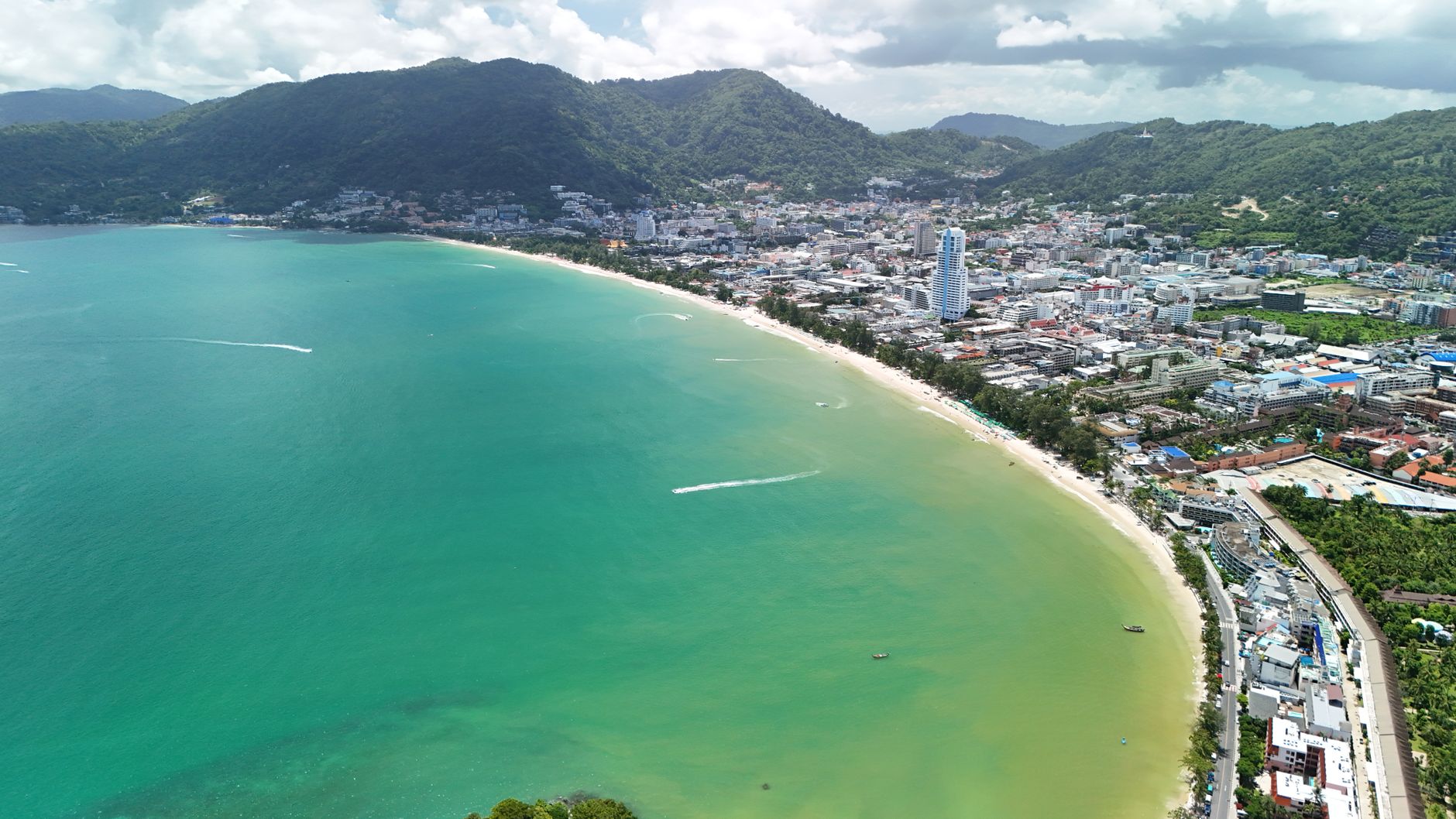
The average asking price for premium condominium units on Surin Beach sits at 185,000 - 210,000 THB per sq m as of Q1 2026, placing this micro-market among the most expensive in Phuket. Based on our tracking data, Surin commands a 25-30% premium over neighbouring Bang Tao and runs 80-90% above Rawai in the south of the island.
We have monitored this corridor for several years. After a sharp run-up in 2022-2024, when annual price growth reached 12-18%, the pace of appreciation has moderated to an estimated 5-7% year-on-year at the 2025/2026 turn. Surin is maturing as a location: the investment case is now less about capital growth and more about the quality and consistency of short-term rental income.
For buyers operating in currencies other than the Thai baht, the exchange rate is a live variable. In 2026 we observe the USD/THB rate hovering in a range that makes a 15 million THB asset equivalent to roughly 370,000 - 420,000 USD before transaction costs, depending on timing. That figure is a useful anchor when comparing Surin against comparable premium beach markets in the region.
Quick answer
- Average asking price on Surin Beach, premium condominium segment: 185,000 - 210,000 THB per sq m (Q1 2026, our data sets)
- Price growth year-on-year: estimated 5-7%, a clear deceleration from 2023-2024 levels
- Dominant renter profile: premium leisure travellers from Europe, the Middle East and Australia; average stay 7-14 nights; nightly budget 5,000-15,000 THB
- New supply pipeline: per our estimates, 4-5 projects in active construction or advanced pre-sale, totalling approximately 280-350 units, with planned delivery in 2026-2028
- Short-term rental occupancy: 72-80% in high season (November-April), 35-45% in low season, based on 2024/2025 season data
- Estimated gross rental yield: 5.5-7.0% per annum under professional management
Options and scenarios
Option A: Resale unit in an existing project
This is the fastest route to income generation. Several completed projects from 2019-2025 have resale inventory on the market at any given time. Resale pricing tends to run 5-10% below comparable new-build asking prices, because sellers typically absorb their own fit-out costs rather than adding them to the headline figure. Based on our observations, the period from signed agreement to first rental booking runs 6-10 weeks in this scenario, covering title transfer and onboarding with a property management operator.
Option B: Off-plan purchase in a new project
Off-plan sales on Surin currently offer payment schedules spread over 18-30 months. The discount relative to post-completion pricing is indicatively 10-20%, but this comes with delivery risk. Our on-the-ground verification in 2026 records average delays of 4-8 months against developer timelines. Investors in this scenario generate no rental income until handover, which should be factored into any yield calculation.
Option C: Villa with leasehold land title (30+30+30 years)
Surin carries a limited pool of villa inventory in the 25-65 million THB range. Villas command higher nightly rates (15,000-40,000 THB in season) but require proportionally higher maintenance expenditure. We estimate villa occupancy at 60-70% in high season and 25-35% in low season - somewhat below the condominium average. Gross yield consequently falls to 4.0-5.5%, though historical capital appreciation for well-located Surin villas has tended to outpace the condominium segment.
Comparison table
| Parameter | Surin Beach | Bang Tao | Kamala | Rawai |
|---|---|---|---|---|
| Price per sq m (THB, 2026 estimate) | 185,000 - 210,000 | 140,000 - 170,000 | 130,000 - 160,000 | 95,000 - 120,000 |
| Year-on-year price growth | 5-7% | 6-9% | 7-10% | 8-12% |
| High-season occupancy | 72-80% | 70-78% | 68-76% | 55-65% |
| Low-season occupancy | 35-45% | 38-48% | 32-42% | 40-50% |
| Gross yield (short-term rental) | 5.5-7.0% | 5.5-7.5% | 5.0-6.5% | 6.0-8.0% |
| Dominant renter profile | Premium leisure, couples | Families, digital nomads | Premium leisure, retirees | Long-stay residents, nomads |
| New projects under construction (estimate) | 4-5 | 10-15 | 6-8 | 8-12 |
| Distance to airport (minutes) | 25-30 | 20-25 | 30-35 | 50-60 |
All figures are indicative, based on our Q1 2026 market monitoring and offer-level data sets.
Risks and mistakes
Constrained land supply and shifting product profiles. Surin occupies a narrow strip between the main road and the shoreline. New developments are progressively being built further from the beach, which changes the product: buyers are increasingly acquiring 'hillside with partial sea view' rather than true beachfront. Our on-the-ground verification shows that walking distance to the beach in newer projects can reach 1.2-1.8 km, which has a measurable effect on achievable nightly rates.
Short-term rental regulation. Thai law (the Hotel Act) formally requires a hotel licence for rentals shorter than 30 consecutive days. In practice, a significant portion of the condominium market operates without full compliance. We monitor regulatory signals closely, and in 2026 we observe increased enforcement activity across Phuket. Buyers should prioritise projects with a clearly documented rental licence or a structured rental pool arrangement managed by a licensed operator.
Currency risk. The Thai baht can move materially against major currencies - historically in a range of 8-12% per annum. For buyers whose home currency is the euro, British pound, or any other non-USD currency, this means that even a 6% net yield in baht terms can translate to a materially lower, or in some scenarios negative, return when measured in the home currency after a year of unfavourable exchange rate movement.
Developer yield projections versus realised income. Marketing materials for new projects on Surin frequently cite gross yields of 8-10%. Our data sets consistently indicate that after deducting property management fees (typically 20-30% of gross rental revenue), common area fees and applicable taxes, net yield on Surin falls to 3.5-5.0%. The gap between headline projections and realised income is significant and should be explicitly modelled before any purchase commitment.
Foreign ownership quota. Under Thai condominium law, foreign nationals may hold freehold title only within the 49% foreign quota of a given project. If that quota is exhausted, the available structures are leasehold or a Thai company vehicle - each carrying distinct legal and tax implications that require independent legal review.
FAQ
How much does a condominium on Surin Beach cost in 2026?
The average asking price in the premium segment is 185,000 - 210,000 THB per sq m. For a typical unit of 45-65 sq m, that translates to a range of approximately 8.3-13.7 million THB before transaction costs.
Is Surin Beach more expensive than Bang Tao?
Yes. Based on our Q1 2026 data, Surin commands a 25-30% premium per sq m over Bang Tao. The difference reflects tighter land supply, the established prestige of the location and the beach proximity of earlier-generation projects.
What rental yield can an investor realistically expect on Surin?
We estimate gross yield at 5.5-7.0% per annum under professional short-term rental management. After deducting operating costs - management fees, common area charges and taxes - net yield falls to approximately 3.5-5.0%.
Who rents property on Surin Beach?
The dominant renter profile is premium leisure: couples and small groups from Western Europe, the Gulf states and Australia. Average length of stay is 7-14 nights, with nightly budgets of 5,000-15,000 THB.
How many new projects are coming to Surin in 2026?
Per our estimates, 4-5 projects are currently in active construction or advanced pre-sale, with a combined pipeline of 280-350 units. Planned delivery dates range across 2026-2028.
Can a foreign national buy property on Surin freehold?
Foreign buyers can hold freehold title to a condominium unit, provided the project's 49% foreign ownership quota has not been exhausted. Villas are accessible via leasehold structures (typically 30+30+30 years) or through a Thai company, each of which carries separate legal and tax considerations.
How does seasonality affect short-term rental occupancy on Surin?
High season (November through April) delivers occupancy of 72-80%. Low season occupancy drops to 35-45%. The annualised average is indicatively 50-60%, depending on property standard and management effectiveness.
What are the typical transaction costs when buying on Surin?
Total costs for title transfer, legal fees and applicable government charges run to approximately 5-7% of the purchase price. The allocation of these costs between buyer and seller is a standard point of negotiation.
How does Surin compare with Rawai as an investment location?
The two micro-markets serve different strategies. Surin offers higher nightly rates and an established premium profile, but net yield (3.5-5.0%) is lower than what we estimate for Rawai (4.5-6.0%). Rawai is seeing stronger year-on-year price growth (8-12%) and carries a lower entry price point. The optimal choice depends on whether the primary objective is current income or capital growth.
What is the risk of off-plan delays on Surin?
Our on-the-ground monitoring in 2026 records average delivery delays of 4-8 months against developer-stated timelines across active Phuket projects. Buyers should model this delay into cash flow projections and review the developer's track record on previous completions before committing.
Researching property in Phuket or Koh Samui? Get in touch - our analysts will prepare a data brief for your shortlisted location.