

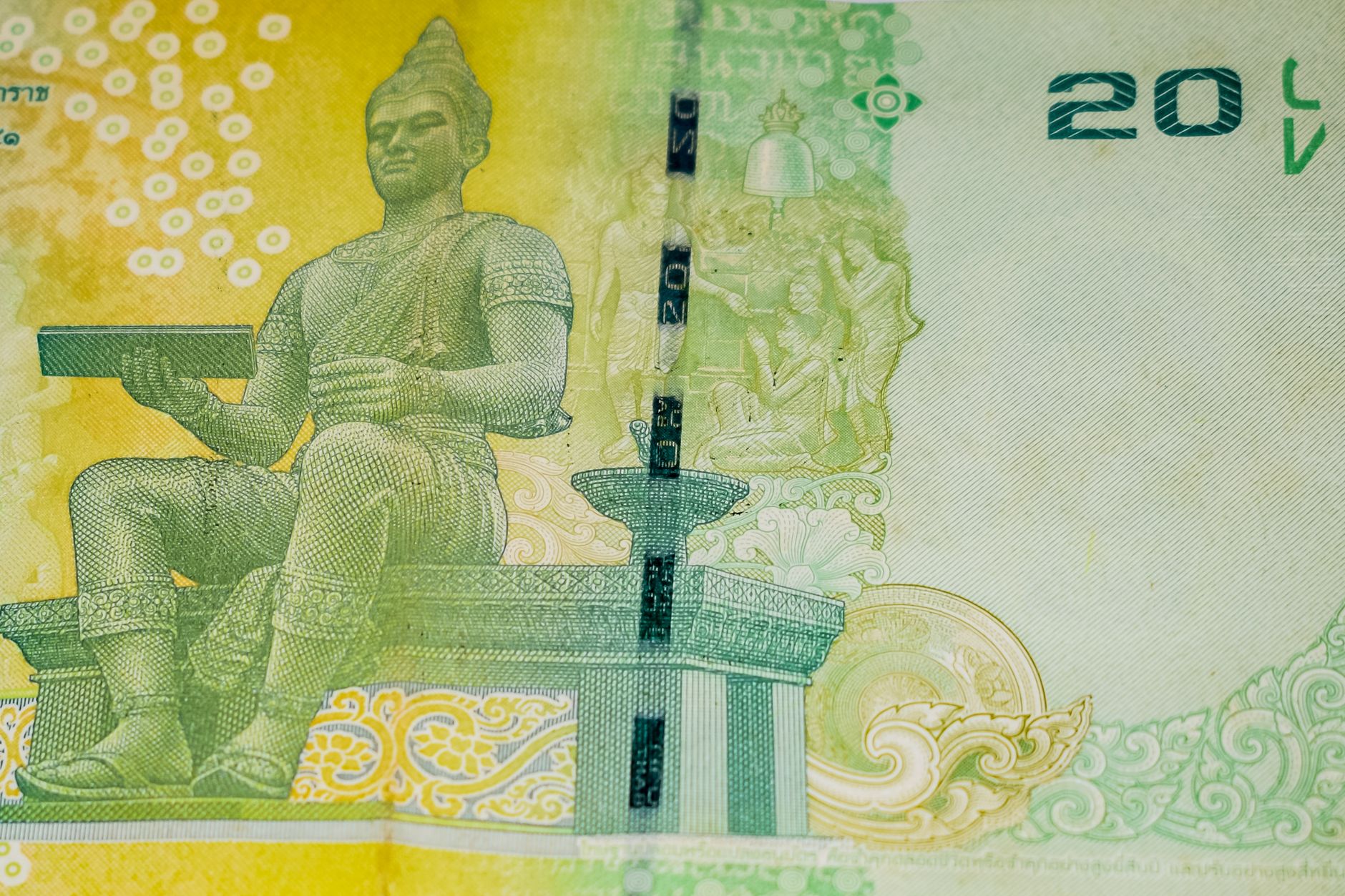
At the start of 2026, the Thai baht sits at approximately 0.0283-0.0295 USD per THB in global markets, while against the Polish zloty the rate holds near 0.113-0.118 PLN per THB. For international buyers funding purchases in other currencies, the core principle is identical: residential property on Phuket and Koh Samui is priced exclusively in Thai baht, so every shift in the exchange rate translates directly into a larger or smaller outlay in the buyer's home currency. A one-percent move in the THB rate on a 6 million THB condominium represents roughly 1,700-2,100 USD (or 6,700-8,400 PLN) in effective cost.
Our analysts have tracked the THB against major buyer currencies since 2019. The baht weakened by roughly 3-4% year-on-year in early 2026 relative to the zloty, and by a comparable margin against the euro in the same period, largely reflecting the interest-rate differential between Thailand and higher-rate economies. We combine currency data with district-level price indices in our quarterly data sets; what follows is the full breakdown.
Quick answer
- The THB/PLN rate in early 2026 sits near 0.115 PLN per THB, roughly 3-4% below the 2025 level; comparable dynamics apply to EUR/THB and GBP/THB pairs
- The Bank of Thailand (BOT) is expected to hold its policy rate at 1.75-2.00% through H1 2026, limiting baht appreciation potential
- The interest-rate spread between Thailand and major high-rate economies (3-4 percentage points or more) structurally supports baht softness in 2026, per our estimates
- In Bang Tao and Layan (Phuket), condominium prices rose 8-12% year-on-year in THB as of Q4 2025, partially offsetting the currency benefit for foreign buyers
- In Bophut and Maenam (Koh Samui), baht-denominated price growth runs at 4-7% per year, meaning the exchange-rate advantage is more tangible in net cost terms
- Phuket International Airport (HKT) handled over 9.8 million international passengers in 2025 (Airports of Thailand data), up 7% year-on-year, supporting short-term rental demand and, by extension, baht-denominated rental income
Options and scenarios
Scenario A - further baht softening (rate: 0.108-0.112 PLN / weaker-THB equivalent)
This path assumes the BOT cuts its policy rate by a cumulative 50 basis points in Q2-Q3 2026 while major central banks (NBP, ECB) hold rates steady. A buyer converting from PLN and purchasing a condominium for 6 million THB in Kamala or Surin would pay roughly 648,000-672,000 PLN instead of the current approximately 690,000 PLN - a currency-driven saving of 18,000-42,000 PLN. For euro-funded buyers the directional saving is proportional. Our analysts place the probability of this scenario at 25-30%, as it requires simultaneous hawkish holds in Europe and a dovish pivot by the BOT.
Scenario B - stabilisation (rate: 0.112-0.118 PLN / current corridor)
The base case and most probable outcome. Both the BOT and major central banks make modest, roughly offsetting adjustments: the BOT cuts by 25 bp, while European and Polish central banks begin cautious easing in H2 2026. The THB/PLN (and THB vs. euro) rate stays within its current corridor. A 6 million THB transaction costs approximately 672,000-708,000 PLN. Probability: 50-55%.
Scenario C - baht strengthening (rate: 0.118-0.126 PLN / stronger-THB equivalent)
If major central banks cut aggressively (100-150 bp within the year) while the BOT holds, the baht gains ground. The same 6 million THB property rises to 708,000-756,000 PLN in effective cost. Foreign capital inflows into Thailand, stimulated by the Long-Term Resident (LTR) Visa programme, add an additional demand-side tailwind for the baht in this scenario. Probability: 15-20%.
Comparison table
| Parameter | Scenario A (soft THB) | Scenario B (stable) | Scenario C (strong THB) |
|---|---|---|---|
| THB/PLN rate | 0.108-0.112 | 0.112-0.118 | 0.118-0.126 |
| Cost of 6M THB in PLN | 648,000-672,000 | 672,000-708,000 | 708,000-756,000 |
| Variance vs. early 2026 | -18,000 to -42,000 PLN | -18,000 to +18,000 PLN | +18,000 to +66,000 PLN |
| BOT rate (forecast) | 1.50% | 1.75% | 2.00% |
| Major-economy rate (e.g. NBP) | 5.75% | 5.25-5.50% | 4.50-5.00% |
| Probability | 25-30% | 50-55% | 15-20% |
| Phuket - Bang Tao outlook | Increased foreign demand | Broadly unchanged | Reduced cost-competitiveness |
| Koh Samui - Bophut outlook | Clear currency window | Moderate net gain | Price growth offsets FX gain |
How the baht rate affects real acquisition costs in Phuket and Koh Samui
The exchange rate is only half the equation. The other half is baht-denominated price growth in specific districts. In our Q4 2025 data sets, average asking prices per square metre in new condominium projects across premium Phuket districts were as follows: Bang Tao - 130,000-165,000 THB/m2; Layan - 140,000-180,000 THB/m2; Kamala - 120,000-155,000 THB/m2; Surin - 135,000-170,000 THB/m2. On Koh Samui, levels are lower: Bophut - 85,000-120,000 THB/m2; Maenam - 75,000-100,000 THB/m2; Chaweng - 90,000-130,000 THB/m2.
When baht prices rise 10% annually (as in Bang Tao) and the baht simultaneously weakens 4%, the net cost increase for a foreign buyer is approximately 6% in home-currency terms. On Koh Samui, where baht-price growth runs at 5% per year, the same currency move produces a net cost increase of only 1%. In Scenario A, Koh Samui therefore offers relatively better value than Phuket for cost-conscious international buyers, based on our estimates.
In Q1 2026, our analysts are monitoring over 2,800 condominium units under construction in Bang Tao and Layan alone, scheduled for delivery by end-2027 - a pipeline 15% larger than the equivalent figure one year ago. On Koh Samui (primarily Chaweng and Bophut), the pipeline is approximately 900 units, up 10%. A larger supply pipeline may moderate baht-price growth from 2027 onward, which, combined with the current rate level, creates a potential purchase window. We estimate that real pricing pressure from new supply will materialise in Q2-Q3 2027, when projects started in 2025 reach the resale market.
Rental income in the currency context
Rental income from Phuket and Koh Samui properties is generated in Thai baht. Our tracking data for the 2024/2025 high season shows average short-term rental income for a studio unit in Bang Tao at 45,000-65,000 THB per month. At the current rate of 0.115 PLN/THB, that translates to approximately 5,175-7,475 PLN per month. At the prior-year rate of roughly 0.120, the same income yielded 5,400-7,800 PLN. The currency-driven shortfall is approximately 200-325 PLN per month - a figure that is frequently absent from investor return calculations.
We note a structural lag in rental markets: a 7% increase in annual arrivals takes 1-2 quarters to lift occupancy rates, and a further 2-3 quarters before it drives rate corrections. Based on arrival data from HKT and Samui Airport (USM), which logged approximately 1.2 million international passengers in 2025 (up 5%), we expect short-term rental rates to rise 5-8% in THB in the highest-demand Phuket districts (Bang Tao, Surin, Kamala) during the 2025/2026 season - sufficient, in our estimates, to offset the adverse currency movement.
Risks and mistakes
- Currency risk on staged payments - many Phuket developers offer payment schedules of 5-8 instalments spread over 18-24 months of construction. The THB rate can shift 5-10% over that window. Buyers who do not lock in rates via forward contracts with a currency broker expose themselves to unplanned cost overruns: on an 8 million THB purchase, a 5% adverse move is equivalent to roughly 46,000 PLN or 11,500 USD in additional outlay
- Yield calculation error - computing rental yield in a home currency using a single spot rate is a common mistake. Rental income in THB is subject to ongoing currency risk. Our analysts recommend calculating yield in the currency of income, meaning in Thai baht, and treating home-currency conversion as a separate, variable layer
- Conversion spread costs - banks and online currency platforms typically charge a spread of 1.5-3.0% on THB transfers. On a 6 million THB transaction, that is an additional 10,000-21,000 PLN (or approximately 2,500-5,300 USD) that does not appear in calculations based on mid-market rates alone. We recommend comparing at least three providers before executing a large transfer
- Currency-timing attempts - historically the THB has traded in a wide band across different base currencies over any multi-year period, and predicting turning points more than one quarter out carries high forecast error. Delaying a purchase for 12 months to capture a 5% rate improvement while baht-denominated prices rise 10% produces a negative net result in most scenarios
- Regulatory risk - proposed amendments to foreign property ownership rules in Thailand have been under parliamentary discussion since 2024. Any legislative change affecting foreign demand would influence both property prices in THB and, indirectly, capital flows and the baht itself
FAQ
What is the THB/PLN exchange rate in 2026?
What is the Thai baht exchange rate in 2026?
In early 2026, 1 Thai baht buys approximately 0.115 PLN. For reference, 1 million THB costs around 115,000 PLN at that rate. The baht is roughly 3-4% weaker against the zloty than it was in early 2025, primarily reflecting the interest-rate differential between Poland and Thailand.
Will the baht weaken further against major currencies in 2026?
In our base case (50-55% probability), the THB/PLN rate holds within the 0.112-0.118 corridor. A further softening below 0.112 (Scenario A) carries a 25-30% probability, conditional on the BOT cutting rates while major central banks hold steady.
How does the baht rate affect property purchase costs in Phuket?
Directly - all properties are priced in THB. On a 6 million THB condominium, the spread between a rate of 0.112 and 0.118 PLN/THB is 36,000 PLN. However, baht-denominated price growth in premium Phuket districts (8-12% per year in Bang Tao and Layan, per Q4 2025 data) can outpace any currency gain, so the net effect must account for both variables.
Does it make sense to wait for a better rate before buying?
In most scenarios we model, the answer is no. Annual price appreciation in premium Phuket districts (8-12% in THB) historically exceeds the likely currency gain from waiting. Deferring a purchase by 12 months in anticipation of a 5% rate improvement, while baht prices rise 10%, results in a net loss in real terms.
How can buyers hedge currency risk on a phased payment plan?
Foreign buyers can use forward contracts offered by specialist currency brokers, which lock in an exchange rate for 3-24 months. The cost is typically 0.5-1.5% of the transaction value - substantially less than the potential adverse move on an unhedged 6-8 million THB purchase.
What do currency conversion fees add to a Thai property purchase?
Typical bank spreads run 2-3%; online currency platforms offer 1.5-2%. On a 6 million THB transaction (approximately 690,000 PLN or 172,000 USD), conversion costs add roughly 10,000-21,000 PLN. We recommend comparing at least three providers to minimise this cost.
Should rental yield be calculated in baht or in a home currency?
For accurate performance tracking, yield should be calculated in THB, the currency in which income is generated. Converting to a home currency at a single spot rate gives a misleading picture because the rate fluctuates quarter to quarter. Home-currency conversion is best treated as a separate, ongoing variable.
What is the most favourable THB rate recorded in recent years?
Based on our data sets, the lowest THB/PLN rate in the past five years occurred in mid-2020, near 0.105 PLN/THB. The current level of approximately 0.115 is historically advantageous relative to the 2022-2024 average of 0.122-0.130.
How does the interest-rate differential affect the THB?
Higher policy rates in economies such as Poland or the eurozone attract capital toward those currencies, structurally pressuring the baht lower. The current gap of 3.75-4.00 percentage points between the BOT rate and the NBP rate is one of the primary factors sustaining the baht's softness in 2026, per our analysis.
Is Koh Samui or Phuket a better currency hedge in 2026?
In Scenario A (baht softening), Koh Samui districts such as Bophut and Maenam offer a more pronounced net gain: lower baht-price growth (4-7% vs. 8-12% in premium Phuket) means the currency advantage is less offset. In Scenario C (baht strengthening), the dynamics reverse and the higher price growth in Bang Tao or Layan becomes more of a burden for foreign buyers.
Researching property in Phuket or Koh Samui? Get in touch - our analysts will prepare a data brief for your shortlisted location.