

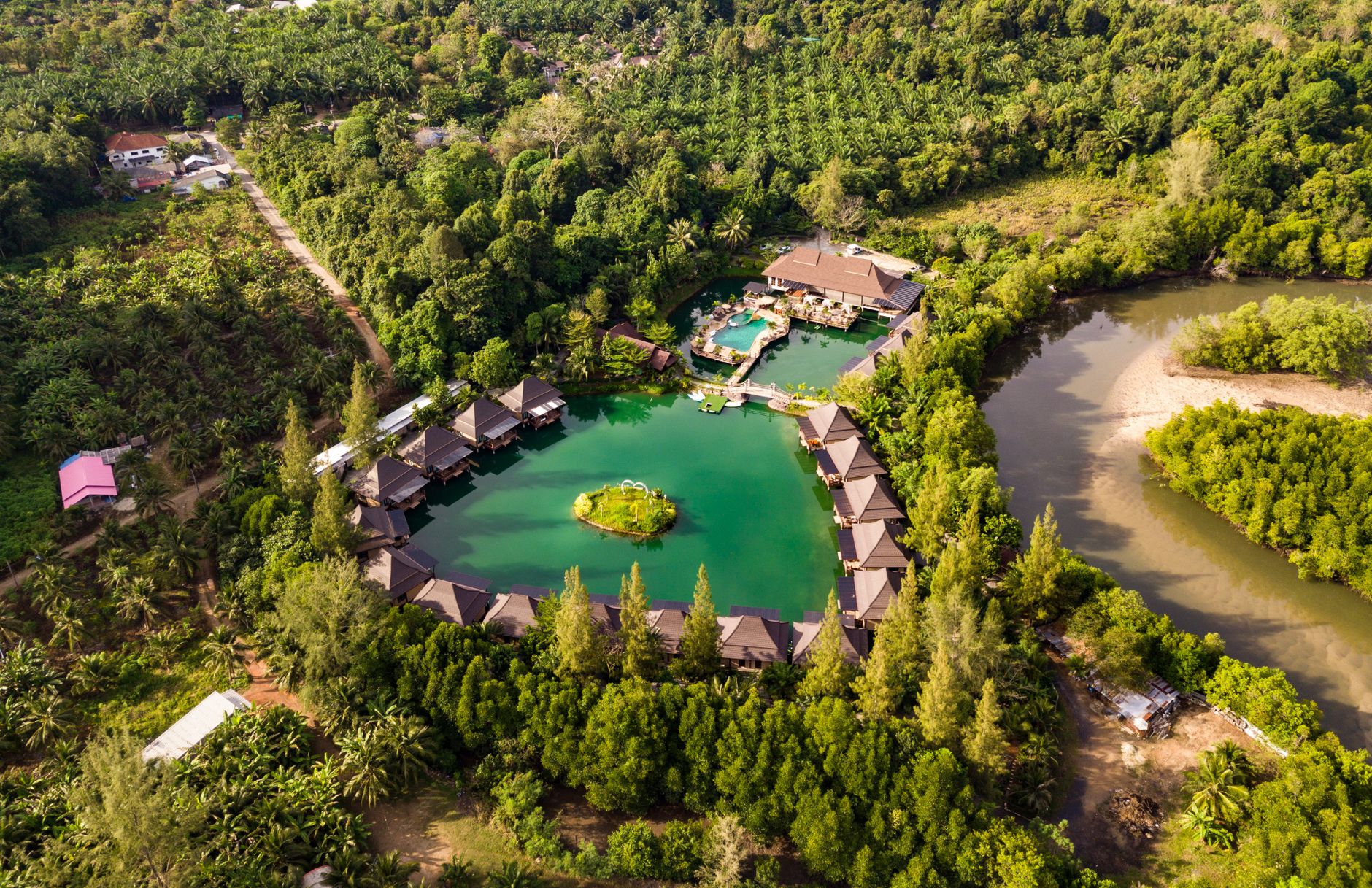
The first half of 2026 has introduced 763 new villa units across 52 projects to the Phuket market, according to Savills Thailand data - a record pace of supply expansion in the luxury segment. Against that backdrop, a significant institutional signal emerged: Thailand's largest exchange-listed residential developer launched its first pool villa collection on the island. Our analysts have been tracking this move and its implications for market structure.
The project in question spans two sites within the Cherng Talay subdistrict - Bang Jo (13 villas) and Pasak (14 villas) - with a combined development value of 1.4 billion THB. Entry prices are set at 45 million THB per unit at Bang Jo and 49.5 million THB at Pasak. Usable areas reach up to 491 sq m on plots starting from 532 sq m. This is firmly ultra-premium territory.
Why does this matter beyond a single project launch? Bangkok-headquartered listed developers have traditionally concentrated on condominium supply in the capital. Their pivot toward island villa product reads, in our assessment, as a direct institutional response to measurable macro shifts - detailed in the sections below.
Quick answer
- Bangkok's condo market is effectively stagnant: price growth of just 0.2% year-on-year per REIC Q3 2026 data, with over 65,300 unsold units valued at approximately 38 billion THB sitting in inventory
- Phuket is on track to absorb roughly 1,200 new villa units in 2026 alone, with supply pressure concentrated in Cherng Talay, Bang Tao, Kamala and Rawai
- Rental rates for 3-bedroom pool villas on Phuket range from 250,000 to 300,000 THB per month; 4-bedroom villas command 350,000 to 500,000 THB per month, exceeding 500,000 THB at peak season
- Average annual villa occupancy across the island holds at approximately 70%
- Property transfers to Chinese buyers declined by roughly 13% in 2025, reshaping the foreign demand profile and creating a gap that European and Middle Eastern buyers are only partly filling
- The entry of listed developers into Phuket villas is, based on our analysis, an institutional confirmation that the island's luxury villa segment has entered a maturation phase
Options and scenarios
Scenario A: Supply is absorbed - the market digests new inventory
In this outcome, foreign demand from Europe and the Middle East compensates for reduced Chinese buyer activity. Rental occupancy holds in the 65-75% range, and asking prices in Cherng Talay appreciate at 5-8% per year. The entry of large, well-capitalised developers raises construction standards and professionalises rental management, attracting further institutional capital.
For an international investor, this scenario implies rising acquisition competition but also stronger rental rates and easier access to premium tenants.
Scenario B: Transitional oversupply - correction in the mid-market
If the 1,200-unit pipeline lands alongside a slowdown in inbound tourism or continued baht strength against the US dollar, the mid-market segment (villas priced 15-30 million THB) could experience a 5-10% pricing correction. The ultra-premium tier (above 45 million THB) is structurally less exposed: owners in that bracket tend to have lower dependence on rental income to service their holding costs.
In our quarterly tracking data, projects in the 20-35 million THB range in districts such as Rawai and Nai Harn are already showing extended time-on-market metrics.
Scenario C: Structural shift - Phuket becomes an institutional market
Over a longer horizon, the entry of exchange-listed developers could transform Phuket from a market dominated by local and boutique operators into one with standardised product, institutionalised rental management and greater price transparency. Land in Cherng Talay and Layan is already reflecting this re-rating. On Koh Samui - where Bophut, Maenam and Chaweng remain the domain of smaller, independent projects - this institutionalisation process is, per our estimates, running 2-3 years behind Phuket's trajectory.
Comparison table
| Parameter | Phuket - premium (45+ M THB) | Phuket - mid-market (15-30 M THB) | Koh Samui - mid-market (12-25 M THB) | Bangkok - condo (under 3 M THB) |
|---|---|---|---|---|
| New supply 2026 | Rising (flagship projects entering) | High (majority of 1,200 units) | Moderate | Being curtailed (65,300-unit overhang) |
| Price growth YoY | 6-10% (based on our estimates) | 2-5% | 3-6% | 0.2% (REIC, Q3 2026) |
| Rental occupancy | 60-70% (premium clientele) | 65-75% | 55-65% | N/A (sales-driven market) |
| Monthly rental range | 350,000-500,000+ THB | 120,000-250,000 THB | 80,000-180,000 THB | 12,000-25,000 THB |
| Buyer profile | International investors, UHNWI | Foreign, Russian, European | European, Scandinavian | Thai domestic, middle class |
| Oversupply risk | Low (land supply constrained) | Elevated | Moderate | High |
| Listed developer presence | Growing (from 2026) | Minimal | Negligible | Dominant |
Risks and mistakes
Localised oversupply in Cherng Talay. The concentration of new launches around Bang Tao, Layan and Cherng Talay creates meaningful micro-market density. These sub-areas account for the majority of the 763 units introduced in H1 2026. Any investor acquiring a villa for rental purposes in this corridor should map the competing supply pipeline within a 2 km radius before committing.
Currency exposure. For investors holding non-THB capital, baht movements are a direct component of total return. A 10% strengthening of the baht against a reference currency - with prices flat in THB terms - translates into an equivalent real increase in acquisition cost. We track this variable in our quarterly reports.
Projecting peak-season rates across the full year. Rental quotes of 500,000+ THB per month for a 4-bedroom villa apply to the high season window (December through March). At a realistic annual occupancy of 70%, accounting for the low-season rate compression (May through October), our analysts estimate gross rental yields in the premium villa segment at 5-7% - not the 8-10% figures that appear in some developer marketing materials.
Confusing developer scale with investment safety. A listed developer materially reduces completion risk, but it does not eliminate market risk. A project can be delivered on schedule and still reach the market at a moment of softened demand.
Legal structure risk. Foreign nationals cannot hold land freehold in Thailand. Villa acquisitions by non-Thais are structured either as leasehold arrangements (typically 30-year initial terms with renewal options) or via Thai company structures. Each path carries distinct legal exposures, which we analyse separately in our legal structure guides.
FAQ
Does a major developer entering Phuket mean prices will rise across the board?
Not across all segments. The move validates demand depth above the 45 million THB threshold, but it also adds supply. In the mid-market (15-30 million THB), additional competition may stabilise or compress asking prices over a 12-18 month horizon.
What does a pool villa on Phuket cost in 2026?
The range is wide. Entry-level pool villas in Rawai or Nai Harn start from around 10-12 million THB for smaller units. Premium product in Cherng Talay and Layan runs 25-50 million THB. Ultra-luxury projects start from 45 million THB per unit.
What rental occupancy is realistic for a Phuket villa?
Our data points to approximately 70% average annual occupancy in the villa segment, with pronounced seasonality. High season (November through April) occupancy approaches 90-95%; the low season (May through October) sees rates fall to 40-50%. Professional rental management is a key variable in sustaining the annual average.
How does Bangkok's market stagnation affect Phuket?
With over 65,300 unsold condo units and price growth of just 0.2% year-on-year, Bangkok developers are actively seeking margin elsewhere. The result for Phuket buyers is a more professionalised product offer - but also a higher volume of competing new supply entering the market simultaneously.
Is Koh Samui following the same trajectory as Phuket?
Yes, but with a lag. In Bophut, Maenam and Chaweng, we do not yet observe listed developers committing to large villa projects. The market remains dominated by smaller operators. Based on our estimates, institutional capital will reach Koh Samui's villa segment roughly 2-3 years after Phuket.
What are realistic net rental yields for a Phuket villa?
At 70% annual occupancy and with seasonal rate variation factored in, we estimate gross yields in the premium 3-4 bedroom pool villa segment at 5-7%. After deducting property management fees (typically 15-25% of rental revenue), insurance and maintenance, net yields settle in the 3.5-5% range.
Has the decline in Chinese buyer activity affected Phuket?
Yes, materially. Transfers to Chinese nationals fell approximately 13% in 2025. The shortfall is being partially absorbed by buyers from Russia, Europe and the Middle East, but the structural shift in demand is influencing product preferences - villa demand is holding up better than demand for compact condominium units.
How can a foreign buyer acquire a villa on Phuket?
Foreign nationals cannot hold land in Thailand in their own name. The two primary structures are leasehold (30-year initial term, with contractual renewal provisions) and acquisition via a Thai-registered company. The appropriate structure depends on the intended use - short-term rental, long-term rental or owner-occupation. We cover each structure in dedicated legal guides.
Researching property in Phuket or Koh Samui? Get in touch - our analysts will prepare a data brief for your shortlisted location.